Java Runtime Binding and Dynamic Dispatch
java runtime binding: Understand how Java resolves method calls at runtime through dynamic dispatch, overriding, and interfaces, and when it matters in production code.
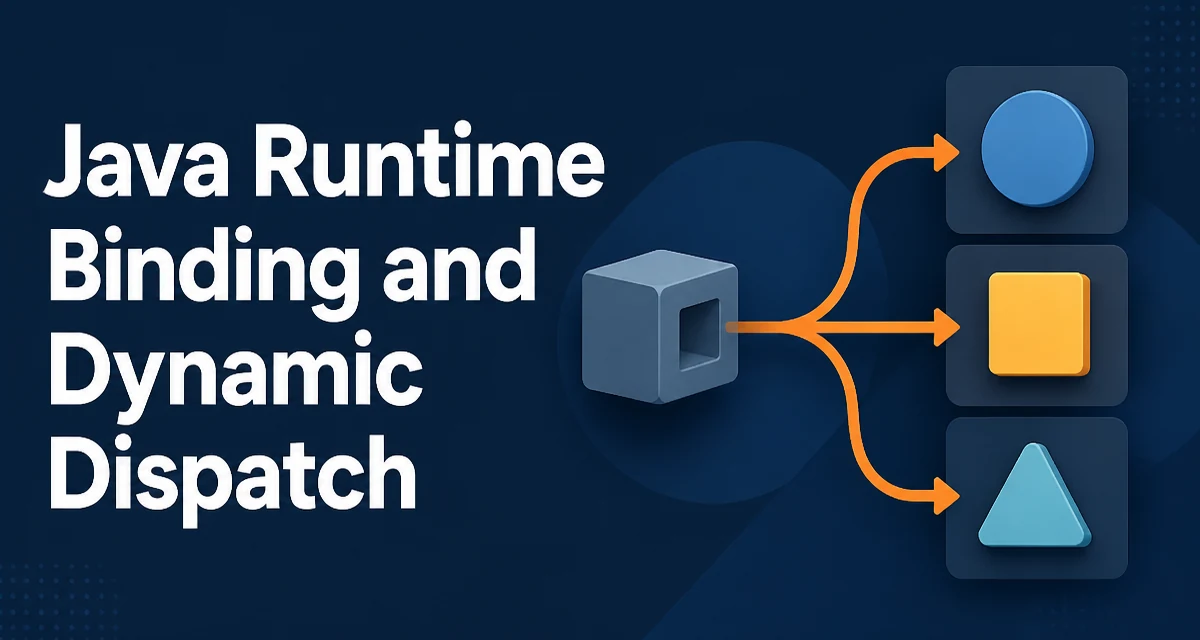
What Runtime Binding Means in Java
Java runtime binding refers to the process by which the JVM determines which method implementation to invoke when a call is made through a reference whose static type differs from the actual object type. Consider this minimal example:
class Animal {
    void speak() {
        System.out.println("Animal speaks");
    }
}

class Dog extends Animal {
    @Override
    void speak() {
        System.out.println("Dog barks");
    }
}

public class BindingDemo {
    public static void main(String[] args) {
        Animal ref = new Dog();
        ref.speak();
    }
}
The variable ref has the static type Animal, but the object it points to is a Dog. At compile time, the compiler verifies that Animal declares speak(), but it does not decide which implementation runs. When the program executes, the JVM inspects the actual object type and invokes Dog.speak(), printing Dog barks. That decision, made at runtime, is what Java developers mean by runtime binding.
Static Binding vs Runtime Binding
Java resolves method calls in two distinct phases. Overloaded methods, private methods, static methods, and constructors are resolved at compile time using the static type of the reference. This is static binding, also called early binding. The compiler picks the exact method signature based on the declared types of the arguments.
class Calculator {
    int add(int a, int b) {
        return a + b;
    }

    double add(double a, double b) {
        return a + b;
    }
}

Calculator calc = new Calculator();
int sum = calc.add(2, 3);           // resolves to add(int, int)
double total = calc.add(2.0, 3.0);  // resolves to add(double, double)
The compiler selects add(int, int) for the first call and add(double, double) for the second, purely from the argument types. No runtime decision is involved.
Runtime binding applies only to overridden instance methods. When a subclass overrides a method declared in a parent class or implements a method declared in an interface, the JVM must decide at runtime which version to execute. The decision depends on the actual object type, not the reference type.
| Aspect | Static Binding | Runtime Binding |
|---|---|---|
| Resolution time | Compile time | Runtime |
| Applies to | private, static, final, overloaded methods | overridden instance methods |
| Decision basis | Reference type and argument types | Actual object type |
| Dispatch mechanism | Direct call | Virtual dispatch (JIT may optimize) |
How the JVM Resolves Virtual Method Calls
Every Java object carries a reference to its class. The JVM maintains a method table, often called a vtable, for each class. The vtable maps each virtual method to the actual implementation for that class. When the JVM executes a virtual call, it looks up the method entry in the vtable of the object's actual class and dispatches to that implementation.
This lookup happens on every virtual call unless the JIT compiler optimizes it. The HotSpot JIT can perform devirtualization when it can prove that only one implementation is possible at a call site, replacing the indirect dispatch with a direct call. It may also use inline caching, which records the target of a call site after the first execution and checks whether the same type appears again before falling back to the full vtable lookup.
These optimizations are internal to the JVM. The observable behavior of runtime binding remains the same: the method that executes is determined by the actual object type.
Runtime Binding with Method Overriding
The most common place runtime binding appears is in inheritance hierarchies. A base class declares a method, and subclasses override it with specialized behavior.
class Shape {
    double area() {
        return 0.0;
    }
}

class Circle extends Shape {
    private final double radius;

    Circle(double radius) {
        this.radius = radius;
    }

    @Override
    double area() {
        return Math.PI * radius * radius;
    }
}

class Rectangle extends Shape {
    private final double width;
    private final double height;

    Rectangle(double width, double height) {
        this.width = width;
        this.height = height;
    }

    @Override
    double area() {
        return width * height;
    }
}
A method that accepts Shape and calls area() does not need to know which concrete subclass it receives:
double totalArea(Shape[] shapes) {
    double total = 0.0;
    for (Shape shape : shapes) {
        total += shape.area();
    }
    return total;
}
Each call to shape.area() is dispatched to the implementation of the actual object. If the array contains a mix of Circle and Rectangle instances, each call resolves to the correct override. This is the core of polymorphism in Java, and it relies entirely on runtime binding.
Runtime Binding Through Interfaces
Interfaces behave the same way. A reference typed as an interface is dispatched to the implementing class's method at runtime.
interface PaymentProcessor {
    void process();
}

class CreditCardProcessor implements PaymentProcessor {
    @Override
    public void process() {
        System.out.println("Charging credit card");
    }
}

class PayPalProcessor implements PaymentProcessor {
    @Override
    public void process() {
        System.out.println("Charging PayPal account");
    }
}

public class Checkout {
    void pay(PaymentProcessor processor) {
        processor.process();
    }
}
When pay() is called with a CreditCardProcessor instance, the JVM invokes CreditCardProcessor.process(). With a PayPalProcessor, it invokes that class's implementation. The caller never needs to branch on the concrete type. Adding a new payment method requires a new class that implements the interface; the pay() method does not change.
This is the practical benefit of runtime binding: code written against an abstraction can handle new implementations without modification, as long as the new class honors the interface contract.
Performance Cost of Dynamic Dispatch
Runtime binding is not free. A virtual call requires an indirect lookup instead of a direct jump to a known address. In tight loops that call virtual methods millions of times, the dispatch overhead can become measurable.
The JIT compiler mitigates this in several ways. Devirtualization converts a virtual call into a direct call when the JIT can prove a single implementation is reachable. Inline caching remembers the target type from previous executions and checks it before performing the full lookup. These optimizations mean that in practice, most virtual calls in long-running code run at near-direct-call speed.
The performance concern is rarely the dispatch itself. It is the loss of inlining. A virtual call cannot be inlined as easily as a direct call, because the JIT must know the exact target before it can inline the method body. When a small method like area() is called in a loop, the inability to inline can prevent other optimizations such as loop unrolling or escape analysis.
If profiling shows that a hot path is dominated by virtual dispatch, consider whether the polymorphism is necessary at that call site. A final method or a switch on a sealed type may give the JIT more room to optimize. But do not replace polymorphism with type checks everywhere; the maintainability cost usually outweighs the dispatch overhead.
Edge Cases Where Runtime Binding Does Not Apply
Runtime binding has clear boundaries. Private methods, static methods, and final methods are not subject to dynamic dispatch.
class Parent {
    static void describe() {
        System.out.println("Parent");
    }

    private void secret() {
        System.out.println("Parent secret");
    }

    final void locked() {
        System.out.println("Parent locked");
    }
}

class Child extends Parent {
    static void describe() {
        System.out.println("Child");
    }

    private void secret() {
        System.out.println("Child secret");
    }
}
Calling Parent.describe() invokes the parent's static method; calling Child.describe() invokes the child's. The compiler resolves static methods by the reference type, so Parent p = new Child(); p.describe(); prints Parent, not Child. This surprises developers who expect polymorphic behavior from static methods.
Private methods are resolved statically as well. A private method in the parent and a private method with the same signature in the child are unrelated; the child's method does not override the parent's. The @Override annotation cannot even be applied to a private method.
Final methods are bound statically. Because no subclass can override a final method, the compiler knows the exact target and emits a direct call. This is one reason final can help the JIT optimize hot code.
Choosing When to Rely on Runtime Binding
Runtime binding is the right tool when you have a family of types that share behavior through a common contract, and the set of implementations may grow. It is the foundation of strategy patterns, plugin architectures, and dependency injection.
Do not use runtime binding when the set of types is fixed and the behavior differs only slightly. In that case, a sealed interface or an enum with a method can give the compiler more information and allow the JIT to optimize more aggressively. Sealed classes, introduced in Java 17, restrict the set of permitted subclasses and let the JIT reason about a bounded number of implementations.
Runtime binding also becomes a maintenance concern when the hierarchy grows deep. A method that is overridden in five levels of subclasses is hard to trace. Keeping the hierarchy shallow and documenting which classes override which methods helps, but the fundamental tradeoff remains: runtime binding gives flexibility at the cost of indirection.