Java Sequential Stream: How the Default Stream Mode Works
java sequential stream: Understand how Java sequential streams process elements in order, when to use them, and how they differ from parallel streams.
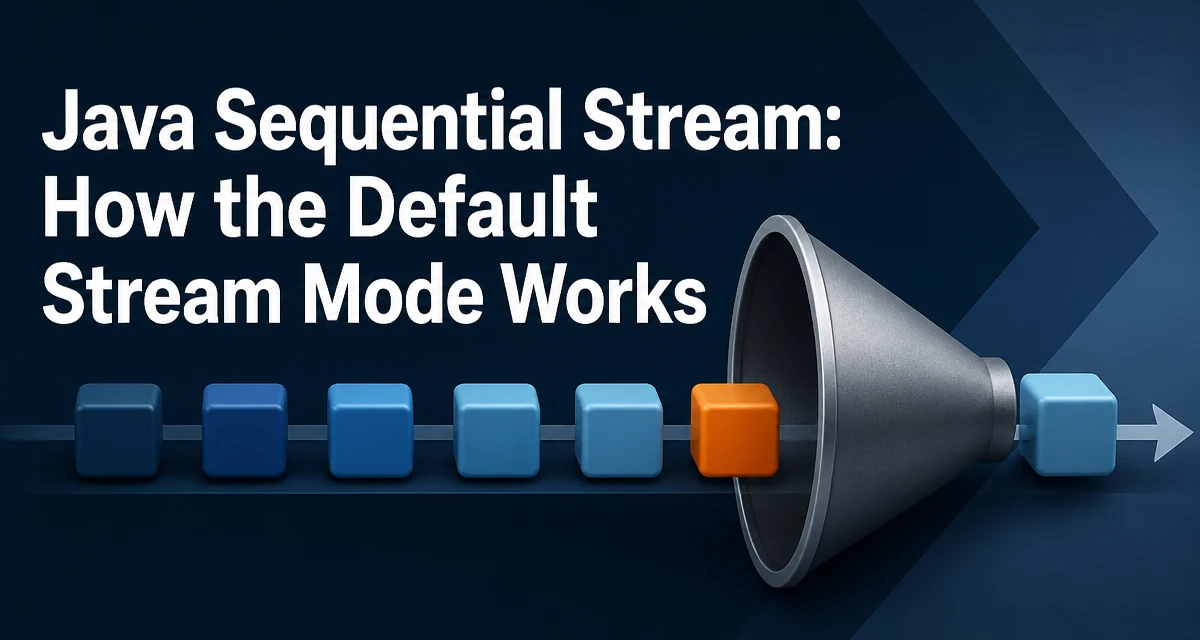
A java sequential stream is the default mode of the Java Stream API. When you call stream() on a collection, you get a sequential stream that processes elements one at a time on the calling thread. This is the behavior most developers expect: elements are handled in encounter order, operations complete in a single pass, and no thread coordination is involved. Understanding how sequential streams work — and when they are the right choice — is essential for writing correct and efficient stream pipelines.
What a Sequential Stream Actually Does
A sequential stream processes its source elements in a single thread, one element at a time, in encounter order. Encounter order is the order in which the source makes elements available. For a List, that is the index order. For an array, it is the array index order. For a HashSet, the order is unspecified but stable for a given set instance.
The pipeline below demonstrates the behavior:
List<Integer> numbers = List.of(1, 2, 3, 4, 5);

numbers.stream()
    .map(n -> n * 2)
    .forEach(System.out::println);
The map operation applies the lambda to each element in order, and forEach prints the results in the same order: 2, 4, 6, 8, 10. Every intermediate operation in a sequential stream processes the entire stream before handing the result to the next stage, but each element flows through the entire pipeline before the next element begins. This is the key distinction from parallel streams, where elements are split across threads and results may be combined out of order.
Creating a Sequential Stream
The stream() method on Collection always returns a sequential stream. There is no separate factory method for sequential streams because it is the default.
List<String> names = List.of("alice", "bob", "carol");
Stream<String> sequential = names.stream();
You can also force a stream back to sequential mode after it has been made parallel:
Stream<String> forcedSequential = names.parallelStream().sequential();
The sequential() method returns a stream that is sequential, regardless of the previous mode. This is useful when you inherit a stream from a method that may return a parallel stream but you need deterministic ordering.
Sequential vs Parallel Streams
The choice between sequential and parallel streams affects ordering guarantees, thread usage, and overhead. The table below summarizes the meaningful differences.
| Aspect | Sequential Stream | Parallel Stream |
|---|---|---|
| Execution thread | Single calling thread | Common ForkJoinPool threads |
| Encounter order | Preserved | Not guaranteed for most operations |
| Setup overhead | None | Thread pool and chunk splitting |
| Best fit | Small data, ordered output, I/O-bound work | Large data, CPU-bound computation |
Parallel streams split the source into chunks and process them concurrently. This introduces coordination cost, and operations like findFirst or sorted must do extra work to restore ordering. For small collections, the overhead of splitting and merging usually outweighs any speedup. A sequential stream avoids that overhead entirely.
Performance Characteristics of Sequential Streams
Sequential streams have minimal runtime cost because there is no thread pool involvement and no result merging. Each element flows through the pipeline in a single pass on the calling thread. The main performance consideration is the cost of the operations themselves, not the stream infrastructure.
For small collections, sequential streams are almost always faster than parallel streams. The break-even point depends on the size of the dataset and the cost of each operation. A rule of thumb is that parallel streams only start to pay off with large collections and CPU-intensive operations. For I/O-bound operations, parallel streams rarely help because the bottleneck is external, and sequential streams keep the logic simple.
One important detail is that short-circuiting operations behave differently in sequential streams. findFirst() stops as soon as the first matching element is found, and limit(n) stops after n elements. In a sequential stream, this means work is only done on the elements actually consumed. In a parallel stream, some extra elements may be processed before the short-circuit takes effect.
Common Pitfalls with Sequential Streams
A frequent mistake is assuming that forEach always preserves order. It does for sequential streams, but if someone later adds .parallel() to the pipeline, the output order becomes nondeterministic. If ordering matters, use forEachOrdered() instead, which preserves encounter order even in parallel streams.
Another pitfall is calling .parallel() and then .sequential() inside a pipeline without understanding why. This pattern is valid but usually indicates confusion about the data size. If the dataset is small enough that a sequential stream is appropriate, the .parallel() call should be removed entirely rather than reverted later.
Stateful operations like sorted() and distinct() buffer the entire stream in memory. In a sequential stream, this is a straightforward single-threaded operation. In a parallel stream, the buffering and merging add complexity. If you need sorted output, a sequential stream gives you the expected result without the overhead of concurrent sorting.
When to Choose a Sequential Stream
Use a sequential stream when any of the following conditions apply:
- The collection is small enough that parallel overhead would dominate.
- The output must preserve encounter order.
- The operation is I/O-bound, such as reading files or making network calls.
- The pipeline uses stateful operations like
sortedordistincton a moderate dataset. - You are working in a constrained thread environment where the common
ForkJoinPoolshould not be used.
Parallel streams are appropriate only for large, CPU-bound computations where the operation cost per element is high and ordering is not required. Even then, you should measure the actual throughput before committing to parallelism. A sequential stream is the safer default because it has no coordination overhead and produces deterministic results.
Forcing Sequential Mode in Shared Code
When a stream is passed into a method from an unknown source, it may already be parallel. If your method relies on ordered processing, call .sequential() explicitly at the start of the pipeline:
public List<String> process(Stream<String> input) {
    return input
        .sequential()
        .filter(s -> s.startsWith("user:"))
        .map(s -> s.substring(5))
        .collect(Collectors.toList());
}
This guarantees that the filtering and mapping happen on the calling thread in encounter order, regardless of how the caller constructed the stream. The cost of this call is negligible, and it makes the ordering behavior explicit rather than accidental.
The same principle applies when you are building a reusable utility method that accepts a Stream. Documenting that the method processes elements sequentially, and enforcing it with .sequential(), prevents subtle bugs when the caller passes a parallel stream expecting ordered output.