Java Stack vs ArrayDeque: Choosing the Right Stack Implementation
java stack vs arraydeque: Compare Java's legacy Stack class with ArrayDeque for stack operations. Understand performance, thread safety, and when to use each.
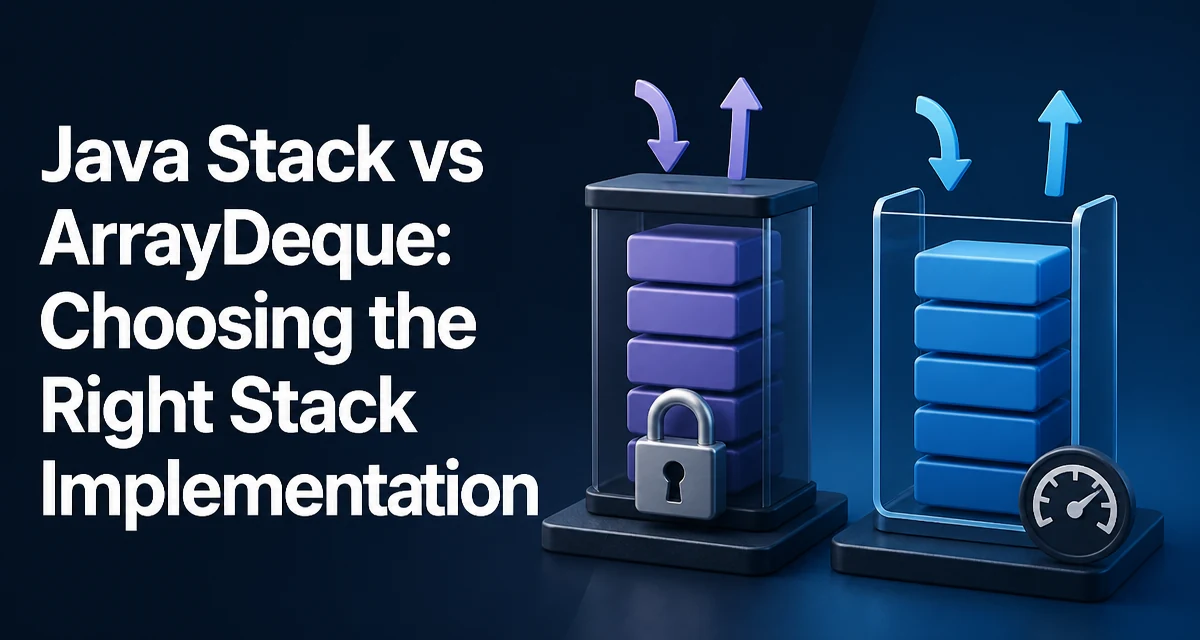
java stack vs arraydeque requires a clear understanding of the core syntax, runtime behavior, and practical implementation patterns demonstrated in the examples below.
The Legacy Stack Class and Its Limitations
Java's java.util.Stack class has existed since JDK 1.0. It extends Vector and implements a LIFO stack with methods like push, pop, peek, and empty. Because it inherits from Vector, every method is synchronized, which makes it thread-safe but also adds overhead even in single-threaded contexts. This synchronization is often unnecessary for typical stack usage, and the class has been effectively deprecated in favor of more modern collections.
ArrayDeque: The Modern Replacement
java.util.ArrayDeque is a resizable-array implementation of the Deque interface. It can be used as a stack by calling push and pop methods, which are equivalent to addFirst and removeFirst. Unlike Stack, ArrayDeque is not synchronized, so it performs better in single-threaded scenarios. It also does not allow null elements, which is a deliberate design choice to avoid ambiguity in queue operations.
Key Differences Between Stack and ArrayDeque
| Feature | Stack | ArrayDeque |
|---|---|---|
| Thread safety | Synchronized | Not synchronized |
| Null elements | Allowed | Not allowed |
| Performance | Slower due to sync | Faster |
| Inheritance | Extends Vector | Implements Deque |
| Iteration order | LIFO (top to bottom) | LIFO (head to tail) |
The most important difference is thread safety. Stack is synchronized, meaning each method call acquires a lock. In a single-threaded application, this adds unnecessary overhead. ArrayDeque has no such synchronization, making it the better choice for most use cases.
Performance Considerations
Because Stack inherits from Vector, its methods are synchronized. Each push or pop acquires a monitor lock, which can become a bottleneck in high-throughput scenarios. ArrayDeque avoids this entirely. Additionally, ArrayDeque uses a circular array that grows dynamically, while Stack also uses an array but with the overhead of Vector's capacity management. In practice, ArrayDeque is measurably faster for stack operations in single-threaded code.
When to Use Stack vs ArrayDeque
Use ArrayDeque when you need a stack in new code and you are working in a single-threaded environment. It is the recommended implementation from the Java Collections Framework. Use Stack only if you are maintaining legacy code that already relies on it, or if you specifically need thread-safe stack operations without additional synchronization. For concurrent access, consider using ConcurrentLinkedDeque or LinkedBlockingDeque depending on your needs.
Implementing a Stack with Both Classes
Here's a simple example that demonstrates the same LIFO behavior:
import java.util.ArrayDeque;
import java.util.Stack;

public class StackComparison {
    public static void main(String[] args) {
        // Using Stack
        Stack<String> stack = new Stack<>();
        stack.push("first");
        stack.push("second");
        System.out.println(stack.pop()); // second

        // Using ArrayDeque as a stack
        ArrayDeque<String> deque = new ArrayDeque<>();
        deque.push("first");
        deque.push("second");
        System.out.println(deque.pop()); // second
    }
}
Both produce identical results. The key difference is that ArrayDeque does not allow null elements. If you try to push null, it throws NullPointerException. This can be a benefit because it prevents accidental null values in your stack.
Handling Null Elements and Edge Cases
If your stack must allow null, Stack is the only option among these two. However, allowing nulls often leads to bugs, so the restriction in ArrayDeque is generally considered a feature. For example, in a queue, null is used to signal the end of a stream, but in a stack, nulls are rarely needed. If you need to store nulls, you can use LinkedList which implements Deque and allows nulls, but it has higher memory overhead.
Choosing Based on Concurrency Requirements
For multi-threaded access, neither Stack nor ArrayDeque is ideal. Stack's synchronization is coarse-grained and can cause contention. ArrayDeque is not thread-safe at all. If you need a thread-safe stack, you can wrap ArrayDeque with Collections.synchronizedDeque, but that still has overhead. Better alternatives include ConcurrentLinkedDeque for lock-free operations or LinkedBlockingDeque if you need blocking behavior.
Final Recommendation
In modern Java code, ArrayDeque should be your default choice for a stack. It is faster, more flexible, and part of the standard collections framework. Stack remains for legacy compatibility, but its synchronized nature and inheritance from Vector make it a poor choice for new development. Understand your concurrency needs and null handling requirements, and you can confidently select the right implementation.