Java Static Binding vs Dynamic Binding Explained
java static binding vs dynamic binding: Understand how Java resolves method calls at compile time and runtime, and why it matters for overloading, overriding, and perf...
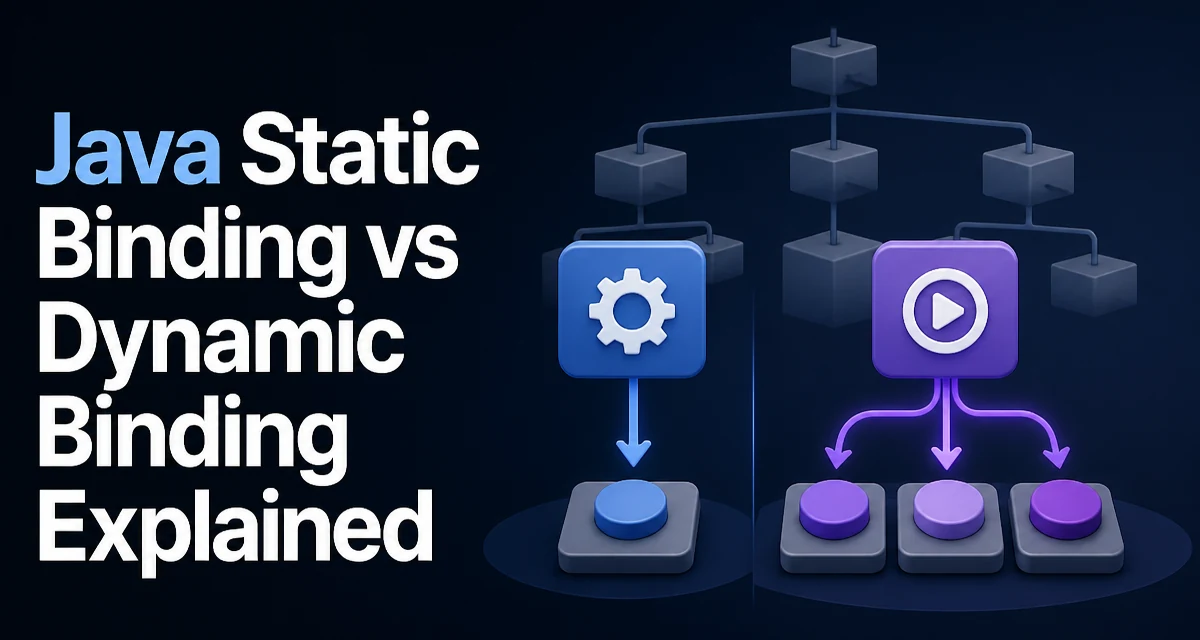
When you call a method in Java, the compiler and the JVM must decide which exact method implementation to execute. This decision is not always obvious, especially when inheritance and method overloading are involved. The distinction between java static binding vs dynamic binding determines whether that resolution happens at compile time or at runtime. Getting this wrong leads to subtle bugs, especially when you expect one method to run but another one does.
The Method Resolution Problem in Java
Consider a simple call like obj.someMethod(). The Java compiler first looks at the declared type of obj to find a matching method signature. If multiple methods with the same name exist in that type (overloaded methods), the compiler picks the most specific one based on the argument types. This selection is a compile-time operation. But if someMethod is overridden in a subclass, the actual method that runs depends on the runtime type of obj, not the declared type. These two mechanisms are called static binding and dynamic binding respectively.
Static binding uses the type information available at compile time. Dynamic binding uses the actual object type at runtime. Every method call in Java falls into one of these two categories. Understanding which one applies is essential for predicting behavior and writing correct code.
Static Binding: Compile-Time Method Resolution
Static binding, also known as early binding, resolves method calls at compile time. The compiler knows the exact method to invoke based on the declared reference type and the method signature. This happens for:
- Static methods because they belong to the class, not an instance.
- Private methods because they are not inherited and cannot be overridden.
- Final methods because they cannot be overridden in a subclass.
- Overloaded methods because the compiler selects the method based on the argument types at compile time.
Here is an example of static binding with overloaded methods:
public class Calculator {
    public int add(int a, int b) {
        return a + b;
    }

    public double add(double a, double b) {
        return a + b;
    }
}

Calculator calc = new Calculator();
int sumInt = calc.add(2, 3);      // picks add(int, int)
double sumDouble = calc.add(2.0, 3.0); // picks add(double, double)
The compiler resolves these calls based on the argument types. The reference type is Calculator, and both methods are in that class. No runtime lookup is needed. This is static binding.
Static binding also applies when you call a static method through an instance reference, though that is poor practice. The compiler uses the declared type, not the runtime type.
Dynamic Binding: Runtime Method Dispatch
Dynamic binding, also called late binding or runtime polymorphism, resolves method calls at runtime. This happens when a method is overridden in a subclass and the call is made through a reference of the superclass type. The JVM determines the actual object type at runtime and invokes the appropriate override.
Consider this example:
class Animal {
    public void speak() {
        System.out.println("Animal speaks");
    }
}

class Dog extends Animal {
    @Override
    public void speak() {
        System.out.println("Dog barks");
    }
}

Animal a = new Dog();
a.speak(); // prints "Dog barks"
The reference type is Animal, but the actual object is a Dog. The JVM looks up the method table for Dog and invokes Dog.speak(). This is dynamic binding.
Dynamic binding is the foundation of polymorphism in Java. It allows code to work with a superclass type while executing subclass-specific behavior. It is essential for design patterns like Strategy or Observer where the exact implementation is chosen at runtime.
Overloading vs Overriding: The Key Difference
Overloading and overriding are often confused, but they map directly to static and dynamic binding.
- Overloading is when multiple methods in the same class share the same name but have different parameter lists. The compiler picks the method based on the arguments. This is static binding.
- Overriding is when a subclass provides a new implementation of a method inherited from a superclass. The method signature is identical. The JVM picks the method based on the runtime object type. This is dynamic binding.
Here is a combined example:
class Parent {
    public void show(String msg) {
        System.out.println("Parent: " + msg);
    }
}

class Child extends Parent {
    @Override
    public void show(String msg) {
        System.out.println("Child: " + msg);
    }

    public void show(int num) {
        System.out.println("Child number: " + num);
    }
}

Parent p = new Child();
p.show("hello"); // dynamic binding -> Child.show(String)
// p.show(5);    // compile error: Parent has no show(int)
When you call p.show("hello"), the compiler sees that Parent has a show(String) method. At runtime, the JVM sees that p actually refers to a Child and invokes Child.show(String). The overloaded show(int) is not considered because the reference type Parent does not have that method. This illustrates that overload resolution is static, while override resolution is dynamic.
How the JVM Implements Dynamic Binding
The JVM uses a method table (vtable) for each class. When a class is loaded, the JVM builds a table of method pointers. For each virtual method, the table entry points to the most specific override. When the JVM encounters a virtual method call, it looks up the method table of the actual object's class and jumps to the corresponding method pointer.
This lookup happens at runtime, but modern JIT compilers optimize it. For example, the JVM may inline a method call if it can prove that only one implementation is possible, or use a technique called inline caching to remember the target method for a given call site. These optimizations make dynamic binding very fast in practice, often with negligible overhead compared to static binding.
Performance and Runtime Cost of Dynamic Binding
Static binding has no runtime lookup cost because the compiler emits a direct method invocation. Dynamic binding requires a table lookup, which is slightly more expensive. However, the difference is usually small, and the JVM's JIT compiler can reduce or eliminate it.
For most applications, the performance difference between static and dynamic binding is irrelevant. You should not avoid polymorphism for performance reasons without profiling. In extremely hot loops, where a virtual method is called millions of times, the JIT can often inline the call if the actual type is predictable. If not, the overhead is still just a few CPU cycles per call.
A more practical concern is that dynamic binding can make code harder to reason about because the exact behavior depends on the runtime type. This is a maintainability tradeoff, not a performance one. Use dynamic binding when you need extensibility and polymorphism. Use static binding for private, static, or final methods where overriding is not intended.
Choosing Between Static and Dynamic Binding in Design
When designing a class hierarchy, you decide which methods should be overridable. Marking methods final or making them static forces static binding. This can be useful for methods that should not change behavior, such as utility functions or template methods that must remain consistent.
On the other hand, dynamic binding is necessary when you want to support polymorphic behavior. For example, a Shape class with a draw() method that subclasses override allows a List<Shape> to be drawn without knowing each concrete type. This is a core principle of object-oriented design.
A practical guideline: use dynamic binding when the behavior should vary based on the actual object type, and use static binding when the behavior is fixed for all instances. Do not mark methods final solely for performance; only do so if you are certain that overriding would break invariants or if profiling shows a real bottleneck.
Consider this scenario: you have a Report class with a generate() method that subclasses override. If you mark generate() as final, you prevent subclasses from customizing the report. That is a design decision that forces static binding. If you need extensibility, leave it non-final and accept dynamic binding.
Another common case is overloaded methods. Overloading is resolved statically, so the argument types at compile time determine which method runs. This can lead to surprising behavior when combined with inheritance. For example, calling an overloaded method with a null argument may pick the most specific overload, which is determined at compile time. Understanding this helps avoid unexpected results.
In summary, static binding and dynamic binding are not competing features but complementary mechanisms. Static binding gives you compile-time safety and direct calls. Dynamic binding gives you runtime flexibility and polymorphism. Knowing which one applies to a given method call helps you write predictable code and debug issues faster.