Java Stream findFirst vs findAny: Key Differences
java stream findfirst vs findany: Understand the difference between Java Stream findFirst and findAny, including behavior in sequential and parallel streams, and when...
The Core Difference Between findFirst and findAny
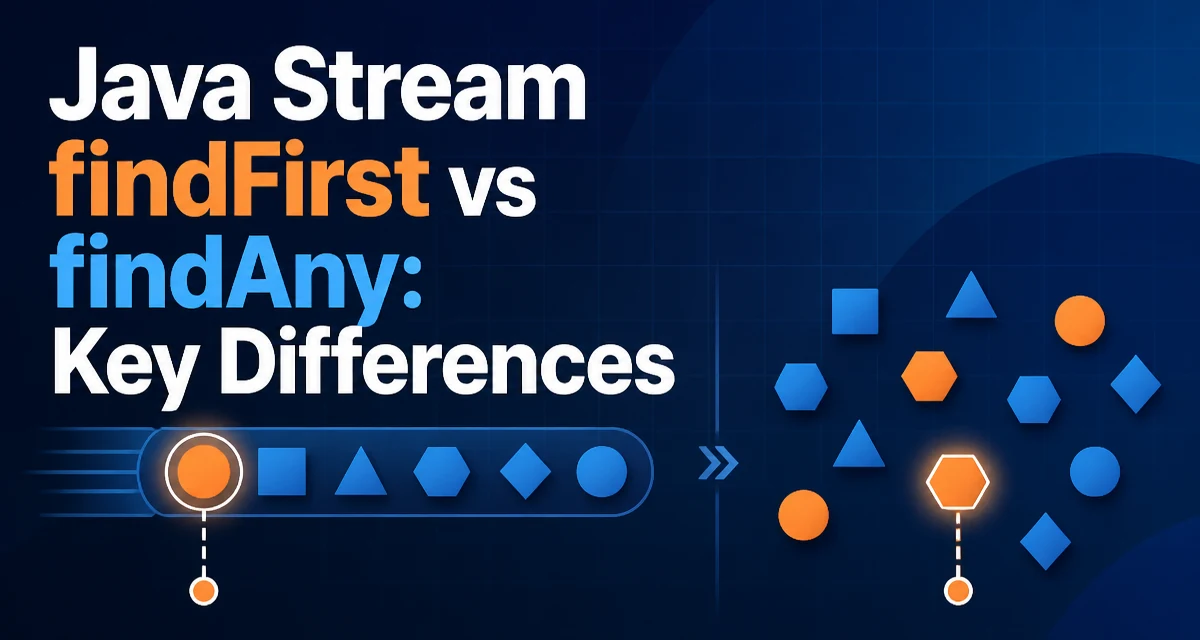
When you compare java stream findfirst vs findany, you're looking at two terminal operations that both return an Optional<T> describing an element of the stream. The critical difference is that findFirst() respects the encounter order of the stream, while findAny() is explicitly nondeterministic. In a sequential stream, both often return the same element, but findAny() makes no guarantee about which element it returns. In a parallel stream, this distinction becomes significant because findAny() can return as soon as any thread finds an element, while findFirst() must coordinate across threads to ensure it returns the element that appears first in the stream's defined order.
How Encounter Order Affects Results
Encounter order is the order in which elements are processed if the stream is ordered. For a stream from a List, the encounter order is the list's iteration order. For a stream from a HashSet, there is no defined order. findFirst() is only meaningful on ordered streams; on an unordered stream it behaves like findAny(). The Stream interface documentation states that findFirst() returns the first element of the stream, but if the stream has no encounter order, it may return any element.
Behavior in Sequential Streams
In a sequential stream, findFirst() and findAny() will typically return the same result because the stream is processed in order and the first matching element is found immediately. However, findAny() is not required to return the first element; it is allowed to return any element. In practice, the current implementation often returns the first, but relying on that is a mistake. The Java API contract for findAny() says: "Returns an Optional describing some element of the stream, or an empty Optional if the stream is empty." The behavior is intentionally loose to allow implementations to optimize.
Parallel Streams and Why findAny Is Faster
In a parallel stream, the difference matters for performance. findAny() can return as soon as any thread finds a matching element, without waiting for other threads to finish. findFirst() must ensure that the element returned is the one with the lowest encounter order index, so it may need to wait for earlier partitions to be processed. This coordination overhead can make findFirst() slower in parallel scenarios, especially when the stream is large and the matching element appears early. The exact performance difference depends on the stream source, the number of cores, and the predicate, but the design intent is that findAny() is more amenable to parallelization.
Choosing Between findFirst and findAny
The choice depends on whether you need the first element in the stream's encounter order. If your logic requires the earliest matching element—for example, finding the first transaction over a threshold in a chronological list—use findFirst(). If you only need any matching element and the order is irrelevant—for example, checking whether any element satisfies a condition—use findAny(). In parallel streams, findAny() is the better choice when order doesn't matter because it avoids the synchronization overhead.
Edge Cases: Empty Streams, Optional, and Unordered Sources
Both methods return an empty Optional if the stream is empty. If the stream is unordered, findFirst() behaves like findAny() because there is no defined first element. When working with parallel streams and an unordered source, findAny() is often more efficient. Also note that findFirst() is a short-circuiting operation; it does not process the entire stream if a match is found early. The same applies to findAny(). However, the short-circuiting behavior in parallel streams is more effective with findAny() because it can stop other threads sooner.
Practical Example: Applying the Right Operation
Consider a list of orders, each with an ID and a timestamp. If you need the earliest order that exceeds a certain amount, you should use findFirst() after sorting by timestamp. If you just need any order that exceeds the amount and the order doesn't matter, use findAny().
List<Order> orders = // ...
Optional<Order> firstLarge = orders.stream()
    .filter(o -> o.amount() > 1000)
    .findFirst();

Optional<Order> anyLarge = orders.parallelStream()
    .filter(o -> o.amount() > 1000)
    .findAny();
In the first case, findFirst() guarantees the earliest order in the list order. In the second, findAny() may return any large order, but it can be faster in parallel because it doesn't need to preserve order. The choice between them should be based on whether the result must be deterministic and order-sensitive.