Java Stream Intermediate Operations Explained
java stream intermediate operations: Learn how Java stream intermediate operations work, including lazy evaluation, stateful vs stateless behavior, and practical perfo...
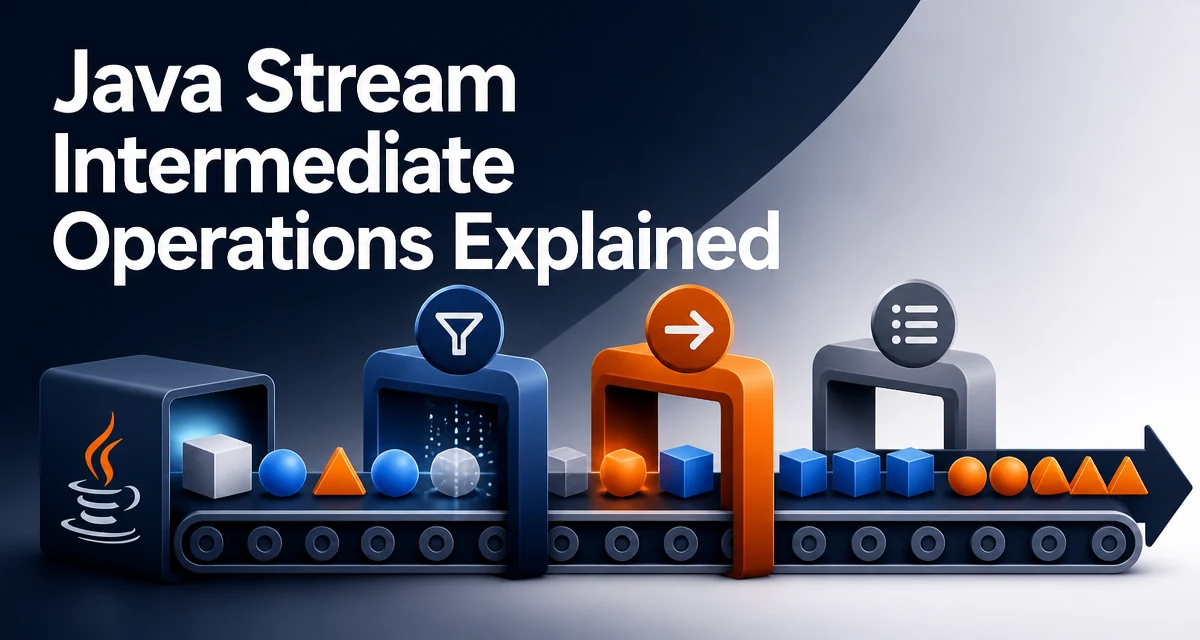
When you build a stream pipeline in Java, the intermediate operations determine how data is transformed before a terminal operation produces a result. Understanding java stream intermediate operations is essential for writing efficient and readable data processing code. These operations return a new stream, allowing you to chain multiple transformations, but their behavior is not always obvious, especially regarding when they actually execute.
How Intermediate Operations Work in a Stream Pipeline
A stream pipeline consists of a source, zero or more intermediate operations, and a terminal operation. Intermediate operations are lazy: they do not process any elements until a terminal operation is invoked. This design allows the stream to optimize the entire pipeline, potentially skipping work that is not needed.
Consider this simple example:
List<String> names = List.of("Alice", "Bob", "Charlie");

long count = names.stream()
    .filter(name -> name.startsWith("A"))
    .map(String::toUpperCase)
    .count();
Here, filter and map are intermediate operations. The count() terminal operation triggers the pipeline. The filter checks each name, and only those that pass move to the map. The map transforms the name, and the count increments. No element is processed until count() is called, and the pipeline processes elements one by one as they flow through.
Core Intermediate Operations and Their Behavior
The Java Stream interface provides a set of intermediate operations that cover most data transformation needs. Each has distinct semantics:
filter(Predicate)– keeps elements that match the predicate.map(Function)– transforms each element using the function.flatMap(Function)– maps each element to a stream and flattens the resulting streams into a single stream.distinct()– removes duplicate elements based onequals().sorted()– sorts the elements in natural order or using a comparator.peek(Consumer)– performs an action on each element as it passes, mainly for debugging.limit(long)– truncates the stream to a maximum number of elements.skip(long)– discards the first n elements.
These operations can be combined to build complex transformations. For example, to extract unique words from a list of sentences:
List<String> sentences = List.of("The quick brown fox", "The lazy dog");

List<String> words = sentences.stream()
    .flatMap(sentence -> Arrays.stream(sentence.split(" ")))
    .map(String::toLowerCase)
    .distinct()
    .sorted()
    .toList();
The flatMap splits each sentence into a stream of words, map lowercases them, distinct removes duplicates, and sorted orders the result. Each operation is applied in sequence, but because the pipeline is lazy, the entire process is executed only when toList() (a terminal operation) is called.
Lazy Evaluation: Why It Matters
Lazy evaluation is not just an implementation detail; it affects how you write and reason about stream code. Because intermediate operations are not executed until a terminal operation is present, you can build a pipeline without worrying about the cost of processing until you actually need the result. This also enables short-circuiting.
Short-circuiting occurs when a terminal operation like findFirst() or anyMatch() only needs a subset of the stream. For example:
Optional<String> first = names.stream()
    .filter(name -> name.startsWith("A"))
    .findFirst();
The filter operation only processes elements until it finds the first match, then stops. It does not process the entire stream. This behavior is only possible because the intermediate operation is lazy.
Without lazy evaluation, you would need to process every element before you could know the first match, which would be wasteful for large streams.
Stateful vs Stateless Intermediate Operations
Intermediate operations can be classified as stateful or stateless, which affects their performance and behavior.
Stateless operations, such as filter, map, and flatMap, treat each element independently. They do not need to remember anything about previous elements. This allows the stream to process elements in parallel without additional coordination.
Stateful operations, such as distinct, sorted, limit, and skip, must maintain some state across elements. For example, distinct needs to remember which elements it has already seen, and sorted must collect all elements before it can produce the first sorted element. This stateful behavior can have significant memory and performance implications, especially for large streams.
Consider sorted():
List<Integer> numbers = List.of(5, 3, 8, 1);

List<Integer> sorted = numbers.stream()
    .sorted()
    .toList();
Internally, sorted() must buffer the entire stream into an array, sort it, and then produce a new stream. This means it cannot emit the first element until it has seen all elements. In contrast, filter can emit elements as soon as they pass the predicate.
When using parallel streams, stateful operations require more careful handling. The JVM must merge partial results from different threads, which can reduce the performance benefit of parallelism. For example, distinct() in a parallel stream uses a concurrent set, but the final result must be combined, which adds overhead.
Order of Operations: Impact on Results and Performance
The order in which you chain intermediate operations can affect both the correctness and the efficiency of your pipeline. Although the final result is often the same regardless of order, the intermediate processing may differ significantly.
Consider filtering and mapping:
// Filter then map
list.stream().filter(valid).map(transform).toList();

// Map then filter
list.stream().map(transform).filter(valid).toList();
The first pipeline applies the filter before the transformation, so only elements that pass the filter are transformed. The second pipeline transforms every element, then filters the transformed ones. If the transformation is expensive, the first order is more efficient because it avoids transforming elements that will be discarded.
Similarly, placing limit() early can reduce the number of elements processed by subsequent operations. For example:
list.stream()
    .limit(10)
    .map(expensiveTransform)
    .toList();
This limits the stream to the first ten elements before applying the expensive transform, which is more efficient than mapping all elements and then limiting.
However, order can also affect correctness when using stateful operations. For instance, if you want the first three distinct elements, you should call distinct() before limit(3), otherwise you might get duplicates in the limit.
Performance Considerations: Memory and Short-Circuiting
Intermediate operations that buffer elements, such as sorted() and distinct(), consume memory proportional to the number of elements in the stream. For very large streams, this can cause OutOfMemoryError or excessive garbage collection. If you only need a few sorted elements, consider using a custom collector or a different approach, such as using a PriorityQueue with a limit.
Short-circuiting operations like limit() and skip() are efficient because they only process the necessary prefix of the stream. However, they can be problematic when combined with stateful operations. For example, skip(n) followed by distinct() will skip the first n elements before deduplication, which might not be what you intend if you want to skip the first n distinct elements.
When working with infinite streams, intermediate operations become critical. You can generate an infinite stream with Stream.iterate() or Stream.generate(), but you must use a short-circuiting operation like limit() or findFirst() to avoid an infinite loop.
Stream.iterate(0, n -> n + 1)
    .filter(n -> n % 2 == 0)
    .limit(10)
    .toList();
This pipeline produces the first ten even numbers. Without limit(), the toList() would never terminate.
Common Mistakes and Edge Cases
One common mistake is assuming that intermediate operations execute eagerly. For example, calling peek() without a terminal operation does nothing:
list.stream().peek(System.out::println); // no output
The peook action is never invoked because no terminal operation triggers the pipeline. This is a frequent source of confusion when debugging.
Another edge case is the interaction between skip() and limit() with parallel streams. The order of elements in a parallel stream is not guaranteed, so skip(1).limit(1) might return a different element than in a sequential stream. If you rely on encounter order, you should use forEachOrdered() or avoid parallel streams.
Also, be aware that distinct() uses equals() and hashCode(). If your elements do not implement these correctly, deduplication will not work as expected. Similarly, sorted() requires elements to be Comparable or you must provide a Comparator.
Finally, intermediate operations do not modify the source collection. They produce a new stream with transformed elements. If you need to collect the results, you must use a terminal operation like toList() or collect().
Choosing the Right Intermediate Operation for Your Data Transformation
When designing a stream pipeline, start by identifying the transformation you need. Use filter to reduce the set of elements, map to change the type or value, and flatMap to flatten nested structures. For deduplication, use distinct, but be mindful of its stateful nature. For ordering, use sorted only when you actually need the; otherwise, it adds overhead. Use peek sparingly, mainly for debugging, and avoid relying on it for side effects in production.
The order of operations should minimize the number of elements passed to expensive operations. Apply filter and limit early to reduce the workload. If you need a specific number of results, use limit after any necessary filtering but before stateful operations that might buffer more than needed.
In parallel streams, prefer stateless operations to maximize performance. If you must use stateful operations, be aware of the merging cost and the potential loss of encounter order. In many cases, a sequential stream with a well-ordered pipeline is more efficient than a parallel stream with heavy stateful operations.
Understanding the lazy nature and statefulness of java stream intermediate operations allows you to write pipelines that are both correct and efficient. By applying these principles, you can process data with confidence, avoiding common pitfalls and ensuring your code performs well even with large datasets.