Java Stream Lazy Evaluation Explained
java stream lazy evaluation: Understand how Java Streams defer computation until a terminal operation is called, and how lazy evaluation affects performance and correc...
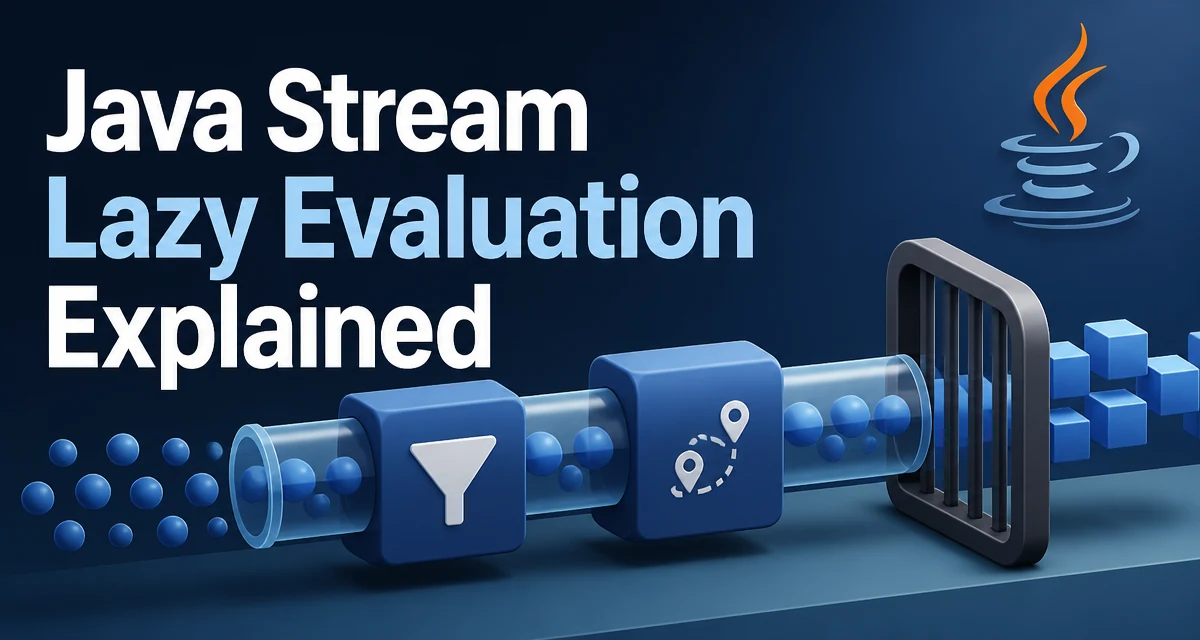
In Java, stream pipelines behave differently from typical imperative code. When you call filter() or map(), nothing actually happens until you call a terminal operation like collect() or forEach(). This is lazy evaluation, and it is central to how the Stream API works. Understanding java stream lazy evaluation is essential for writing efficient and predictable stream-based code.
What Lazy Evaluation Means for Java Streams
Lazy evaluation means that the stream does not process elements until a terminal operation forces it to. Intermediate operations such as filter, map, and sorted are not executed immediately; they merely configure the pipeline. The stream waits until a terminal operation is invoked, then processes elements in a single pass. This design allows the JVM to optimize the entire pipeline, potentially skipping unnecessary work.
For example, consider this code:
List<String> names = List.of("Alice", "Bob", "Charlie");
Stream<String> stream = names.stream()
    .filter(name -> name.startsWith("A"))
    .map(String::toUpperCase);
At this point, no filtering or mapping has occurred. The stream object is ready, but the elements have not been touched. Only when you call collect() or another terminal operation does the pipeline execute.
Intermediate Operations Are Not Executed Immediately
Every intermediate operation returns a new stream that describes the next stage of the pipeline. These operations are lazy by design. They do not inspect any elements until the terminal operation triggers the chain. This is different from eager operations like List.removeIf() or a simple for loop, where each step happens immediately.
The lazy nature of intermediate operations enables composition. You can build a complex pipeline step by step, pass it around, and decide later whether to execute it. This is useful when you want to conditionally add filters or maps based on runtime input.
Stream<String> stream = names.stream();
if (someCondition) {
    stream = stream.filter(name -> name.length() > 3);
}
List<String> result = stream.collect(Collectors.toList());
The stream remains lazy until collect() is called, so the conditional logic does not cause premature processing.
When the Pipeline Actually Executes
A terminal operation is required to start the execution. Common terminal operations include collect(), forEach(), reduce(), count(), anyMatch(), and findFirst(). When one of these is invoked, the stream processes elements according to the pipeline definition. The processing happens in a single pass, and each element flows through the chain of intermediate operations.
The key consequence is that a stream cannot be reused. After a terminal operation runs, the stream is considered consumed. Attempting to call another terminal operation on the same stream throws an IllegalStateException. This is a direct result of the one-shot, lazy execution model.
Stream<String> stream = names.stream().filter(name -> name.length() > 3);
long count = stream.count(); // executes
// stream.forEach(...); // throws IllegalStateException
Short-Circuiting Operations and Their Effect
Lazy evaluation enables short-circuiting. Some terminal operations do not need to process the entire stream to produce a result. For example, anyMatch() stops as soon as it finds a matching element. Similarly, intermediate operations like limit() can truncate the number of elements processed. This can dramatically reduce work, especially on infinite streams.
Optional<String> first = names.stream()
    .filter(name -> name.startsWith("B"))
    .findFirst();
Here, the stream stops after the first element that satisfies the filter. Without lazy evaluation, the entire list would be processed even if the first element matched. This behavior is not just a performance optimization; it is what makes infinite streams practical.
Stream.iterate(0, n -> n + 1)
    .filter(n -> n % 2 == 0)
    .limit(10)
    .forEach(System.out::println);
The limit() operation prevents infinite processing by only taking the first ten even numbers.
Side Effects and Stateful Operations
Because evaluation is deferred, side effects inside intermediate operations can behave unexpectedly. If you write peek() or map() that modifies external state, you cannot rely on when or how many times that code runs. The JVM may reorder operations, skip elements due to short-circuiting, or even run the pipeline in parallel. This makes side effects fragile and hard to debug.
Stateful intermediate operations like sorted() and distinct() also interact with laziness. They need to buffer the entire stream before producing results, which breaks the streaming nature. For example, sorted() must see all elements before it can emit the first one. This can cause memory pressure and delays, especially on large or infinite streams. Use them with caution.
List<Integer> sorted = numbers.stream()
    .sorted()
    .collect(Collectors.toList());
This pipeline will buffer all numbers in memory before sorting, even though other operations like filter could have been applied earlier to reduce the input size.
Performance Implications and Common Misconceptions
Lazy evaluation is often misunderstood as a performance guarantee. It is not. The benefit is that it avoids unnecessary work, but the overhead of creating stream objects and lambdas can be higher than a simple loop for small collections. The real gains appear when you have large data sets, complex pipelines, or when short-circuiting can skip most elements.
Another misconception is that ordering is preserved. Streams are not guaranteed to preserve encounter order unless you use sequential() and avoid certain operations. Parallel streams can process elements concurrently, and lazy evaluation does not change that. If order matters, you must explicitly use sequential() and ensure the operations respect it.
A common performance mistake is to reuse a stream by storing it in a variable and calling multiple terminal operations. Since a stream is consumed after one terminal operation, this fails. Instead, create a new stream each time. The lazy design encourages this because building a stream is cheap; the cost is only incurred when the terminal operation runs.
Practical Guidance for Using Lazy Evaluation Effectively
To get the most out of lazy evaluation, keep these principles in mind. First, treat intermediate operations as declarative descriptions, not executable steps. Second, avoid side effects in peek() and map(); use them only for debugging. Third, place filter() before map() when possible to reduce the number of elements that need mapping. Fourth, use short-circuiting operations like limit() and findFirst() to minimize work. Finally, be aware that stateful operations like sorted() and distinct() break the streaming model and may require buffering the entire dataset.
When you need to process a collection multiple times, create a new stream each time rather than trying to reuse one. The lazy evaluation model makes this natural and efficient. If you are working with infinite streams, always include a short-circuiting operation to avoid running forever.
Understanding lazy evaluation also helps with debugging. When you see unexpected output from a peek() or a forEach(), consider whether the stream is being short-circuited or whether a parallel stream is causing non-deterministic order. The deferred execution can hide bugs until the terminal operation runs, so it is wise to test the entire pipeline rather than inspecting individual intermediate steps.
In summary, lazy evaluation is a powerful feature of the Java Stream API, but it requires a shift in how you think about code execution. By understanding when work actually happens and how short-circuiting can alter behavior, you can write streams that are both efficient and correct.