Using Java Stream limit to Control Stream Size
java stream limit: Learn how the Java Stream limit operation works, its short-circuiting behavior, and practical usage patterns for controlling stream size.
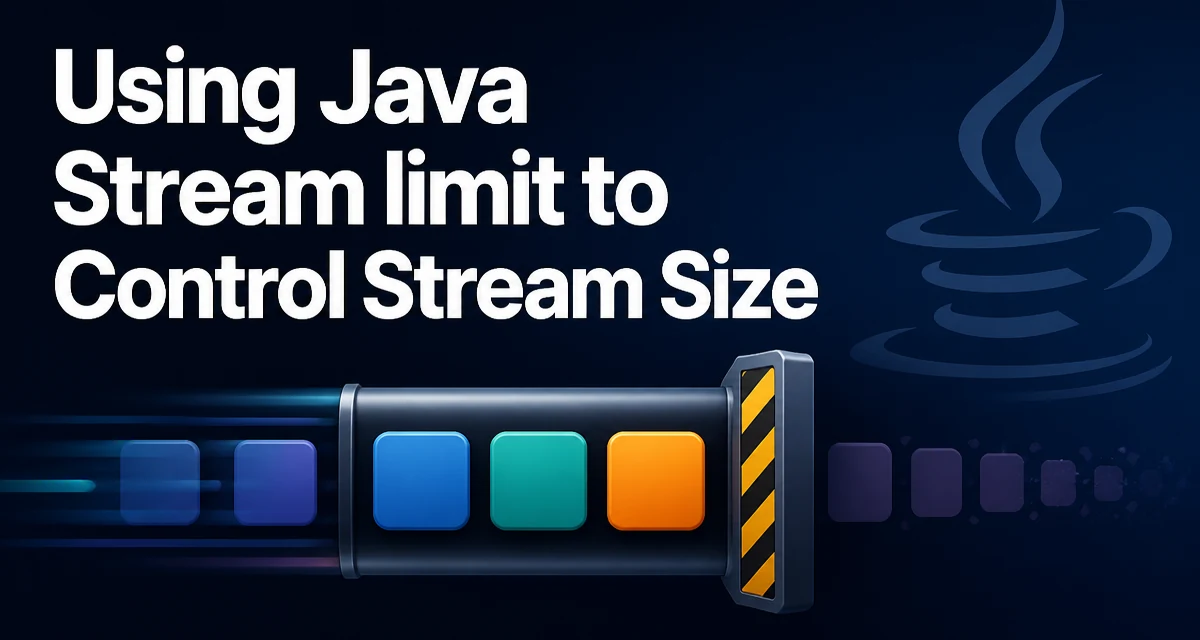
java stream limit requires a clear understanding of the core syntax, runtime behavior, and practical implementation patterns demonstrated in the examples below.
The limit operation is an intermediate operation in the Java Stream API that truncates a stream to a maximum number of elements. It is often used to cap the amount of data processed, especially when dealing with infinite streams or when only a subset of results is needed. Understanding how limit interacts with other stream operations and its short-circuiting behavior is essential for writing efficient and correct stream pipelines.
What limit Does in a Stream Pipeline
The limit(n) method returns a new stream that contains at most n elements from the original stream, preserving encounter order for ordered streams. It is a lazy operation: the elements are not consumed until a terminal operation is invoked. The following example shows a simple use case where a list of integers is truncated to the first three elements:
List<Integer> numbers = List.of(1, 2, 3, 4, 5);
List<Integer> firstThree = numbers.stream()
    .limit(3)
    .collect(Collectors.toList());
System.out.println(firstThree); // [1, 2, 3]
The limit operation does not modify the source collection; it only affects the stream pipeline. The source remains unchanged, and the stream can be reused if it is a collection-based stream (though reusing a stream after a terminal operation is not allowed).
Short-Circuiting with Infinite Streams
One of the most important characteristics of limit is that it is a short-circuiting intermediate operation. This means that it can terminate processing of an infinite stream without consuming all elements. For example, you can generate an infinite sequence of random numbers and take only five:
Random random = new Random();
random.ints()
    .limit(5)
    .forEach(System.out::println);
Without limit, the ints() stream would produce an unbounded number of elements, and the terminal operation would never complete. The limit operation signals the stream pipeline to stop producing elements once the limit is reached. This behavior is crucial for building efficient pipelines over potentially unlimited data sources, such as sensor streams, log feeds, or generated sequences.
Combining limit with Other Intermediate Operations
The order of intermediate operations matters. When limit is placed after a filter, the stream first filters elements and then truncates the result. This can lead to a situation where the stream processes more elements than the limit if the filter rejects many items. Consider this example:
Stream.iterate(0, i -> i + 1)
    .filter(i -> i % 2 == 0)
    .limit(3)
    .forEach(System.out::println); // prints 0, 2, 4
The stream iterates over all integers, filters for even numbers, and then takes the first three even numbers. The filter is applied to each element, and the limit stops the iteration once three even numbers have been collected. This is efficient because limit short-circuits the entire pipeline; the underlying iteration stops after the third even number is found.
However, if you place limit before filter, the stream first truncates the source and then filters the truncated subset. This can produce different results and may cause the filter to yield fewer elements than expected. For example:
Stream.iterate(0, i -> i + 1)
    .limit(3)
    .filter(i -> i % 2 == 0)
    .forEach(System.out::println); // prints 0, 2
Here, the stream takes the first three integers (0, 1, 2), filters for even numbers, and outputs 0 and 2. The order of operations changes the semantics, so you must decide which behavior matches your requirement.
Performance and Memory Considerations
Because limit is lazy and short-circuiting, it can significantly reduce the amount of work performed by a stream pipeline. For infinite or very large streams, this is essential for avoiding resource exhaustion. However, the performance benefit depends on the source and the operations before limit. If the stream is sourced from a collection, limit does not avoid the cost of iterating the collection; it only stops the iteration early. For a List with millions of elements, limit(10) will still traverse the list until it has collected ten elements, but it will not process the remaining elements.
When combined with expensive operations like map or flatMap, placing limit early can prevent those operations from being applied to elements beyond the limit. For example, in a pipeline that maps every element to a heavy computation, putting limit before map ensures that the mapping is only applied to the limited number of elements:
list.stream()
    .limit(100)
    .map(this::expensiveTransformation)
    .collect(Collectors.toList());
This is more efficient than mapping the entire list and then limiting, because the expensive transformation is only invoked on the first 100 elements. The short-circuiting behavior of limit propagates backward through the pipeline, so the source stops being consumed once the limit is reached.
Common Mistakes and Edge Cases
A common mistake is assuming that limit preserves the order of elements for unordered sources. If the stream is unordered (e.g., from a HashSet), the elements selected by limit are non-deterministic. For ordered sources like List or arrays, the order is preserved, but for parallel streams, the behavior can be unpredictable unless the stream is explicitly ordered. If order matters, use sequential() or ensure the source has a defined encounter order.
Another edge case is passing a negative value to limit. The limit method throws an IllegalArgumentException if n is negative. A value of zero returns an empty stream. This is often overlooked when the limit is computed dynamically. For example:
int max = -1;
List<Integer> result = numbers.stream()
    .limit(max) // throws IllegalArgumentException
    .collect(Collectors.toList());
Always validate the limit value before using it in a stream pipeline, or use a conditional to handle non-positive values gracefully.
When to Use limit vs takeWhile and findFirst
Java 9 introduced takeWhile, which is similar to limit but uses a predicate instead of a fixed count. takeWhile takes elements as long as the predicate is true and stops when the predicate becomes false. This is useful when you want to stop based on a condition rather than a count. For example, you can take numbers from an infinite stream until a value exceeds 100:
Stream.iterate(0, i -> i + 1)
    .takeWhile(i -> i <= 100)
    .forEach(System.out::println);
limit is preferable when you know exactly how many elements you need. findFirst is a terminal operation that returns the first element of the stream, optionally with a predicate. It is useful when you only need a single element and want to short-circuit the stream. The choice depends on the requirement:
| Operation | Behavior | Use case |
|---|---|---|
limit(n) | Takes exactly n elements | Fixed-size truncation |
takeWhile(predicate) | Takes elements while predicate is true | Conditional truncation |
findFirst() | Returns the first element | Single result |
For example, to get the first three even numbers from an infinite sequence, limit is the right tool. To get all numbers until a value exceeds a threshold, takeWhile is more expressive. Using limit with a predicate requires a separate filter and may not stop as early as takeWhile.
Handling Unordered Parallel Streams with limit
When a stream is parallel and unordered, the limit operation may not select the same elements as a sequential stream. This is because parallel processing splits the source into chunks, and each chunk may produce elements independently. The final result is not guaranteed to be the first n elements in encounter order unless the stream is ordered. To enforce deterministic behavior, you can force the stream to be ordered by calling sequential() or by using a source that is inherently ordered. For most use cases, if you need a specific subset, it is safer to keep the stream sequential.
For example, the following code may produce different results on each run if the source is a HashSet:
Set<Integer> set = new HashSet<>(List.of(1, 2, 3, 4, 5));
List<Integer> firstTwo = set.parallelStream()
    .limit(2)
    .collect(Collectors.toList());
Because the set has no defined encounter order, the two elements chosen are non-deterministic. If you need a reproducible selection, convert the set to a list first or use sorted() to impose an order before applying limit.
The limit operation is a fundamental tool for controlling stream size and enabling short-circuiting. Used correctly, it prevents unnecessary computation and memory usage, especially in infinite or high-volume streams. Pay attention to operation order, source ordering, and edge cases to avoid subtle bugs in your stream pipelines.