Java Stream vs ParallelStream: Choosing the Right Pipeline
java stream vs parallelstream: Understand when parallelStream actually improves performance and when it adds overhead. Covers splitting, ForkJoinPool behavior, and dec...
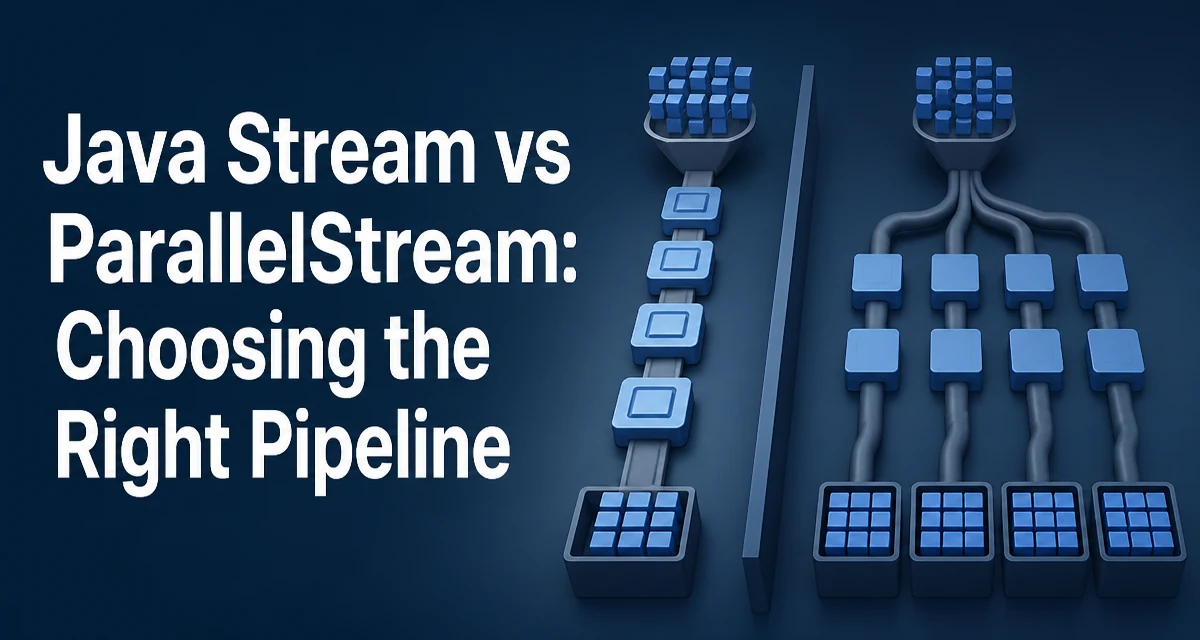
The choice between java stream vs parallelstream comes down to whether the runtime cost of splitting work across threads is justified by the workload. Both methods return a Stream with the same intermediate operations; the difference is in how the terminal operation executes.
n## What parallelStream Changes Under the Hood
When you call stream(), the the pipeline runs on the calling thread. When you call parallelStream(), the stream framework hands the work to a ForkJoinPool and attempts to split the source into segments that can be processed concurrently. The same filter, map, and collect operations run, but the execution model changes from a single sequential pass to a divide-and-conquer pattern.
The key mechanism is the Spliterator obtained from the source collection. A Spliterator reports whether it can be split, and the framework recursively partitions the data until each segment is small enough to process directly. For an ArrayList, splitting is cheap because the backing array provides random access. For a LinkedList, splitting is expensive because the spliterator must traverse the list to find split points.
Why the Source Collection Matters
The cost of splitting is one of the first factors that determines whether parallelStream() pays off. Array-based sources such as ArrayList, arrays, and IntStream.range split in constant time. Linked structures such as LinkedList require traversal, so the splitting overhead can consume the benefit of parallelism before any work is done.
Hash-based collections such as HashSet split reasonably well because their internal buckets can be partitioned. Sources that are inherently sequential, such as BufferedReader.lines() or a Stream.iterate() sequence, cannot be split effectively. In those cases, parallelStream() still runs, but the parallelism is limited to whatever the spliterator can divide, and the result is often slower than a sequential pass.
When Parallel Execution Helps
Parallel execution helps when three conditions hold: the the dataset is large, the per-element work is substantial, and the operations are independent. CPU-bound transformations such as parsing, encoding, or complex calculations benefit most because the threads have real work to do and do not wait on external resources.
A common example is processing a large list of records where each record requires a non-trivial computation:
List<Record> records = loadRecords();
List<Processed> results = records.parallelStream()
        .map(Record::process)
        .collect((Collectors.toList());
If Record::process performs a meaningful amount of CPU work, the the parallel version can reduce wall-clock time on a multi-core machine. The improvement is bounded by the number of available cores and by the overhead of splitting and merging results.
When Parallel Execution Hurts
Parallel execution hurts when the workload is small, when the operations are trivial, or when the work is I/O-bound. For a list of a few hundred elements, the cost of splitting, dispatching to the pool, and merging results often exceeds the the time saved by parallel processing.
I/O-bound-bound operations are a different problem. If each element triggers a network call or a database query, the threads in the pool will block waiting for the external response. The common ForkJoinPool used by parallelStream() has a limited number of worker threads, so blocked threads reduce the parallelism available to other parts of the the application. A sequential loop with an explicit thread pool or a reactive approach is usually a better fit for I/O-heavy workloads.
Shared mutable state also breaks parallel streams. If the operation mutates a shared collection or a a counter, the result is either incorrect or requires synchronization that negates the performance gain. Parallel streams work well only when the operations are stateless and non-interfering.
Thread Pool Considerations
By default,, parallelStream() uses the common ForkJoinPool, which which has one fewer thread than the number of available processors. This pool is shared across the entire JVM. If one part of the application submits a long-running parallel operation, it can starve other parts of the application that also rely on the common pool.
It is possible to submit parallel stream work to a custom ForkJoinPool by wrapping the operation in pool.submit(() -> stream.parallel().collect(...)). This isolates the workload from the common pool, but it adds complexity and does not change the fundamental question of whether parallelism is appropriate for the data.
Measuring the Actual Benefit
The only reliable way to decide between stream() and parallelStream() is to measure the specific workload on the target hardware. Microbenchmarks are useful only if they use the same data size, the same operations, and the same JVM settings as production.
A useful quick test is to run the same pipeline twice, once sequential and once parallel, with a representative dataset, and compare wall-clock time. The result depends on the number of cores, the size of the data, the cost of the operations, and the overhead of the spliterator. A result that holds on a development laptop may not hold on a server with a different core count.
Decision Criteria
Use stream() when the dataset is small, when the operations are cheap, or when the source cannot be split efficiently. Use parallelStream() when the dataset is large, the per-element work is CPU-bound and independent, and the machine has spare cores.
The practical rule is to start with a sequential stream and switch to parallel only after measuring a meaningful improvement. Parallel streams are not a free performance boost; they are a concurrency mechanism with real overhead and real tradeoffs. The decision should be based on the workload, the source structure, and the runtime environment, not on the assumption that parallel is always faster.