Java System.arraycopy: How to Copy Arrays Efficiently
java system arraycopy: Learn how to use Java System.arraycopy to copy array segments efficiently, avoid common pitfalls, and understand when it outperforms manual loops.
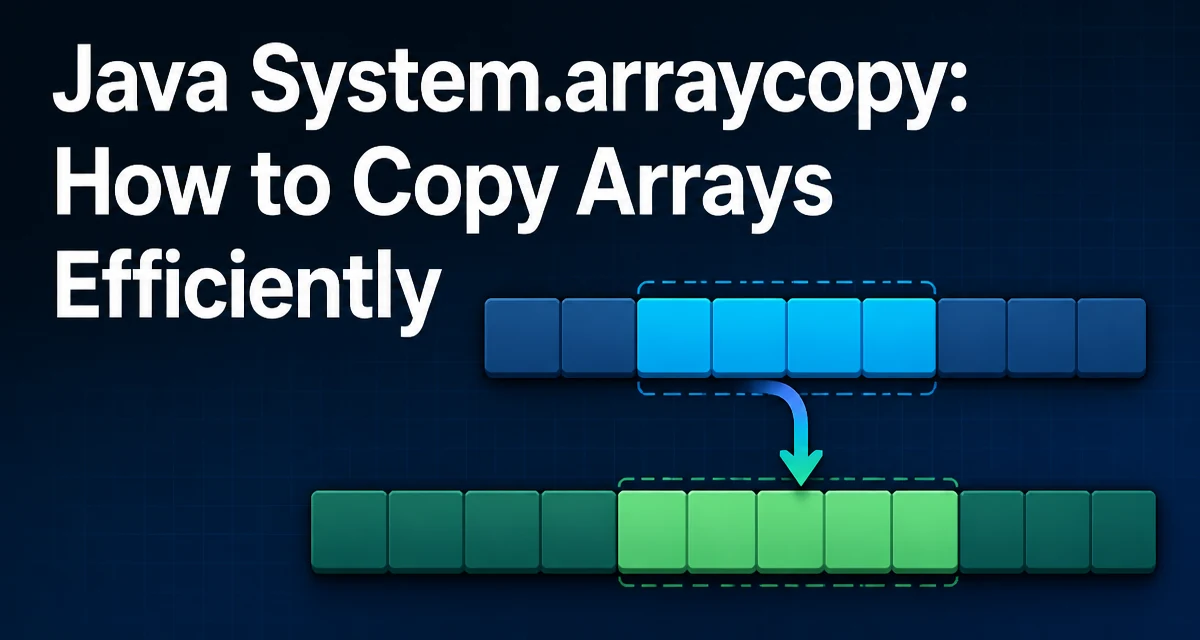
java system arraycopy requires a clear understanding of the core syntax, runtime behavior, and practical implementation patterns demonstrated in the examples below.
Java's System.arraycopy is a native method that copies array elements from a source array to a destination array. It is a low-level operation that many developers use when they need to copy a range of elements without writing a manual loop. Understanding its exact behavior is important because it handles type checking, overlapping ranges, and performance differently than a simple for loop.
How System.arraycopy Works
The method signature is:
public static native void arraycopy(Object src, int srcPos, Object dest, int destPos, int length)
It copies length elements from src starting at index srcPos to dest starting at index destPos. Both arrays must be of the same type or compatible types, and the destination array must be large enough to hold the copied elements. The method performs a shallow copy: for reference types, it copies the references, not the underlying objects.
One key detail is that System.arraycopy handles overlapping regions correctly. If the source and destination ranges overlap, the copy behaves as if the elements were first copied to a temporary buffer and then written to the destination. This is not guaranteed by a manual loop, which could corrupt data if the ranges overlap.
Basic Usage Example
Here is a minimal example that copies a segment of an integer array:
int[] source = {1, 2, 3, 4, 5};
int[] destination = new int[5];

System.arraycopy(source, 1, destination, 0, 3);

// destination now contains {2, 3, 4, 0, 0}
The copy starts at source[1] and writes three elements to destination starting at index 0. The remaining elements of destination retain their initial values. This is a common pattern when you need to extract a subarray or merge data into an existing buffer.
Common Mistakes and Edge Cases
System.arraycopy throws several exceptions when its arguments are invalid. The most frequent are:
NullPointerExceptionif either array isnull.ArrayStoreExceptionif the source and destination types are not compatible. For example, copying aString[]into anInteger[]fails.IndexOutOfBoundsExceptionif any of the index parameters are negative, or ifsrcPos + lengthexceedssrc.length, ordestPos + lengthexceedsdest.length.
A subtle issue is that the method performs a shallow copy for object arrays. If you copy an array of mutable objects, both arrays reference the same objects. Modifying an object through one array affects the other. For a deep copy, you must clone or recreate the objects manually.
Performance Considerations
System.arraycopy is a native call, so it can leverage optimized memory-copy routines at the JVM level. For large arrays, it is typically faster than a manual for loop because it avoids bounds checks and may use vectorized instructions. However, it is still an O(n) operation, and for very small arrays (a few elements), the overhead of the native call might outweigh the benefit. In practice, the difference is negligible for most applications, but if you are copying arrays in a tight loop, System.arraycopy is usually the safer choice for performance.
Another performance-related detail is that the JVM may optimize System.arraycopy into a single memmove operation when the element type is primitive. This is particularly efficient for byte[], int[], and other primitive arrays. For object arrays, it still copies references, which is also fast but involves reference assignment.
Comparing System.arraycopy with Arrays.copyOf
Java's Arrays.copyOf is a higher-level convenience method that internally uses System.arraycopy. The key difference is that Arrays.copyOf creates a new array of a specified length and copies the elements into it. It is simpler when you need a new array, but it does not allow copying into an existing array or specifying a source range directly.
| Feature | System.arraycopy | Arrays.copyOf |
|---|---|---|
| Destination array | Provided by caller | Created internally |
| Source range | Explicit srcPos and length | Copies from index 0 to newLength |
| Overlapping ranges | Handled correctly | Not applicable (new array) |
| Return value | void | New array |
| Use case | Copy into existing buffer | Create a new array of a given size |
Use System.arraycopy when you need to copy into a pre-allocated array, such as when implementing a custom collection that maintains a backing array. Use Arrays.copyOf when you simply want a new array that is a copy of the original or a truncated/expanded version.
Copying Multi-Dimensional Arrays
System.arraycopy works on any array type, but for multi-dimensional arrays, it only copies the top-level references. Consider a 2D array:
int[][] matrix = {{1, 2}, {3, 4}};
int[][] copy = new int[2][];
System.arraycopy(matrix, 0, copy, 0, 2);
This copies the references to the two inner arrays. The inner arrays are shared between matrix and copy. If you need a deep copy, you must iterate over the rows and copy each inner array separately, or use a utility that handles deep cloning.
When to Use System.arraycopy in Production Code
System.arraycopy is commonly used in low-level data manipulation, such as:
- Implementing dynamic arrays or buffer resizing, where you need to move existing elements into a new larger array.
- Parsing binary data from a
byte[]into separate segments without creating intermediate objects. - Combining multiple arrays into a single array, as in
byte[]concatenation.
In these scenarios, the method's ability to copy into an existing array and its native performance make it a practical choice. It also avoids the overhead of creating temporary arrays that Arrays.copyOf might introduce when you only need to move a portion of data.
One production consideration is that System.arraycopy does not perform any type checking beyond the runtime compatibility check. If you are copying an array of a generic type, you must ensure that the destination array is of the correct type, because generic type erasure can hide mismatches until runtime. This is a common source of ArrayStoreException in generic code, so it is worth validating the array types before calling the method.
Another practical detail is that the method is native, so its exact performance characteristics depend on the JVM implementation and the underlying platform. On modern JVMs, it is highly optimized, but you should not assume it is always the fastest option for every array size. Profiling your specific use case is the only way to know for sure, but for most production code, System.arraycopy is the idiomatic and reliable choice for copying array segments.