Java transient Keyword: Excluding Fields from Serialization
Learn how the java transient keyword controls field serialization, when to use it, and how it interacts with records, Externalizable, and serialVersionUID.
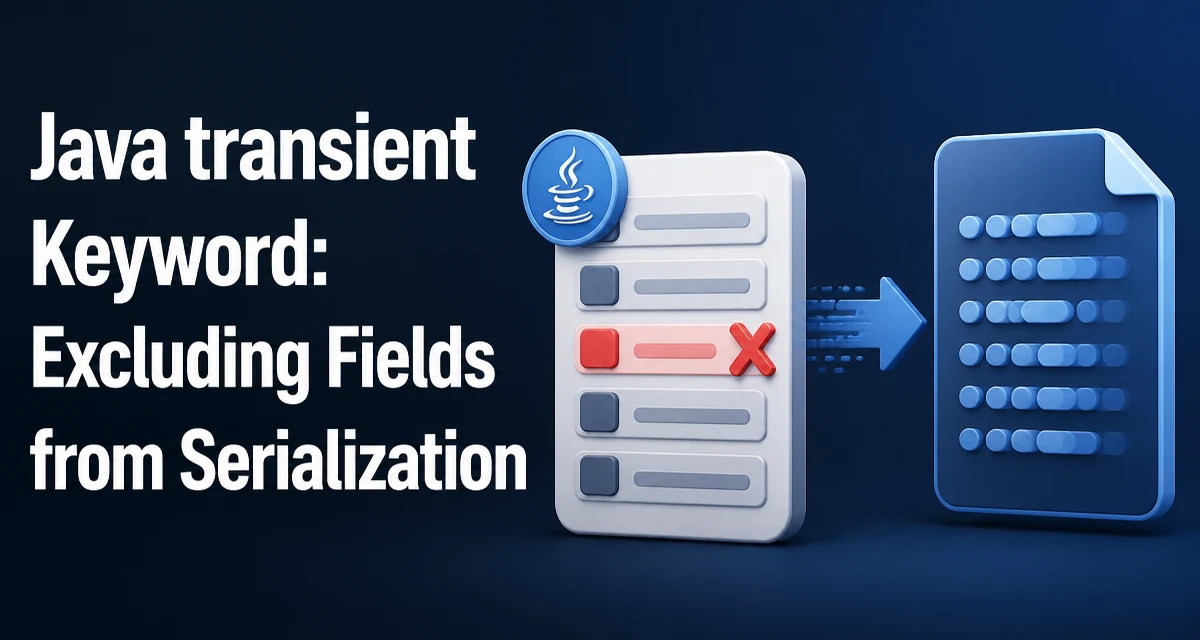
The java transient keyword marks a field so that the default Java serialization mechanism skips it when writing an object to a byte stream. When an object is deserialized, a transient field is restored to its default value—null for reference types, zero for primitives—rather than the value it held before serialization. This behavior is part of the java.io.Serializable contract and is often misunderstood because transient does not affect in-memory behavior; it only changes what gets written during serialization.
What Does transient Do in Java Serialization?
Java's built-in serialization writes an object's state to a stream using reflection. For each non-static, non-transient field, the runtime captures the field's value and stores it in the serialized representation. The transient modifier tells the serialization mechanism to ignore that field entirely. The field is not written to the stream, and on deserialization it receives the JVM's default value for its type: null for objects, 0 for numeric primitives, false for boolean, and '\u0000' for char.
This behavior is defined by the Java Object Serialization Specification. It applies only when using the default serialization path—that is, when you implement Serializable and do not override writeObject or readObject. If you provide custom serialization logic, you have full control over which fields are written, and the transient modifier becomes a hint rather than a hard rule.
Declaring a transient Field
Applying transient is straightforward. Add the modifier to a field declaration, typically alongside private or protected. Here is a minimal example:
import java.io.Serializable;

public class UserSession implements Serializable {
    private static final long serialVersionUID = 1L;

    private String username;
    private String sessionId;
    private transient String passwordHash; // not serialized
    private transient long lastAccessTime; // not serialized
}
In this class, username and sessionId are serialized normally. passwordHash and lastAccessTime are transient, so they will not appear in the serialized byte stream. After deserialization, passwordHash will be null and lastAccessTime will be 0. This is useful when a field is derived from other data or when it contains sensitive information that should not be persisted.
When to Use transient
The most common use case is excluding derived or cached data that can be recomputed after deserialization. For example, a field that holds a parsed representation of another field, or an in-memory cache that is expensive to serialize and unnecessary to persist. Marking such fields transient keeps the serialized form smaller and avoids writing redundant data.
Another important use is protecting sensitive information. If you serialize an object to a file or over a network, any non-transient field is exposed in the byte stream. Marking passwords, tokens, or cryptographic keys as transient prevents them from being written accidentally. However, this is not a security mechanism—the data may still exist in memory, and custom serialization could write it if you choose to. It is a way to enforce that sensitive fields are not part of the default serialized representation.
Transient is also appropriate for fields that reference non-serializable objects. If a field's type does not implement Serializable, marking it transient avoids a NotSerializableException during serialization. For example, a field holding a thread pool or a database connection should not be serialized; transient is the clean way to exclude it.
transient and Externalizable
The Externalizable interface gives a class complete control over its serialized form by requiring implementations of writeExternal and readExternal. When a class implements Externalizable, the transient modifier has no effect on the default serialization because there is no default serialization—the class decides exactly what to write and read. If you implement Externalizable, you can choose to ignore transient fields in your writeExternal method, but you are not forced to. The transient keyword is a signal to the default mechanism, not to custom code.
transient with Records and Java Versions
Java records, introduced in Java 16, provide a compact way to define immutable data carriers. A record's fields are implicitly final and cannot be declared transient. The Java language specification does not allow the transient modifier on record components. If you need to exclude a field from serialization in a record, you must either use a custom serialization strategy or redesign the record to avoid storing that field. For example, you could store a derived value in a separate non-record class, or use a custom writeObject and readObject within the record, though that is unusual for records.
For older Java versions, transient works consistently across all classes that implement Serializable. There is no version-specific behavior beyond the standard specification.
Common Pitfalls and Edge Cases
One frequent mistake is assuming transient affects static fields. Static fields are not serialized at all by the default mechanism, regardless of whether they are marked transient. The transient modifier is only meaningful for instance fields.
Another pitfall is forgetting to handle transient fields when you override writeObject or readObject. If you provide custom serialization logic, the default field-by-field writing is bypassed. You must explicitly write and read any fields you want to persist. If you intend to exclude a transient field, your custom methods should not touch it. But if you accidentally include it in your custom logic, it will be serialized despite the modifier.
Transient also interacts with serialVersionUID. The serialVersionUID is a static field, so it is never serialized. Adding or removing transient modifiers changes the class's serialized form, which can affect compatibility. If you change a field from non-transient to transient, the serialized bytes for existing objects will not contain that field. On deserialization, the field gets its default value. This can break backward compatibility if the receiving code expects the field to have a meaningful value. You should plan for such changes and consider versioning your serialized data.
Serialization Overhead and Runtime Considerations
Marking fields transient reduces the size of the serialized byte stream because those fields are not written. For large objects with many derived or cache fields, this can meaningfully reduce storage and network transfer costs. However, the runtime cost of serialization is dominated by reflection and stream writing, not by the number of fields alone. Excluding a few fields does not dramatically change performance unless the fields themselves are large, such as arrays or collections.
On deserialization, transient fields are not populated, so any code that uses them must handle null or zero values. This is a common source of NullPointerException if you forget to reinitialize transient fields in a readObject method or in a factory method after deserialization. You can override readObject to recompute derived transient fields after the default deserialization completes. For example:
private void readObject(ObjectInputStream in) throws IOException, ClassNotFoundException {
    in.defaultReadObject();
    this.cachedHash = computeHash(this.username);
}
This pattern ensures that transient fields that depend on serialized data are rebuilt correctly. It is a standard approach for maintaining object invariants after deserialization.
From a security perspective, transient fields are not written to the stream, so they are not exposed in serialized form. This reduces the attack surface if serialized data is intercepted. However, you should not rely solely on transient for security; use encryption or other protections when serializing sensitive data. The transient modifier is a design tool, not a security boundary.
When deciding whether to mark a field transient, consider whether the field can be reconstructed from other serialized state, whether it holds sensitive information, and whether it references a non-serializable resource. These three criteria cover most practical uses. If none apply, leaving the field non-transient is usually simpler and preserves the original behavior.