Java Transient vs Static Serialization: Key Differences
java transient vs static serialization: Understand how transient and static fields behave during Java serialization, why they are excluded, and how to handle state cor...
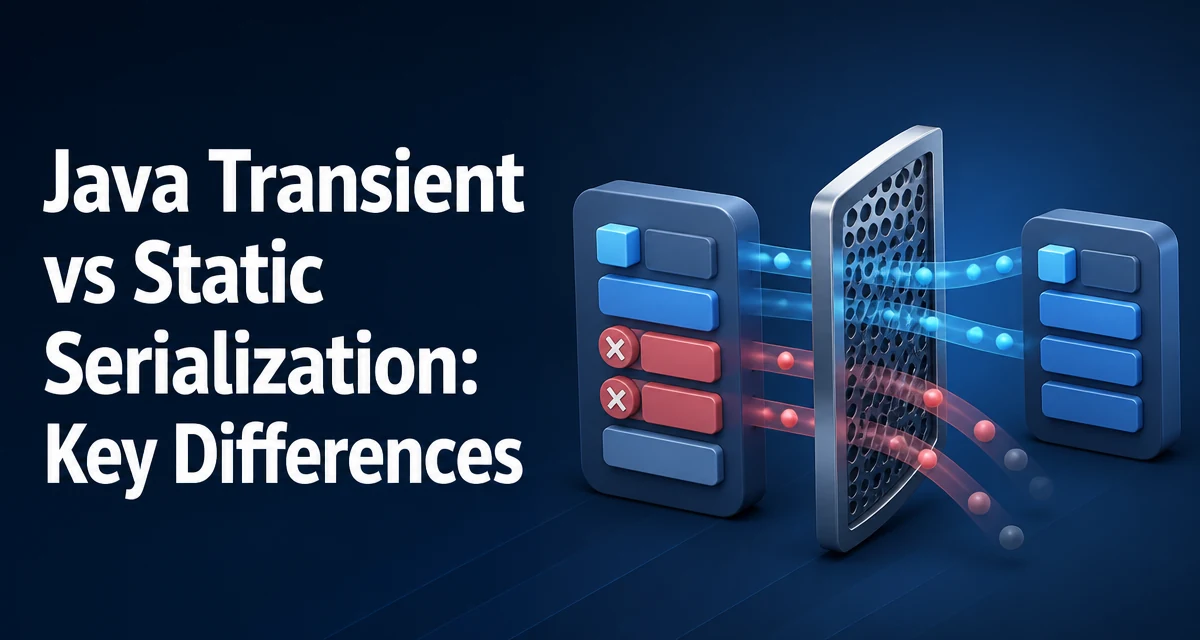
When you mark a field as transient or static in a Java class, you change how that field behaves during serialization. The java transient vs static serialization question often confuses developers because both keywords cause a field to be skipped by the default serialization process, but they do so for different reasons and with different side effects. Understanding the distinction matters when you design classes that implement Serializable.
What transient and static Mean in Serialization
Java's default serialization mechanism writes the state of an object by traversing its instance fields. A field declared transient is explicitly excluded from that traversal. The transient keyword tells the serialization runtime: "This field is not part of the persistent state of this object." A field declared static, on the other hand, belongs to the class rather than to any single instance. Because serialization operates on instances, static fields are never written to the output stream by default.
public class User implements Serializable {
    private static final long serialVersionUID = 1L;
    private String username;
    private transient String passwordHash;
    private static int loginCount;
}
In this example, passwordHash is transient and loginCount is static. When a User object is serialized, both fields are omitted from the serialized byte stream. However, the reasons are fundamentally different: passwordHash is omitted because it is marked transient; loginCount is omitted because it is a class-level variable, not part of any instance.
Why Static Fields Are Excluded from Serialization
Serialization is concerned with the state of an object. Each object has its own copy of instance fields, but static fields are shared across all instances of the class. They belong to the class itself, not to a particular object. When you serialize an object, you capture the object's individual state, not the state of the entire class. Writing static fields would be misleading because they are not tied to the object being serialized.
Consider a class that tracks the total number of created instances:
public class Counter implements Serializable {
    private static int instanceCount = 0;
    private int id;

    public Counter() {
        instanceCount++;
        id = instanceCount;
    }
}
If you serialize a Counter object, the id field is saved, but instanceCount is not. When you deserialize the object later, the static field retains whatever value it currently has in the JVM, not the value from the serialization time. This behavior is intentional: static fields represent global state that is not owned by any single instance.
Why Transient Fields Are Excluded from Serialization
The transient keyword is a deliberate developer choice. You use it when a field should not be serialized because it is derived, sensitive, or not meaningful after deserialization. For example, a cached value that can be recomputed, or a password hash that should not be written to disk or sent over a network.
public class Session implements Serializable {
    private String token;
    private transient long lastAccessTime;

    public Session(String token) {
        this.token = token;
        this.lastAccessTime = System.currentTimeMillis();
    }
}
When a Session is serialized, lastAccessTime is skipped. After deserialization, it will have the default value for long, which is 0. If the field is needed, you must either recompute it or use custom serialization methods like readObject() to restore it. The transient keyword gives you control over what gets persisted, but it also means you must handle the missing state yourself.
The Key Differences Between Transient and Static
The most important difference is ownership. transient applies to instance fields and is a per-field decision. static applies to class fields and is a fundamental property of the field's scope. You can have a static transient field, but it is redundant because static fields are already excluded from serialization. The transient keyword has no effect on static fields.
| Aspect | transient | static |
|---|---|---|
| Scope | Instance field | Class field |
| Serialization | Excluded by keyword | Excluded by nature |
| Value after deserialization | Default value (null, 0, false) | Current class value, not from stream |
| Control | Developer explicitly opts out | No opt-in; always excluded |
| Typical use | Sensitive or derived data | Constants or shared counters |
Another difference is how the field is restored. A transient field is reset to its default value when the object is deserialized. A static field is not affected by deserialization at all; it keeps whatever value it had in the JVM. This means that if you serialize an object on one machine and deserialize it on another, the static field's value will be whatever that class variable holds on the second machine, not the value from the first.
Handling Static State When You Need to Serialize It
Sometimes you do need to persist static state along with an object. For example, you might want to save a class-level configuration that is currently stored in a static field. The default serialization will not include it, so you must handle it manually.
One approach is to copy the static value into an instance field before serialization. You can implement writeObject() and readObject() to manage this:
public class Config implements Serializable {
    private static String globalSetting = "default";
    private String instanceSetting;

    private void writeObject(ObjectOutputStream out) throws IOException {
        out.defaultWriteObject();
        out.writeObject(globalSetting);
    }

    private void readObject(ObjectInputStream in) throws IOException, ClassNotFoundException {
        in.defaultReadObject();
        globalSetting = (String) in.readObject();
    }
}
This approach works but couples the static field's lifecycle to a specific object's serialization. It can lead to surprising behavior if multiple objects of the same class are serialized and each overwrites the static value. A cleaner design is to avoid storing mutable state in static fields altogether and instead use instance fields or a separate serializable configuration object.
Common Mistakes and Pitfalls
A frequent mistake is assuming that transient and static are interchangeable. They are not. Removing static from a field that was intended to be class-wide changes the semantics of your program. Conversely, adding transient to a static field has no effect on serialization, which can mislead developers into thinking they have excluded it when it was already excluded.
Another pitfall is relying on the default value of a transient field after deserialization. If the field is an object reference, it will be null. If it is a primitive, it will be 0 or false. Code that accesses the field without checking for these defaults can throw NullPointerException or behave incorrectly. Always initialize transient fields in readObject() or provide a getter that handles the missing value.
Static fields also cause problems when you change them after serialization. Suppose you serialize an object, then modify a static field, and then deserialize the object. The deserialized object will see the new static value, not the one that existed at serialization time. This can lead to subtle bugs if the static field is used in business logic.
Production Considerations for Serializable Classes
When you design a class for serialization, decide explicitly which fields are part of the object's persistent state. Mark everything else as transient to avoid accidental inclusion of sensitive or derived data. For static fields, remember that they are never serialized, so any state that must survive serialization should be moved to instance fields.
Also consider serialVersionUID. If you change the serialized form of a class—for example, by adding or removing fields—the JVM uses this version number to ensure compatibility. If you do not declare it explicitly, the JVM computes one based on the class structure, which can change unexpectedly. Declare a private static final long serialVersionUID to maintain control over versioning.
Finally, be aware that custom serialization methods (writeObject, readObject) give you full control over what gets written. If you have a mix of transient and static fields, you can use these methods to implement a custom format that includes exactly what you need, while keeping the default behavior for the rest of the object.