Java TreeSet Null Handling: Allow or Reject Nulls
java treeset null handling: Learn how TreeSet handles null elements, why it throws NullPointerException by default, and how to use a custom comparator to allow nulls s...
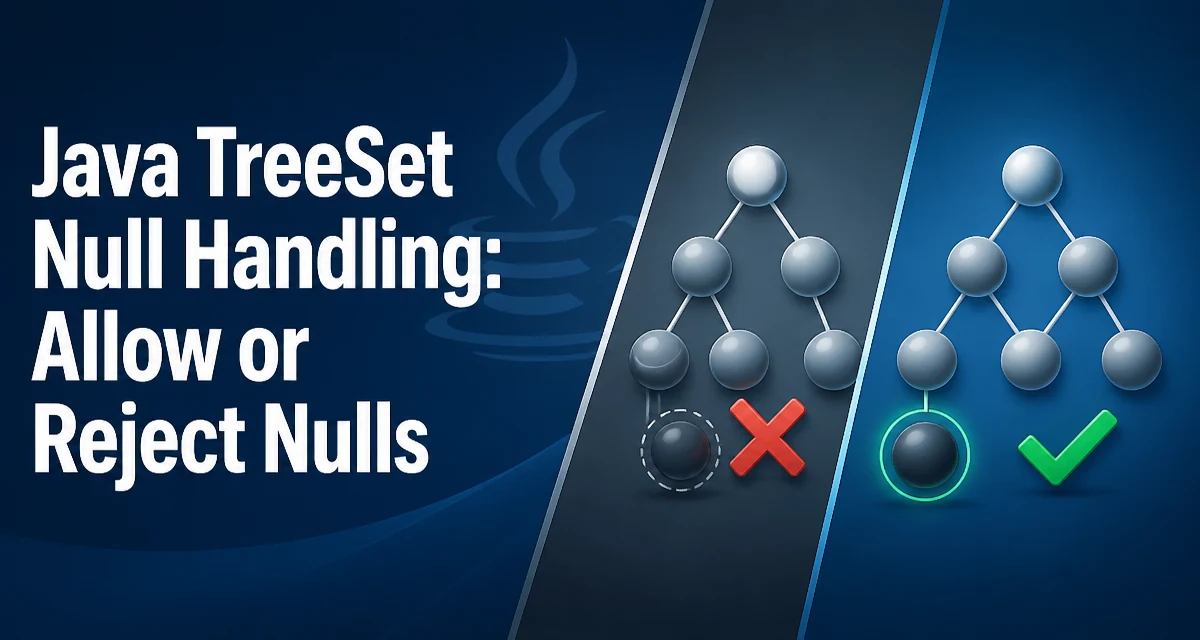
java treeset null handling requires a clear understanding of the core syntax, runtime behavior, and practical implementation patterns demonstrated in the examples below.
Adding null to a TreeSet with its default natural ordering throws a NullPointerException. This is not a bug; it is a direct consequence of how TreeSet maintains sorted order. The set relies on the compareTo method of its elements (or a provided Comparator) to place each element in a red-black tree. Since null has no natural ordering, the default comparator cannot compare it, so the insertion fails immediately.
Default Behavior: NullPointerException on Insert
The most common encounter with java treeset null handling is the unexpected NullPointerException when calling add(null) on a TreeSet without an explicit comparator. Consider this minimal example:
TreeSet<String> set = new TreeSet<>();
set.add("apple");
set.add(null); // throws NullPointerException
The exception occurs inside TreeMap.put, which TreeSet delegates to. The map attempts to compare the new key with existing keys to find its position. With natural ordering, the comparison invokes ((Comparable) key).compareTo(existingKey). Since null cannot be cast to Comparable without causing a NullPointerException at the call site, the insertion aborts.
Why TreeSet Rejects Null by Default
TreeSet is backed by a TreeMap, which is a red-black tree implementation. The tree's invariants require that every element be comparable to every other element. The default comparator is the natural ordering of the elements, which relies on the Comparable interface. null does not implement Comparable, and there is no sensible natural ordering for it. Therefore, the only way to allow null is to supply a Comparator that explicitly defines how null relates to non-null values.
This behavior is consistent across all Java versions. The TreeSet and TreeMap classes have never permitted null keys or elements without a custom comparator. If you need to store null, you must take control of the ordering logic.
Allowing Nulls with a Custom Comparator
To permit null elements in a TreeSet, provide a Comparator that handles null values. The Comparator interface includes two static factory methods designed for this purpose: nullsFirst and nullsLast. These methods wrap an existing comparator and define a total order that treats null as either less than or greater than every non-null value.
TreeSet<String> set = new TreeSet<>(Comparator.nullsFirst(String::compareTo));
set.add("banana");
set.add(null);
set.add("apple");
System.out.println(set); // [null, apple, banana]
In this example, null is considered smaller than any String, so it appears first in iteration order. The comparator is applied consistently for all operations, including contains, remove, and first/last.
If you prefer null to be treated as the largest element, use nullsLast:
TreeSet<String> set = new TreeSet<>(Comparator.nullsLast(String::compareTo));
set.add("banana");
set.add(null);
set.add("apple");
System.out.println(set); // [apple, banana, null]
Both methods return a comparator that is serializable and safe to use with TreeSet. They also work with any existing comparator, not just natural ordering.
Ordering Nulls with nullsFirst and nullsLast
The choice between nullsFirst and nullsLast affects not only iteration order but also the behavior of boundary operations. For example, first() returns the smallest element according to the comparator. With nullsFirst, first() returns null if the set contains a null. With nullsLast, last() returns null if present.
| Method | nullsFirst | nullsLast |
|---|---|---|
first() | Returns null if present | Returns smallest non-null |
last() | Returns largest non-null | Returns null if present |
add(null) | Allowed, placed at beginning | Allowed, placed at end |
This distinction is important when you rely on first() or last() to obtain a meaningful boundary value. If your application treats null as a sentinel that should not be returned as a real element, you may need to guard against it explicitly.
Operational Considerations When Nulls Are Allowed
Allowing null in a TreeSet introduces a few operational concerns. First, the comparator must be consistent with equals. If the comparator returns 0 for two non-null elements that are not equal, the set will treat them as duplicates and discard one. The nullsFirst and nullsLast wrappers preserve the underlying comparator's consistency, so this is only a risk if you write a custom comparator from scratch.
Second, methods like subSet, headSet, and tailSet require a bound that is also comparable. If you allow null, you must ensure that the bounds are non-null or that your comparator handles null in the bound as well. For example, set.headSet(null) would attempt to compare null with the elements. With nullsFirst, null is smaller than everything, so headSet(null) would return an empty set. This may be surprising.
Third, if you later decide to change the comparator (for instance, to sort by a different attribute), the set's behavior with existing null elements becomes undefined. The comparator is used for all operations, and changing it after elements are added is not supported by the TreeSet API. You would need to recreate the set.
Performance and Runtime Cost of Null Handling
From a performance perspective, allowing null with nullsFirst or nullsLast adds a negligible overhead. The comparator performs a null check on each comparison. In a red-black tree, each insertion or lookup performs O(log n) comparisons, so the extra null check is constant-time per comparison. There is no additional memory allocation or tree restructuring specifically for null.
However, there is a subtle runtime consideration: if your comparator does not handle null consistently (for example, it throws an exception for null in some code paths), you may introduce intermittent failures that are hard to debug. The nullsFirst and nullsLast wrappers eliminate this risk by centralizing null handling.
Another point is that TreeSet does not allow duplicate elements. If you add multiple null values, only one is stored, because the comparator returns 0 when comparing null to null. This is usually the desired behavior for a set, but it means you cannot use TreeSet to count occurrences of null.
When to Avoid Nulls in a TreeSet
While custom comparators make it possible to store null, doing so often indicates a design issue. A TreeSet is meant to maintain a sorted collection of non-null elements. If you find yourself adding null frequently, consider whether a different collection better fits your needs.
- If order is not required, a
HashSetallowsnullwithout any special handling. - If you need order and must store
null, aListwith a null-safe comparator and manual duplicate checks may be simpler. - If
nullrepresents an absence of value, consider using anOptionalor a sentinel object that implementsComparable.
Allowing null also complicates the API for consumers of your code. Every caller must remember that first() might return null, and that contains(null) is a valid query. This increases the cognitive load and the chance of a NullPointerException elsewhere in the codebase. Weigh the convenience of allowing null against the long-term maintainability of the collection.
If you do decide to allow null, document the comparator's behavior clearly and use Comparator.nullsFirst or nullsLast rather than a hand-written comparator. This keeps the null handling explicit and reduces the risk of subtle ordering bugs.