Java Upcasting vs Downcasting: Key Differences
java upcasting vs downcasting: Understand Java upcasting vs downcasting: how they work, when to use them, and how to avoid ClassCastException in your code.
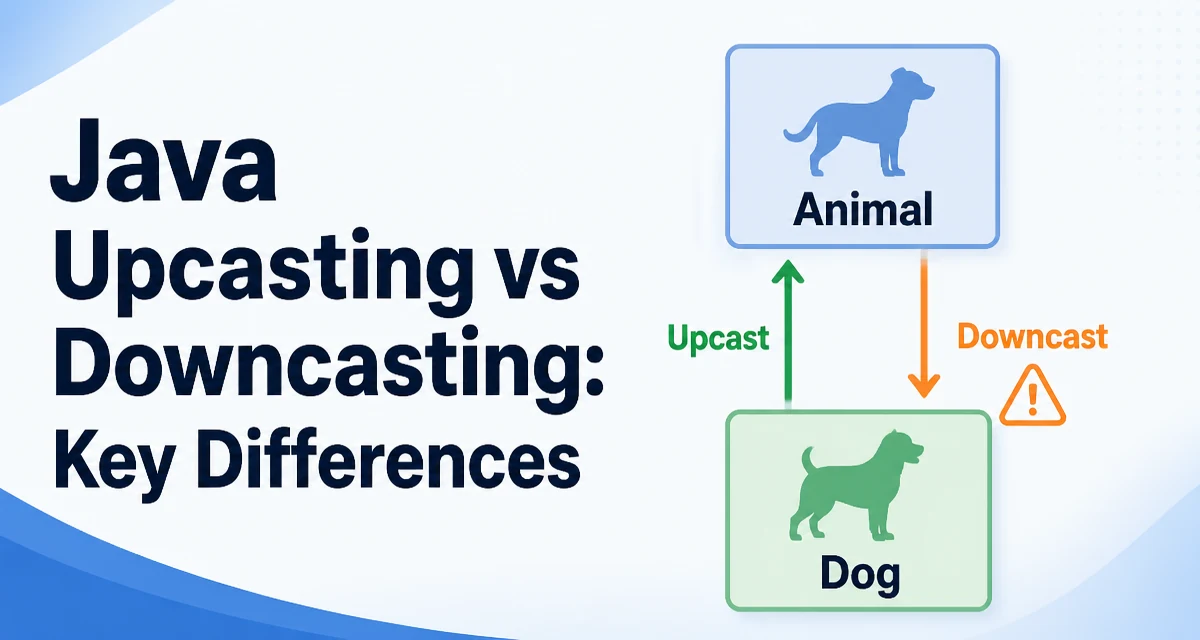
java upcasting vs downcasting requires a clear understanding of the core syntax, runtime behavior, and practical implementation patterns demonstrated in the examples below.
When working with inheritance hierarchies in Java, you will frequently need to move between a supertype and a subtype reference. The two operations, upcasting and downcasting, are often confused because both involve assigning an object to a variable of a different type. The critical distinction is the direction of the cast relative to the inheritance tree and the runtime safety of the operation. Let's clarify the mechanics and the practical consequences of each.
Upcasting: Widening the Reference Type
Upcasting is the process of assigning an object of a subclass to a reference variable of its superclass (or an implemented interface). This is always safe because the subclass object is guaranteed to be an instance of the superclass. The JVM knows that every subclass inherits the members of its superclass, so the reference can be widened without any risk of runtime failure.
class Animal {
    void makeSound() {
        System.out.println("Some sound");
    }
}

class Dog extends Animal {
    void makeSound() {
        System.out.println("Bark");
    }
    void fetch() {
        System.out.println("Fetching...");
    }
}

Animal a = new Dog(); // upcasting
Here, a is of type Animal, but it points to a Dog object. The upcast is implicit; no explicit cast operator is required. The reference a can only access members declared in Animal. Even though the underlying object is a Dog, you cannot call a.fetch() because the compiler only sees the static type Animal. The actual method invoked at runtime is determined by dynamic dispatch, so a.makeSound() will print "Bark".
Upcasting is a core mechanism for polymorphism. It allows you to write code that operates on a general type, such as a method that accepts Animal and works with any subclass. This reduces coupling and enables the substitution principle: a Dog is an Animal, so it can be used wherever an Animal is expected.
Downcasting: Narrowing the Reference Type
Downcasting is the opposite direction: you cast a superclass reference to a subclass type. This is necessary when you have a reference of a supertype but you need to access subclass-specific members. Unlike upcasting, downcasting is not safe at compile time because the actual object might not be an instance of the target subclass. The compiler allows the cast, but the JVM performs a runtime check. If the object is not compatible, it throws a ClassCastException.
Animal a = new Dog();
Dog d = (Dog) a; // downcasting, safe because a actually refers to a Dog
d.fetch(); // now you can call Dog-specific method
In this example, the downcast is safe because a was originally created as a Dog. However, consider this scenario:
Animal a = new Animal();
Dog d = (Dog) a; // throws ClassCastException at runtime
Here, a points to a plain Animal object, which is not a Dog. The cast fails because the runtime type check determines that Animal cannot be cast to Dog. The compiler cannot catch this error because the static type of a is Animal, and the cast to Dog is syntactically valid.
Why Downcasting Is Risky and How to Mitigate It
Downcasting introduces a runtime failure mode that upcasting never has. To avoid ClassCastException, you should always verify the actual object type before performing a downcast. The instanceof operator provides this check:
if (a instanceof Dog) {
    Dog d = (Dog) a;
    d.fetch();
} else {
    // handle the case where a is not a Dog
}
Using instanceof ensures that the cast is safe. Since Java 16, you can use pattern matching for instanceof to combine the check and the cast in one step:
if (a instanceof Dog d) {
    d.fetch();
}
This reduces boilerplate and makes the code more readable. The variable d is only in scope if the check succeeds, so you don't need a separate cast statement.
Runtime Behavior and Performance Considerations
Upcasting is a compile-time operation that has no runtime cost. The JVM does not perform any type check because the assignment is always valid. Downcasting, on the other hand, incurs a runtime type check. The JVM must inspect the actual object's class to verify that it is assignable to the target type. This check is fast, but it is not free. In performance-sensitive code, excessive downcasting can add measurable overhead, especially if it happens inside tight loops. However, the cost is usually negligible compared to the cost of object allocation or I/O. The bigger issue is the risk of exceptions, not the performance.
Another subtlety: downcasting does not change the object itself. It only changes the type of the reference. The object remains the same, and its identity and runtime class are unchanged. This is a common misconception—downcasting does not convert an Animal into a Dog; it merely exposes the Dog-specific members if the object already is a Dog.
When to Use Upcasting and Downcasting in Practice
Upcasting is the default choice when you want to write generic code that works with any subclass. For example, a method that accepts List<Animal> can process a list of Dog, Cat, or any other Animal subclass. This is the foundation of polymorphism and is used extensively in frameworks and libraries.
Downcasting should be used sparingly and only when you have a specific need to access subclass-specific functionality. A common pattern is when you receive an object from a general collection or a method that returns a supertype, and you need to handle it differently based on its concrete type. In such cases, always guard with instanceof to avoid runtime exceptions.
Consider a scenario where you have a List<Animal> and you want to call fetch() on Dog instances:
for (Animal animal : animals) {
    if (animal instanceof Dog dog) {
        dog.fetch();
    }
}
This is safe and idiomatic. Without the check, the code would throw ClassCastException when encountering a non-Dog element.
Common Mistakes and How to Avoid Them
One common mistake is assuming that an upcast reference can be downcast without checking, because you believe the object is of a certain subtype. This assumption is fragile and breaks when the object comes from a different source. For example, a method that returns Animal might actually return a Cat depending on its logic. If you blindly cast to Dog, you'll get an exception.
Another mistake is confusing upcasting with object conversion. Upcasting does not change the object's behavior; it only narrows the interface you can access. Similarly, downcasting does not modify the object; it just widens the accessible interface. The object's runtime type remains the same throughout.
A third mistake is overusing downcasting in code that could be redesigned to use polymorphism. If you find yourself checking the type of an object and then casting it to call a specific method, consider whether that method could be moved to the superclass or defined as an abstract method. This improves maintainability and reduces the need for risky casts.
Comparing Upcasting and Downcasting
The following table summarizes the key differences:
| Aspect | Upcasting | Downcasting |
|---|---|---|
| Direction | Subclass to superclass | Superclass to subclass |
| Compile-time safety | Always safe | Not safe; requires runtime check |
| Runtime exception | Never | Can throw ClassCastException |
| Need for explicit cast | Implicit | Explicit cast required |
| Typical use | Polymorphism, generic code | Accessing subtype-specific members |
| Performance overhead | None | Small runtime type check |
Best Practices for Safe Casting
To keep your code robust, follow these guidelines:
- Prefer upcasting whenever possible. Design your APIs to accept supertypes, not concrete subclasses, to increase flexibility.
- Use downcasting only when you have a concrete need to access subtype-specific behavior that cannot be expressed through the supertype interface.
- Always guard downcasts with
instanceof(or pattern matching) to preventClassCastException. - Avoid long chains of
instanceofchecks; refactor to use polymorphism or design patterns like the Visitor pattern when the logic gets complex. - Document any downcast with a comment explaining why the type is known to be safe, if you are certain, but still keep the check for defensive programming.
Advanced Edge Cases: Casting with Interfaces and Generics
The same principles apply when casting between interfaces and classes. Upcasting to an interface is safe and common. Downcasting from an interface to a concrete class is possible but requires a runtime check. For example:
interface Flyable {
    void fly();
}

class Bird implements Flyable {
    public void fly() { /* ... */ }
    void sing() { /* ... */ }
}

Flyable f = new Bird();
if (f instanceof Bird b) {
    b.sing();
}
With generics, casting becomes trickier because of type erasure. You cannot directly cast List<Animal> to List<Dog> without an unchecked warning. The correct approach is to iterate and cast each element individually, or use wildcard types. For example:
List<? extends Animal> animals = getAnimals();
for (Animal a : animals) {
    if (a instanceof Dog d) {
        d.fetch();
    }
}
This avoids unchecked casts and maintains type safety.
Final Technical Consideration: The getClass() Approach
Sometimes you need to compare exact runtime types rather than using instanceof. The instanceof operator checks whether the object is an instance of the class or any subclass. If you need to ensure that the object is exactly a specific class and not a subclass, you can compare getClass():
if (a.getClass() == Dog.class) {
    Dog d = (Dog) a;
    d.fetch();
}
This is stricter and can be useful in certain equality or serialization scenarios. However, it breaks the Liskov substitution principle because it rejects subclasses of Dog. Use it only when the exact type is required.
Understanding the direction of the cast and the runtime type check is the key to using upcasting and downcasting correctly. Upcasting gives you polymorphism; downcasting gives you access to specific behavior when needed, but it must be handled with care. By following the safe patterns described here, you can avoid the most common pitfalls and keep your Java code reliable.