Java Variable Initialization: Rules and Defaults
java variable initialization: Understand Java variable initialization: default values for fields, mandatory initialization for locals, final variables, and initializat...
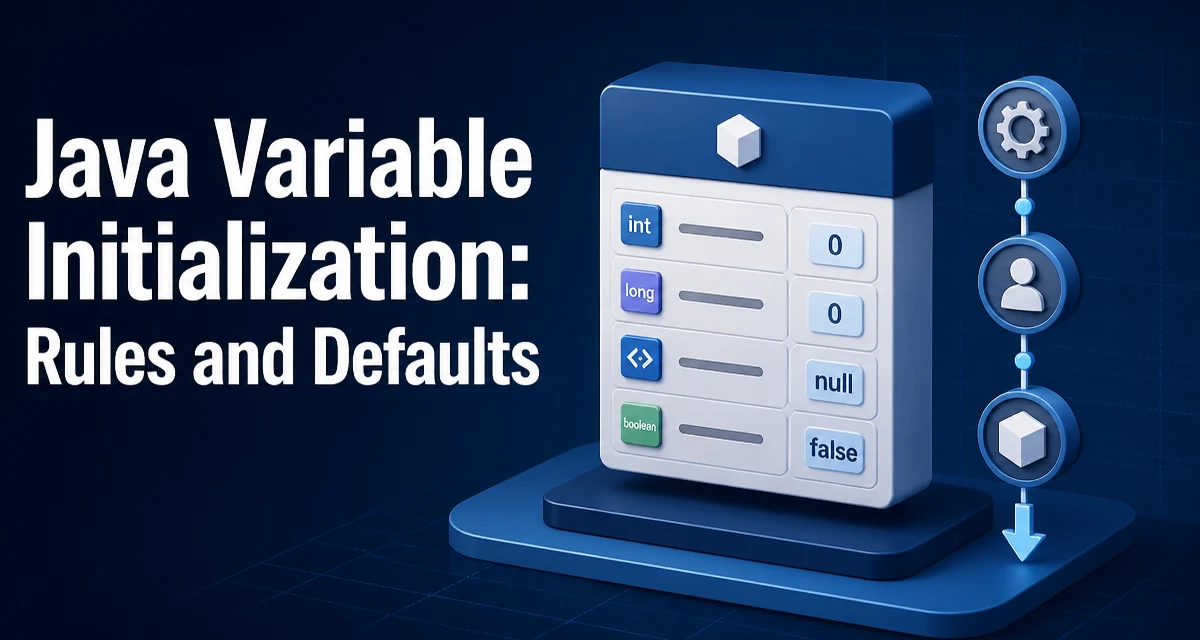
Java variable initialization is one of the first places where subtle bugs appear. The language applies different rules depending on whether a variable is a field, a local variable, or a static member. Misunderstanding these rules leads to null pointer exceptions, compilation errors, or unexpected values in production. This article explains the exact behavior and the reasoning behind it.
Default Initialization for Fields
Instance and static fields in Java receive a default value if you do not initialize them explicitly. The compiler does not require you to assign a value in the declaration or constructor. The defaults are defined by the Java Language Specification and depend on the field's type.
| Field type | Default value |
|---|---|
byte | 0 |
short | 0 |
int | 0 |
long | 0L |
float | 0.0f |
double | 0.0d |
char | '\u0000' |
boolean | false |
| reference | null |
These defaults are applied before any constructor or initialization block runs. For example, the following class compiles and prints 0 and null:
public class Example {
    private int count;
    private String name;

    public void print() {
        System.out.println(count); // 0
        System.out.println(name);  // null
    }
}
Relying on defaults can make code harder to read. If a field has a meaningful default, assign it explicitly. If it does not, consider leaving it uninitialized so the default null or 0 signals that no value was set yet.
Local Variables Must Be Initialized Before Use
Local variables do not get default values. The Java compiler performs definite assignment analysis and rejects code that reads a local variable before it has been assigned. This is a compile-time error, not a runtime one.
public void method() {
    int value;
    System.out.println(value); // compilation error: variable value might not have been initialized
}
You must assign a value before the variable is used. The assignment does not have to be at the declaration, but the compiler must be able to prove that every execution path assigns a value before the read. For example, this code is valid:
public void method(boolean flag) {
    int value;
    if (flag) {
        value = 10;
    } else {
        value = 20;
    }
    System.out.println(value); // OK
}
But this version fails because the else branch does not assign value:
public void method(boolean flag) {
    int value;
    if (flag) {
        value = 10;
    }
    System.out.println(value); // compilation error
}
The rule exists to prevent reading uninitialized memory. Unlike C or C++, Java does not allow undefined behavior from uninitialized locals; the compiler enforces safety.
Explicit Initialization and Constructors
Fields can be initialized at the declaration, in an instance initializer block, or in a constructor. The order matters: declaration initializers and instance initializer blocks run in the order they appear in the source, and all of them run before the constructor body.
public class OrderExample {
    private int a = 1;
    private int b;

    {
        b = a + 1;
    }

    public OrderExample() {
        b = b * 2;
    }
}
In this example, a becomes 1, then the instance initializer sets b to 2, and finally the constructor sets b to 4. If a field is initialized in both a declaration and a constructor, the constructor assignment wins because it runs later.
Using a constructor to initialize fields gives you the flexibility to compute values from parameters. Declaration initializers are convenient for constants or simple defaults. Instance initializer blocks are rare; they are useful when you need to share initialization logic across multiple constructors without introducing a separate method.
Initialization Blocks and Their Order
Java allows instance initializer blocks and static initializer blocks. An instance initializer block runs every time an object is created, after superclass constructors and before the current class's constructor body. A static initializer block runs once when the class is first loaded.
The order of initialization within a class is:
- Static variable declarations and static initializer blocks, in source order.
- Instance variable declarations and instance initializer blocks, in source order.
- Constructor body.
This order is predictable and is specified by the Java Language Specification. Consider the following class:
public class InitOrder {
    static int s1 = 10;
    static { s2 = 20; }
    static int s2;

    int i1 = 1;
    { i2 = 2; }
    int i2;

    public InitOrder() {
        i2 = 3;
    }
}
Here, s2 is assigned 20 in the static block before its declaration, but that is legal because static initialization runs in source order and the assignment is allowed even if the declaration appears later. The instance block sets i2 to 2, then the constructor sets it to 3. Understanding this order helps when you are debugging why a field has a certain value during construction.
final Variables and Blank Finals
A final variable can be assigned only once. For a local variable, the compiler enforces that it is definitely assigned exactly once before use. For a field, the rules are stricter: a final instance field must be assigned by the end of every constructor, and a final static field must be assigned in a static initializer or at declaration.
A final field that is not initialized at the declaration is called a blank final. You must assign it in every constructor, or the compiler reports an error. For example:
public class Config {
    private final String name;

    public Config(String name) {
        this.name = name; // required
    }
}
If you do not assign name in the constructor, the class will not compile. This is a compile-time guarantee that the field is always initialized before the object is used.
Blank finals are useful when the value depends on constructor parameters. They also make the object effectively immutable, which simplifies reasoning about concurrency because the field cannot be reassigned after construction.
Static Variables and Initialization Order
Static variables belong to the class, not to any instance. They are initialized when the class is loaded, before any instance is created. The order of static initialization follows the order of declarations and static initializer blocks in the source file.
A common pitfall is referencing a static variable from a static initializer block that appears before the variable's declaration. The variable will have its default value at that point, not the value you might expect. For example:
public class StaticOrder {
    static { System.out.println(STATIC_VALUE); } // prints 0
    static int STATIC_VALUE = 42;
}
The static block runs before STATIC_VALUE is assigned 42, so it prints 0. To avoid this, declare static variables before any static initializer that depends on them.
Static initialization also interacts with class loading. If a static initializer throws an exception, the class is marked as erroneous, and subsequent attempts to use the class throw ExceptionInInitializerError. This is a production concern because it can happen at any time the class is first referenced, not just at application startup.
Common Pitfalls with Variable Initialization
Several recurring mistakes cause bugs related to variable initialization.
One is using a field before it is initialized in a constructor. If a method called from a constructor reads a field that has not been assigned yet, it sees the default value. For example:
public class BadInit {
    private int value;

    public BadInit() {
        printValue(); // prints 0, not the intended value
        value = 5;
    }

    private void printValue() {
        System.out.println(value);
    }
}
Calling overridable methods from a constructor is even more dangerous because the subclass method may run before the subclass fields are initialized. Avoid this pattern entirely.
Another pitfall is relying on the default value of a local variable that is never assigned. The compiler catches this, but developers sometimes work around it by initializing to null or 0 without thinking about whether that is the correct default. For example, initializing a collection to null and then conditionally assigning it can lead to null pointer exceptions later. Prefer assigning an empty collection if that is the logical default.
Finally, remember that final fields do not protect the object from all mutation. If the field is a reference to a mutable object, the reference cannot be reassigned, but the object's state can still change. Initialization guarantees that the reference is set, not that the object is immutable.
Understanding these rules makes Java variable initialization predictable. The compiler enforces many constraints at compile time, and knowing the runtime order of initialization helps you avoid subtle bugs that only appear under specific construction paths.