Java Widening vs Narrowing Conversion
java widening vs narrowing conversion: Learn the difference between widening and narrowing conversions in Java, including implicit casting, precision loss, and when to...
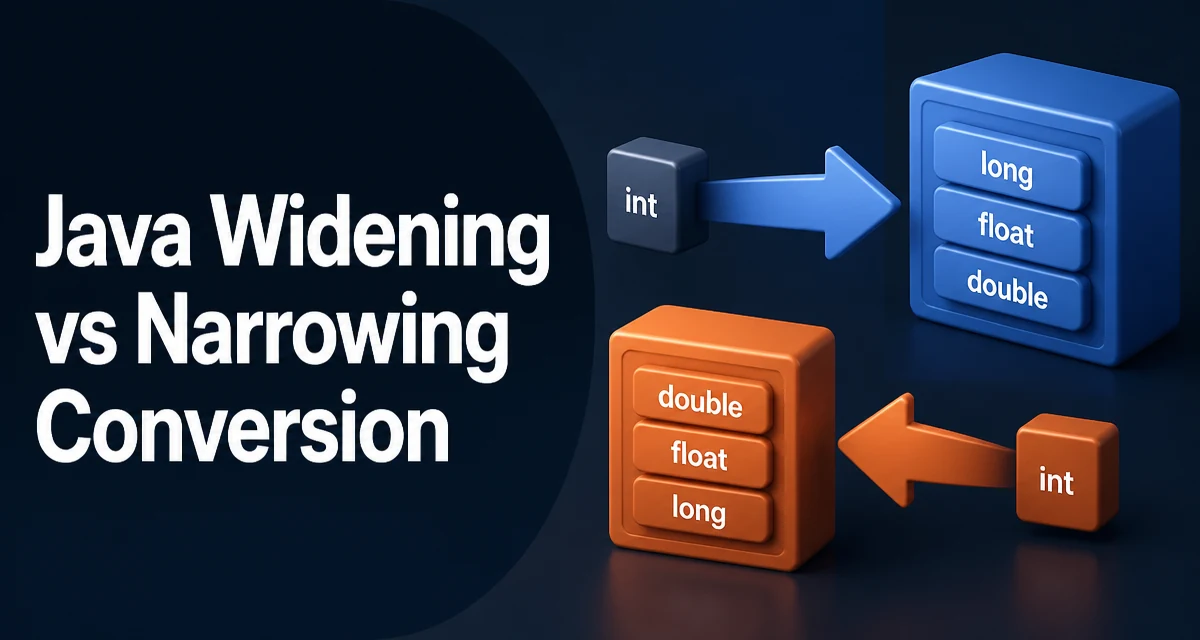
In Java, converting a value from one primitive type to another is a routine operation, but the rules differ depending on whether the conversion widens or narrows the type's range. Understanding java widening vs narrowing conversion is essential for avoiding unexpected precision loss, overflow, or compile-time errors. Widening conversions are safe and happen implicitly, while narrowing conversions require explicit casting and carry risks. This article explains both, shows practical examples, and highlights the pitfalls that commonly trip up developers.
What Are Widening Conversions?
A widening conversion, also called an implicit conversion, occurs when you convert a value from a smaller primitive type to a larger one. The target type has a range that fully contains the source type's range, so no data is lost. Java performs these conversions automatically when assigning a value to a variable of a wider type or when passing arguments in method calls.
The widening order for primitive types is:
byte -> short -> int -> long -> float -> double
Note that char also widens to int and above, and int widens to long, float, and double. The key point is that the conversion is lossless in terms of magnitude, though floating-point types may lose precision for very large integers due to the limited mantissa.
For example:
int intValue = 100;
long longValue = intValue;      // implicit widening
float floatValue = intValue;    // implicit widening
Here, intValue is automatically widened to long and float. No cast is needed because the compiler knows the conversion is safe. Widening also happens in expressions; for instance, adding an int to a double promotes the int to double before the operation.
What Are Narrowing Conversions?
A narrowing conversion moves a value from a larger type to a smaller type. The target type may not be able to represent the original value, so data can be lost. Java does not allow narrowing implicitly because the compiler cannot guarantee correctness. You must use an explicit cast, which tells the compiler you accept the risk.
Common narrowing conversions include:
double doubleValue = 9.99;
int intValue = (int) doubleValue;   // explicit cast, truncates to 9
long longValue = 100L;
byte byteValue = (byte) longValue;  // explicit cast, may overflow
Without the cast, the code will not compile. The cast is a deliberate statement that you understand the value may be truncated or wrapped around. For floating-point to integer conversions, the fractional part is discarded (truncated toward zero). For integer-to-integer narrowing, the high-order bits are discarded, which can produce unexpected values if the source value exceeds the target's range.
Implicit vs Explicit: When Casting Is Required
The decision between implicit and explicit conversion is not arbitrary. Java's type system enforces a clear rule: widening conversions are always allowed implicitly; narrowing conversions always require a cast. This rule applies to assignments, method arguments, and return statements.
Consider a method that accepts a long parameter:
void process(long value) { ... }

int i = 42;
process(i); // implicit widening from int to long
If the method instead accepted an int and you passed a long, you would need a cast:
void process(int value) { ... }

long l = 42L;
process((int) l); // explicit narrowing cast
The compiler's strictness prevents accidental data loss. If you find yourself needing a narrowing cast, ask whether the value truly fits. In many cases, using a wider type is a better design choice than forcing a cast.
Precision and Overflow Risks in Narrowing
Narrowing conversions are not just about syntax; they carry real correctness risks. When converting from a floating-point type to an integer, the fractional part is truncated. This can be surprising if you expect rounding. For example:
double d = 3.99;
int i = (int) d; // i is 3, not 4
For integer-to-integer narrowing, overflow occurs when the value exceeds the target type's maximum or minimum. For instance, converting an int to a byte discards the upper 24 bits:
int big = 300;
byte small = (byte) big; // small becomes 44 because 300 mod 256 = 44
This behavior is defined by the Java Language Specification: the value is reduced modulo 2^N, where N is the number of bits in the target type. It is not an exception; it is a deterministic wrap-around. Developers often misinterpret this as a random or undefined behavior, but it is predictable and can be used intentionally in low-level code (e.g., hashing or compression). However, relying on wrap-around without documenting it is a maintenance hazard.
Practical Examples of Widening and Narrowing
The following table summarizes the key differences:
| Aspect | Widening Conversion | Narrowing Conversion |
|---|---|---|
| Direction | Smaller type to larger type | Larger type to smaller type |
| Syntax | Implicit, no cast required | Explicit cast required |
| Data loss | None (except possible precision loss in float/double) | Possible truncation or overflow |
| Compile-time behavior | Always allowed | Only with explicit cast |
| Typical use | Assigning int to long, int to double | Casting double to int, long to byte |
Here is a more complete example that demonstrates both conversions in a realistic scenario:
public class ConversionDemo {
    public static void main(String[] args) {
        // Widening: int to long
        int items = 5000;
        long totalItems = items;

        // Widening: int to double in arithmetic
        double average = totalItems / 3.0;

        // Narrowing: double to int (truncation)
        int truncatedAverage = (int) average;

        // Narrowing: long to byte (wrap-around)
        long largeValue = 130L;
        byte wrapped = (byte) largeValue;

        System.out.println("totalItems: " + totalItems);
        System.out.println("average: " + average);
        System.out.println("truncatedAverage: " + truncatedAverage);
        System.out.println("wrapped: " + wrapped);
    }
}
This code compiles and runs without errors. The output shows totalItems: 5000, average: 1666.666..., truncatedAverage: 1666, and wrapped: -126 (because 130 - 256 = -126). Understanding these results helps you predict behavior when you must narrow values.
Common Pitfalls and How to Avoid Them
One frequent mistake is assuming that narrowing a floating-point value rounds instead of truncates. If rounding is needed, use Math.round() before casting:
double d = 3.99;
int rounded = (int) Math.round(d); // rounded is 4
Another pitfall is mixing types in compound assignments. For example, short s = 1; s = s + 1; does not compile because s + 1 is an int. You must cast or use s += 1;, which performs an implicit narrowing cast. The compound assignment operator includes a hidden cast, which can surprise developers who think it is a pure widening operation.
When dealing with large integer values, be aware that widening an int to a float can lose precision. A float has only 24 bits of mantissa, so an int larger than about 16 million may not be represented exactly. If you need to preserve integer precision, widen to long or double instead.
Finally, consider using Integer.parseInt or similar methods when converting from strings, as they throw exceptions for out-of-range values, unlike a direct cast that silently wraps. The choice between implicit widening and explicit narrowing should be driven by the data's expected range and the operation's intent. Document any narrowing cast with a comment explaining why the value is known to fit, or why wrap-around is acceptable. This makes the code easier to maintain and reduces the chance of a future change introducing a subtle bug.