Python Array Slicing vs List Comprehension
python array slicing vs list comprehension: Compare Python array slicing and list comprehension to decide which approach fits your use case for extracting, filtering,...
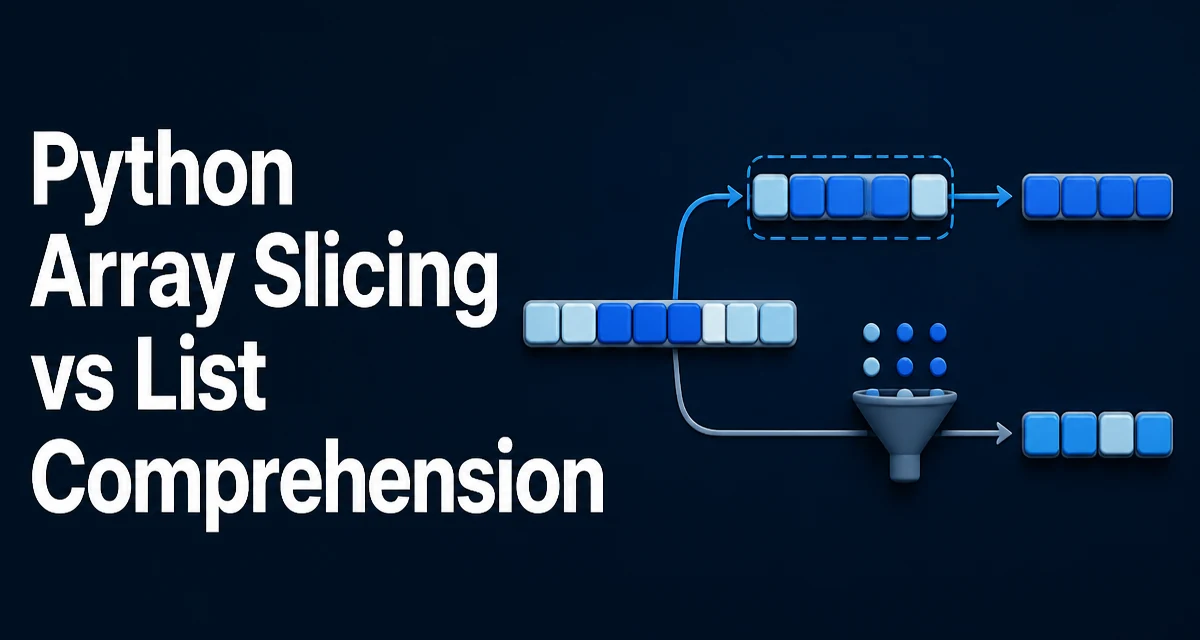
python array slicing vs list comprehension requires a clear understanding of the core syntax, runtime behavior, and practical implementation patterns demonstrated in the examples below.
Python array slicing and list comprehension are both common ways to build a new list from an existing one, but they solve different problems. Slicing selects a subsequence by position, while list comprehension filters or transforms elements by value. Choosing the right tool affects both performance and code clarity.
What Slicing Does
Python's slice syntax list[start:stop:step] returns a new list containing elements from start up to but not including stop, stepping by step. All three parts are optional. list[:] copies the entire list, list[::-1] reverses it, and list[::2] returns every second element. Slicing is a single operation implemented in C, so it is fast for simple positional extraction.
numbers = [0, 1, 2, 3, 4, 5, 6, 7, 8, 9]
print(numbers[2:6])   # [2, 3, 4, 5]
print(numbers[::2])   # [0, 2, 4, 6, 8]
print(numbers[::-1])  # [9, 8, 7, 6, 5, 4, 3, 2, 1, 0]
The slice creates a new list containing references to the same elements. Modifying the slice does not affect the original list.
What List Comprehensions Do
A list comprehension builds a new list by applying an expression to each item in an iterable, optionally filtering with an if clause. The syntax is [expression for item in iterable if condition]. This is the idiomatic way to transform or filter a list in Python.
numbers = [0, 1, 2, 3, 4, 5, 6, 7, 8, 9]
squares = [x * x for x in numbers]
evens = [x for x in numbers if x % 2 == 0]
The comprehension runs a Python loop, so it is more flexible than slicing but has more overhead for simple extraction.
Where the Two Approaches Overlap
Some tasks can be expressed with either tool. For example, selecting every second element can be done with a slice or with a comprehension that checks the index.
numbers = [0, 1, 2, 3, 4, 5, 6, 7, 8, 9]
every_second_slice = numbers[::2]
every_second_comp = [x for i, x in enumerate(numbers) if i % 2 == 0]
Both produce [0, 2, 4, 6, 8]. The slice is shorter and faster because it avoids the Python loop. But the comprehension version can also check the value, something slicing cannot do directly. When you need both index and value conditions, comprehension is the only option.
Key Differences: Position vs Value
The fundamental difference is that slicing selects by position, while list comprehension selects by value. Slicing cannot ask 'give me all numbers greater than 5'. Comprehension cannot ask 'give me elements from index 2 to 5' without also using slicing or enumerate. In practice, you choose based on what you know about the data: if you know the positions, use slicing; if you need to evaluate each element, use comprehension.
Performance and Memory Behavior
Slicing is implemented in C and performs a single copy of references. For a simple contiguous subsequence, it is the fastest way to get a new list. A list comprehension runs a Python-level loop, so for the same output it is slower. However, when you need to filter or transform, comprehension is the only direct approach, and its overhead is usually acceptable.
Both operations allocate a new list. Slicing copies references, not the elements themselves, so the memory cost is proportional to the number of references in the slice. A comprehension also allocates a new list and evaluates the expression for each item. If you only need to iterate over a slice without storing it, consider itertools.islice to avoid the copy, but that is a separate optimization.
Readability and Intent
Code clarity often matters more than micro-optimization. A slice like data[3:7] immediately tells the reader that you want a contiguous block of items. A comprehension like [x for x in data if x > 0] tells the reader that you are filtering by value. Using slicing for a value-based filter, or a comprehension for a simple positional range, makes the code harder to understand. Match the tool to the intent.
When to Use Slicing
Use slicing when you need:
- a contiguous subsequence, such as
data[start:end] - a step pattern, like every other element or a reversed list
- a shallow copy of the list, via
data[:] - to remove a slice in place with
del data[start:end]
Slicing is also the natural way to work with fixed-size windows in algorithms that process sequences.
When to Use List Comprehension
Use list comprehension when you need:
- to filter elements by a value-based condition
- to transform each element, such as converting types or applying a function
- to combine multiple conditions or nested loops
- to build a list from another iterable, not just a list
For example, converting a list of strings to integers with error handling can be done in a comprehension, though you may need a helper function for complex logic.
Common Mistakes and Edge Cases
One common mistake is assuming slicing behaves like list comprehension when the underlying data is a NumPy array. In NumPy, slicing returns a view, not a copy, so modifying the slice changes the original array. Python lists always copy, so the behavior differs. If you work with both, keep that distinction in mind.
Another edge case is slicing beyond the list bounds. Python silently truncates the slice, so data[5:100] returns the elements from index 5 to the end, not an error. A comprehension with an index condition would need explicit bounds checking.
Finally, remember that both slicing and list comprehension create a new list. If you modify the original list after creating a slice or comprehension, the new list is unaffected. This is usually what you want, but it can be surprising when you expect a view.