Python Barrier: Coordinating Threads in Python
python barrier: Understand Python's threading.Barrier: how it coordinates threads at a rendezvous point, resets for reuse, raises BrokenBarrierError, and when to prefe...
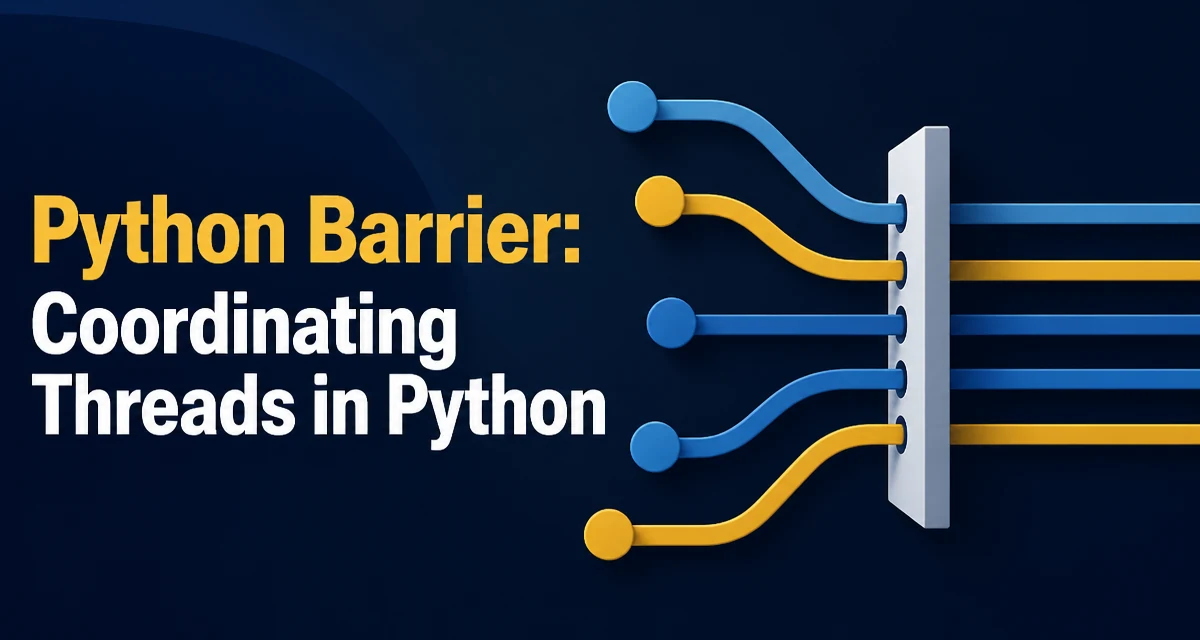
The Python barrier, implemented in the standard library as threading.Barrier, is a synchronization primitive that blocks a fixed number of threads until all of them have arrived at a common point. When the expected number of threads calls wait(), the barrier releases them all at once, and each thread continues with the next stage of its work. This pattern is useful whenever a computation has phases that cannot start until every worker has finished the previous phase.
The barrier is created with a party count:
import threading

barrier = threading.Barrier(4)
The 4 means that exactly four threads must call wait() before any of them is allowed to proceed. A thread that calls wait() blocks until the remaining parties arrive.
What threading.Barrier Does
The barrier enforces a rendezvous point. Each participating thread performs some work, then calls wait() and blocks. The barrier tracks how many threads have arrived. When the count reaches the configured party size, the barrier releases every waiting thread simultaneously.
This is different from a lock or a semaphore. A lock protects a critical section by allowing one thread at a time. A semaphore caps how many threads may enter a section. A barrier, by contrast, requires all participating threads to reach the same line before any of them proceeds. It is a phase-coordination tool, not a mutual-exclusion tool.
A Minimal Barrier Example
The following example shows three workers synchronizing before starting a second phase of work:
import threading
import time

def worker(barrier, name):
    print(f"{name}: phase 1 work")
    time.sleep(0.5)
    barrier.wait()
    print(f"{name}: phase 2 starts")

barrier = threading.Barrier(3)
threads = [
    threading.Thread(target=worker, args=(barrier, f"worker-{i}"))
    for i in range(3)
]

for t in threads:
    t.start()
for t in threads:
    t.join()
Each worker prints its phase 1 message, sleeps briefly to simulate work, then blocks on wait(). The "phase 2 starts" message is not printed by any thread until all three have reached the barrier. This guarantees that no worker begins phase 2 while another is still inside phase 1.
The barrier is the right tool here because the number of cooperating threads is known in advance and the synchronization point is a hard requirement: phase 2 depends on every worker completing phase 1.
How the Barrier Resets and Reuses
A barrier is reusable. After the last party arrives, the barrier resets to its initial state automatically, so the same barrier object can synchronize multiple rounds of a phased computation.
def phased_worker(barrier, name):
    for phase in range(3):
        # perform work for this phase
        barrier.wait()
        print(f"{name}: finished phase {phase}")
The barrier also accepts an optional action callable. When the last party arrives, the barrier invokes action in exactly one thread before releasing the others. This is convenient for preparing shared state or logging the transition between phases:
def on_release():
    print("all parties present, releasing")

barrier = threading.Barrier(3, action=on_release)
The parties attribute reports the configured party count, and n_waiting reports how many threads are currently blocked at the barrier. These are useful for diagnostics but should not be used to make control-flow decisions, since the values change as threads arrive.
Handling BrokenBarrierError
A barrier can enter a broken state. If a thread calls wait() with a timeout and the timeout expires before all parties arrive, that thread receives a BrokenBarrierError. The barrier is then marked broken, and every other thread currently waiting, as well as any thread that calls wait() afterward, also receives BrokenBarrierError.
The same happens if a thread is cancelled while blocked in wait(), for example by a KeyboardInterrupt. A broken barrier cannot be reused; the application must create a new barrier or handle the failure explicitly.
try:
    barrier.wait(timeout=5)
except threading.BrokenBarrierError:
    # one or more parties never arrived; recover or abort
    print("barrier broken, aborting phase")
Without a timeout, a missing party would block the remaining threads forever. Timeouts and broken-state handling are therefore the primary defense against hangs in barrier-based code.
Barrier vs Other Synchronization Primitives
The standard library provides several ways to coordinate threads, and each addresses a different problem.
| Primitive | Purpose | Party count |
|---|---|---|
Barrier | All threads wait until every party arrives | Fixed, known in advance |
Event | One thread signals a condition to any number of waiters | Not required |
Semaphore | Limits how many threads may enter a section | Not required |
Condition | Threads wait for a predicate, with manual notification | Not required |
Use a Barrier when the computation has distinct phases and every participating thread must finish the current phase before any thread starts the next one. An Event is a better fit when a single producer needs to notify an arbitrary number of consumers, and a Semaphore is better when the goal is simply to cap concurrent access to a resource. A Condition offers more flexibility for complex predicates, but it requires the developer to manage notifications manually and is easier to get wrong.
The fixed party count is the key distinction. If the number of participants varies between runs, a barrier cannot express the requirement, and one of the other primitives is more appropriate.
Concurrency and Performance Considerations
A barrier enforces a global synchronization point, which means the release latency is determined by the slowest thread. If one worker takes significantly longer than the others, every other thread waits for it. This is a deliberate correctness tradeoff: the barrier prevents any thread from racing ahead into a phase that depends on results that do not exist yet.
Creating a new barrier for every request or task in a high-throughput server is usually wasteful. Barriers are cheap to construct, but the real cost is the blocking behavior itself. If the synchronization point is not actually required, removing the barrier reduces contention and lets threads proceed independently.
The barrier does not interact with the global interpreter lock in any special way. It coordinates thread scheduling, not CPU parallelism. On CPython, CPU-bound work still benefits from the barrier only in the sense that it orders phases; it does not make threads run in parallel across cores.
When to Use a Barrier in Production Code
Barriers appear in scenarios such as parallel data processing where each chunk must be complete before aggregation begins, multi-stage simulations where each stage consumes the previous stage's output, and test harnesses that need several threads to start a timed section simultaneously.
The main limitation is the fixed party count. If threads are created or destroyed dynamically, or if the number of participants is only known at runtime after some setup step, a barrier cannot express that. In those cases, an Event or a Condition gives the required flexibility.
A practical pattern is to combine a barrier with a try/finally so that a broken barrier does not leave worker threads blocked:
def safe_worker(barrier, name):
    try:
        barrier.wait(timeout=10)
    except threading.BrokenBarrierError:
        return
    # proceed with the next phase
This keeps the timeout and the broken-state recovery in one place, so a single missing party degrades to a logged failure instead of a permanent hang. The barrier remains a narrow, well-defined tool: it solves phase coordination for a fixed set of threads, and it should not be stretched into a general-purpose synchronization mechanism.