Python Comprehension vs Filter: When to Use Each
python comprehension vs filter: Compare Python comprehensions and filter() for readability, performance, and memory. See when each approach fits your code.
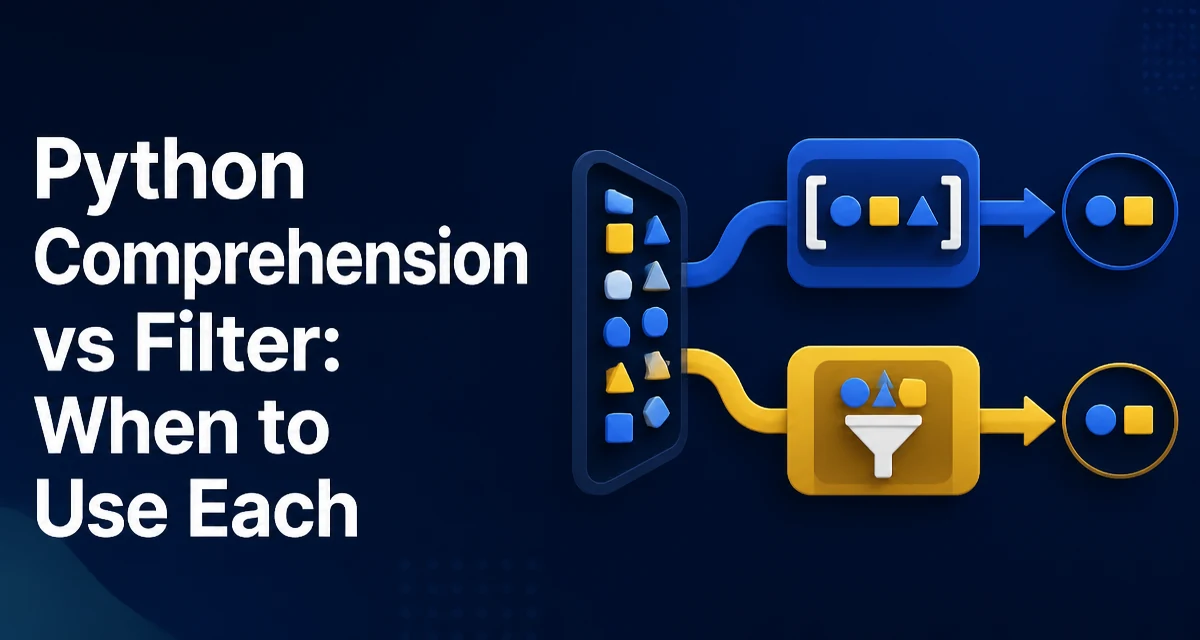
python comprehension vs filter requires a clear understanding of the core syntax, runtime behavior, and practical implementation patterns demonstrated in the examples below.
When you need to select items from an iterable, the choice between a comprehension and filter() often comes down to more than syntax. Both approaches can produce the same result, but they differ in readability, memory behavior, and how they handle transformation. Understanding those differences helps you pick the right tool for each situation.
Consider a simple case: keep only even numbers from a list.
numbers = [1, 2, 3, 4, 5, 6]

evens_comprehension = [n for n in numbers if n % 2 == 0]
evens_filter = list(filter(lambda n: n % 2 == 0, numbers))
Both produce [2, 4, 6]. The comprehension reads more directly for many developers, but filter() has its own strengths. The real question is not which one is universally better; it is which one fits the specific context.
How filter() Works and Its Limitations
filter() is a built-in function that takes a predicate and an iterable, then returns an iterator that yields only the items for which the predicate returns a truthy value. The predicate can be a built-in function, a callable object, or a lambda.
positive = filter(lambda x: x > 0, [-2, -1, 0, 1, 2])
print(list(positive))  # [1, 2]
Because filter() returns an iterator, you must convert it to a list if you need a materialized sequence. That extra step is easy to forget, and it can obscure the intent when you are only interested in the filtered values.
Another limitation is that filter() only selects items; it does not transform them. If you need to apply a function to the items that pass the predicate, you must combine filter() with map() or fall back to a comprehension. This makes filter() less expressive for multi-step pipelines.
What Comprehensions Do Differently
A list comprehension combines filtering and transformation in a single expression. The syntax [expression for item in iterable if condition] lets you apply a function to the selected items without a second call.
squares_of_evens = [n ** 2 for n in numbers if n % 2 == 0]
This is more compact than the equivalent filter() plus map() version:
squares_of_evens = list(map(lambda n: n ** 2, filter(lambda n: n % 2 == 0, numbers)))
Comprehensions also have a natural place in generator expressions. By swapping the brackets for parentheses, you get a lazy iterator that computes values on demand, which can be important for large data sets.
even_gen = (n for n in numbers if n % 2 == 0)
This generator expression behaves similarly to filter() in that it produces values one at a time, but it also allows transformation in the same expression.
Readability and Intent: When filter() Is Clearer
Although comprehensions are often more readable, filter() can be the better choice when the predicate is already a named function. For example, filtering out None values or empty strings benefits from using a built-in like bool or a custom predicate that already exists.
clean = list(filter(None, [0, 1, '', 'a', None, [], [1]]))
Here filter(None, ...) removes all falsy values. The comprehension version [x for x in data if x] is equally short, but filter(None, ...) signals the intent more explicitly when the reader knows the convention.
Similarly, if you already have a function like is_valid defined elsewhere, using filter(is_valid, items) reads better than repeating the condition inside a comprehension. This keeps the logic in one place and avoids duplicating the predicate across multiple call sites.
Performance and Memory: Generator Expressions vs filter()
Both filter() and generator expressions are lazy, so neither builds an intermediate list when you iterate over them. The memory behavior is similar: each item is produced and consumed one at a time. However, a list comprehension materializes the entire result immediately, which can be a problem for very large inputs.
In terms of speed, the difference is rarely significant for typical data sizes. filter() with a lambda can be slightly slower than a comprehension because the lambda adds an extra function call per item. A comprehension's condition is evaluated inline, avoiding that call overhead. But if the predicate is a built-in function implemented in C, filter() can be faster than a comprehension with a Python-level condition.
For example, filtering a list of strings by whether they are digits:
strings = ['123', 'abc', '456', 'def']

digits_filter = list(filter(str.isdigit, strings))
digits_comp = [s for s in strings if s.isdigit()]
Here filter(str.isdigit, ...) may outperform the comprehension because str.isdigit is a C method, while the comprehension calls the same method on each string. The overhead difference is usually small, but it can matter in tight loops.
Without benchmark numbers, the practical guidance is: do not optimize prematurely. Choose the approach that expresses the intent clearly. If profiling shows that filtering is a bottleneck, test both forms with your actual data and predicate.
Handling Complex Conditions: Where Comprehensions Win
Comprehensions become clearly superior when the filtering condition involves multiple clauses, local variables, or a transformation that depends on the item. For example, extracting values from a list of dictionaries where a key exists and meets a threshold:
records = [{'id': 1, 'score': 85}, {'id': 2}, {'id': 3, 'score': 92}]

high_scores = [r['id'] for r in records if r.get('score', 0) > 90]
The equivalent with filter() and map() is harder to follow because you must separate the predicate and the transformation:
high_scores = list(map(lambda r: r['id'], filter(lambda r: r.get('score', 0) > 90, records)))
When the logic is more than a simple boolean check, a comprehension keeps the condition and the output expression together. This reduces the cognitive load of jumping between two callbacks.
Another case is when you need to use an else clause in the expression. A comprehension can apply a transformation based on the condition, which filter() cannot do without a separate map() step.
Choosing Based on the Predicate and Data Size
A practical decision rule is to use filter() when you already have a named predicate function and you do not need to transform the items. This is common in data cleaning pipelines where functions like str.strip, operator.itemgetter, or custom validators are reused. It also reads well in a functional style where you compose small functions.
Use a comprehension when you need to transform the items, when the condition is complex, or when you want the result as a list immediately. Comprehensions are also the default choice for most Python developers because they are more idiomatic and often more readable.
For large data sets that you only need to iterate once, a generator expression is a good middle ground. It gives you the lazy evaluation of filter() while retaining the flexibility of a comprehension. If you need a list later, you can convert it at that point.
Compatibility and Style Considerations
Both filter() and comprehensions are supported in all modern Python versions, so compatibility is rarely a concern. However, Python's official style guide, PEP 8, does not mandate one over the other. The community generally favors comprehensions for their readability, but filter() is still common in code that emphasizes functional programming or that reuses existing predicates.
One subtle difference is how each handles a None predicate. filter(None, iterable) removes all falsy values, which is a convenient idiom. A comprehension with if item does the same thing, but the intent may be less obvious to a reader who is not familiar with the idiom.
Another consideration is debugging. A comprehension is a single expression, so you cannot easily insert a print() statement inside it without converting it to a loop. With filter(), you can wrap the predicate in a function that logs each call, which can be useful during development. This is a minor point, but it can affect maintainability in complex filtering logic.
Ultimately, the choice between python comprehension vs filter should be driven by what the code is trying to say. If you are selecting items without transformation and you have a named predicate, filter() is clean and direct. If you are transforming, combining conditions, or building a list, a comprehension is usually the better fit. For lazy iteration over large inputs, a generator expression gives you the best of both worlds without the extra filter() call overhead when the predicate is a lambda.