Python Comprehension vs Generator: Key Differences
python comprehension vs generator: Understand the difference between Python list comprehensions and generator expressions, including memory usage, performance, and whe...
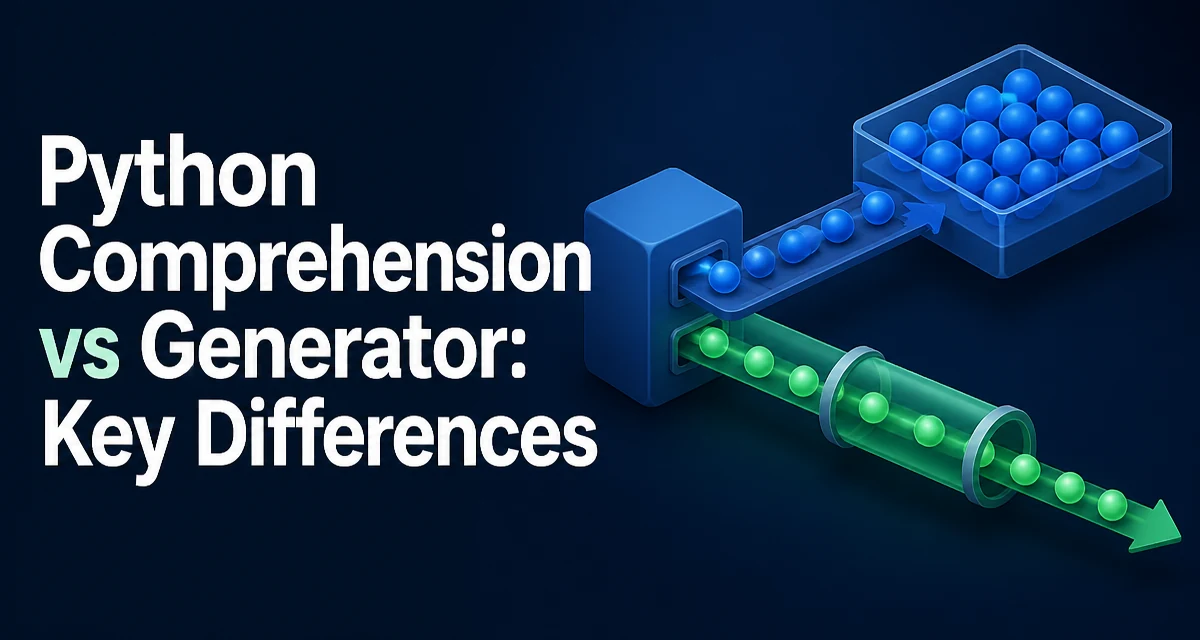
When evaluating python comprehension vs generator, the decision often comes down to whether you need the full collection in memory at once or you want to process elements lazily. Both list comprehensions and generator expressions share similar syntax, but they behave very differently at runtime.
What a List Comprehension Produces
A list comprehension builds a complete list in memory before any element is used. The syntax uses square brackets:
squares = [x * x for x in range(10)]
This statement creates a list object containing all ten squared values immediately. The list is fully materialized, so you can index it, iterate over it multiple times, and pass it to functions that expect a sequence. The cost is that every element occupies memory for as long as the list exists.
For small datasets, this is usually fine. But when the input is large or infinite, materializing a list can exhaust memory or take a noticeable amount of time before the first element is accessible.
What a Generator Expression Produces
A generator expression uses parentheses instead of square brackets:
squares = (x * x for x in range(10))
This does not compute any values yet. Instead, it returns a generator object, which is an iterator that yields one value at a time. The expression inside is evaluated lazily: each element is produced only when requested, typically via next() or a for loop.
A generator is single-use. Once you have iterated through it, it is exhausted. You cannot index it, and you cannot know its length without consuming it. This tradeoff is acceptable when you only need to traverse the data once, especially for large or streaming inputs.
The same syntax can be used to create a generator function with yield, but the expression form is more concise for simple transformations.
Memory Behavior and Large Data
The most significant difference between a list comprehension and a generator expression is memory usage. A list stores all elements at once. A generator stores only the current state and produces elements on demand.
Consider reading lines from a large file and processing them. Using a list comprehension:
lines = [line.strip() for line in open("data.txt")]
This reads the entire file into memory as a list of strings. If the file is gigabytes in size, this can crash the process. A generator expression avoids that:
lines = (line.strip() for line in open("data.txt"))
Now lines is a generator that reads one line at a time. You can iterate over it without loading the whole file. This is a classic example of when a generator is the correct choice.
The same principle applies to infinite sequences. A generator can represent an infinite series because it never needs to store all values. A list comprehension over an infinite range would never terminate.
Performance Characteristics
Performance comparisons between list comprehensions and generators are often misunderstood. A list comprehension is faster when you need all the elements and you will iterate over them multiple times, because the values are already computed and stored. A generator has per-element overhead: each next() call resumes the generator frame, evaluates the expression, and yields the value. For a single pass, the difference is usually small, but for millions of elements, the generator's overhead can become measurable.
However, the larger performance factor is memory. If a list comprehension causes swapping or memory exhaustion, the actual runtime cost is far higher than the small CPU overhead of a generator. The right comparison is not raw speed but the tradeoff between memory and CPU.
Another point is that a generator can be composed with other lazy operations. For example, itertools.islice can take a slice of a generator without materializing the whole sequence. This is impossible with a list unless you already have it in memory.
When to Use Each
Choose a list comprehension when:
- You need random access to elements by index.
- You need to iterate over the same data multiple times.
- The dataset is small enough to fit comfortably in memory.
- You are passing the result to a function that expects a list, such as
sorted()orjson.dumps().
Choose a generator expression when:
- You only need to iterate once.
- The dataset is large or unbounded.
- You want to chain lazy operations to avoid intermediate lists.
- You are building a pipeline where each step consumes the previous generator.
There is also a middle ground: if you need a list but want to avoid building it manually, a list comprehension is still the clearest approach. If you need a tuple, a generator expression passed to tuple() works, but a list comprehension is often more readable.
Common Misconceptions and Edge Cases
A generator expression is not a list. Trying to index it raises a TypeError. Similarly, len() does not work on a generator. These limitations are not bugs; they are consequences of lazy evaluation.
Another misconception is that a generator expression always saves memory. That is true only if you consume it without storing the results. If you collect all yielded values into a list, you have the same memory usage as a list comprehension, plus the overhead of the generator itself.
A subtle edge case occurs when a generator expression references a variable that changes during iteration. For example:
funcs = [lambda: i for i in range(3)]
This is a list comprehension of lambdas, not a generator, but the same closure issue applies. If you write a generator expression that captures a loop variable, the value is looked up when the generator is consumed, not when it is created. This can lead to surprising results if the variable is mutated between creation and consumption.
Practical Examples: Filtering and Mapping
Both syntaxes support the same filtering and mapping clauses. The difference is only in the result type.
# List comprehension
even_squares = [x * x for x in range(20) if x % 2 == 0]

# Generator expression
even_squares_gen = (x * x for x in range(20) if x % 2 == 0)
The list version is immediately usable for indexing or repeated iteration. The generator version is useful when you want to pass it to sum() or max() without building an intermediate list:
total = sum(x * x for x in range(1000))
Here the generator expression avoids creating a list of 1000 numbers just to sum them. Many built-in functions accept iterables, so using a generator expression is often more memory-efficient and equally readable.
Maintainability and Readability
Readability is subjective, but a generator expression can become harder to read when it is long. A list comprehension that fits on one line is often clearer than a multi-line generator expression. For complex logic, a generator function with yield may be more maintainable because it allows multiple statements and local variables.
def process_items(items):
    for item in items:
        if item.is_valid():
            yield item.transform()
This is easier to extend than a dense generator expression. The choice between a comprehension and a generator function depends on the complexity of the transformation. For simple expressions, the comprehension form is idiomatic; for anything with branching or multiple steps, a function is better.
Compatibility and Version Considerations
List comprehensions and generator expressions have been part of Python since version 2.0 and 2.4 respectively. They are fully supported in all modern Python 3 releases. However, there is a subtle difference in Python 3: list comprehensions have their own local scope, so variables assigned inside do not leak. Generator expressions also have their own scope, but they are evaluated lazily, so the scope persists until the generator is exhausted.
If you are writing code that must run on both Python 2 and 3, be aware that list comprehensions in Python 2 leak the loop variable into the enclosing scope. This is rarely a problem today, but it can affect code that relies on the old behavior. In Python 3, the behavior is consistent and safer.
Another consideration is that a generator expression is an iterator, not an iterable in the sense of having a __len__ or __getitem__. Some libraries expect a sequence and will fail if you pass a generator. In such cases, you must explicitly convert it to a list or tuple, which negates the memory benefit. Always check the API contract before passing a generator where a list is expected.