Python deque pop and popleft: syntax and behavior
python deque pop popleft: Learn how deque.pop() and deque.popleft() work in Python, including return values, empty-deque errors, performance tradeoffs, and when to cho...
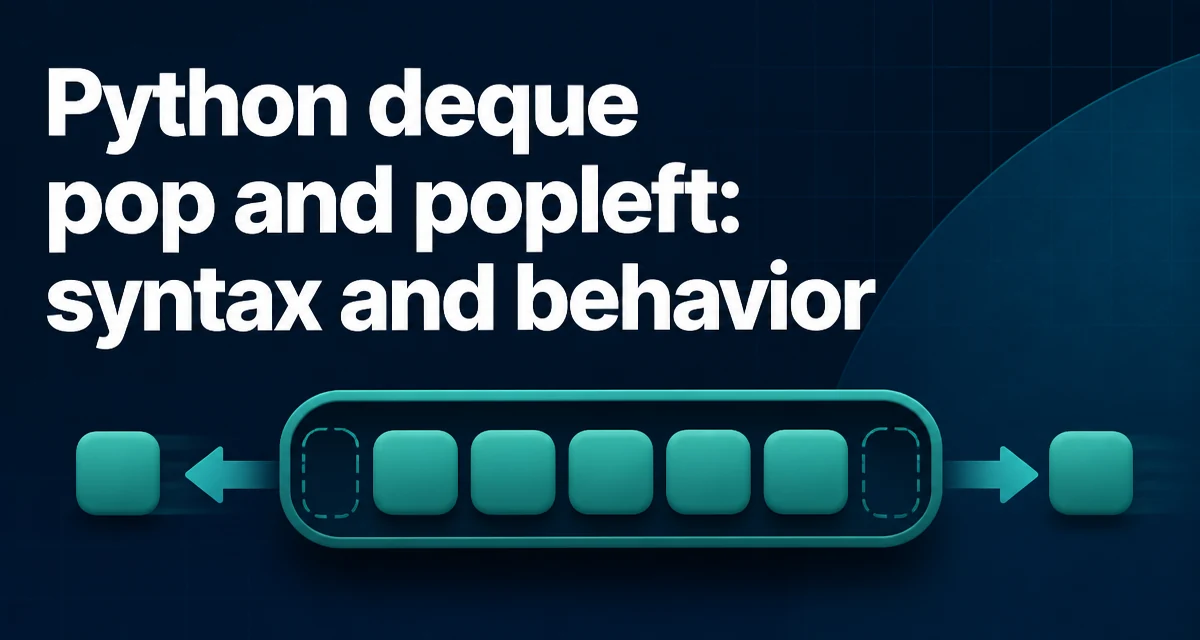
When you work with a Python collections.deque, removing elements from either end is a core operation. The pop() method removes from the right end, and popleft() removes from the left end. Understanding python deque pop popleft behavior matters because these two methods are what make a deque useful as a queue or a stack replacement in performance-sensitive code.
How pop() and popleft() Remove Elements
deque.pop() removes and returns the rightmost element. deque.popleft() removes and returns the leftmost element. Both run in O(1) time because the deque is implemented as a doubly-linked list of fixed-size blocks.
from collections import deque

d = deque([1, 2, 3, 4])
right = d.pop()      # right = 4, d is now deque([1, 2, 3])
left = d.popleft()   # left = 1, d is now deque([2, 3])
The return value is the removed element itself. If you only need to discard the element, the return value can be ignored, but the method still performs the removal.
What Happens When the Deque Is Empty
Both methods raise IndexError when called on an empty deque. This is the same exception type that list.pop() raises, but the message differs slightly.
from collections import deque

empty = deque()
try:
    empty.popleft()
except IndexError as e:
    print(e)  # pop from an empty deque
In a producer-consumer pattern where multiple threads drain the same deque, you cannot assume an element is available just because the deque was non-empty a moment earlier. Guard the call with a check or catch the exception, depending on whether the race is expected.
Why deque Is Faster Than list for Left Removal
A list stores elements in contiguous memory. Removing the first element with list.pop(0) shifts every remaining element one position to the left, an O(n) operation. A deque stores elements in fixed-size blocks linked together, so removing from either end only adjusts pointers and block bookkeeping. That is the core reason to choose deque.popleft() over list.pop(0) when the left end is removed frequently.
For small collections the difference is negligible, but for a queue that processes thousands of items per second, the shift cost of a list becomes visible. The deque avoids that cost entirely.
Practical Usage: Queue and Sliding Window
The most common pattern is a FIFO queue where items are appended on the right and consumed from the left.
from collections import deque

queue = deque()
queue.append("task-1")
queue.append("task-2")
queue.append("task-3")

while queue:
    task = queue.popleft()
    # process task
For a sliding window over a stream, the deque keeps the window bounded by removing from the left when it exceeds the limit.
from collections import deque

def sliding_window(stream, size):
    window = deque(maxlen=size)
    for item in stream:
        window.append(item)
        # popleft() is called internally when maxlen is exceeded
        yield list(window)
Note that with maxlen set, the deque discards the opposite end automatically when a new element is appended at capacity. You do not need to call popleft() manually in that scenario, though calling it explicitly still works when the deque is not at capacity.
Edge Cases and Common Mistakes
A frequent mistake is assuming popleft() exists on a regular list. It does not; list only has pop() and pop(index). Another mistake is using deque.pop() when the intent was to remove from the left, which silently changes the order of processing in a queue.
Another edge case involves maxlen. When the deque is at capacity, appending a new item automatically discards the opposite end. If you maintain a separate count of items in the deque, that count can drift out of sync because items disappear without an explicit popleft() call.
Performance Considerations
Both pop() and popleft() are O(1) amortized. There is no reallocation or shifting of elements. The memory overhead per element is higher than a list because each block stores pointers, but for large collections the difference is usually acceptable when the access pattern is append and remove from the ends.
If you need random access by index in the middle of the collection, a deque is a poor choice. Indexing into a deque is O(n) in the worst case because it must traverse blocks. In that scenario, a list or another structure is more appropriate.
When to Choose deque Over list
Use deque when you append and remove from both ends, when you need a FIFO queue with O(1) left removal, or when you process a stream with a bounded window.
Use list when you need fast random access by index, when the collection is small and the left-removal cost is negligible, or when you need slicing and other list-specific operations.
For a one-off script processing a few hundred items, the difference rarely matters. For a long-running service that drains a queue continuously, deque.popleft() is the correct choice because the cost of removing from the left does not grow with the number of elements.