Python Double Star Unpacking: Syntax and Use Cases
python double star unpacking: Learn how Python double star unpacking works for function calls, definitions, and dictionary merging, with practical examples and pitfalls.
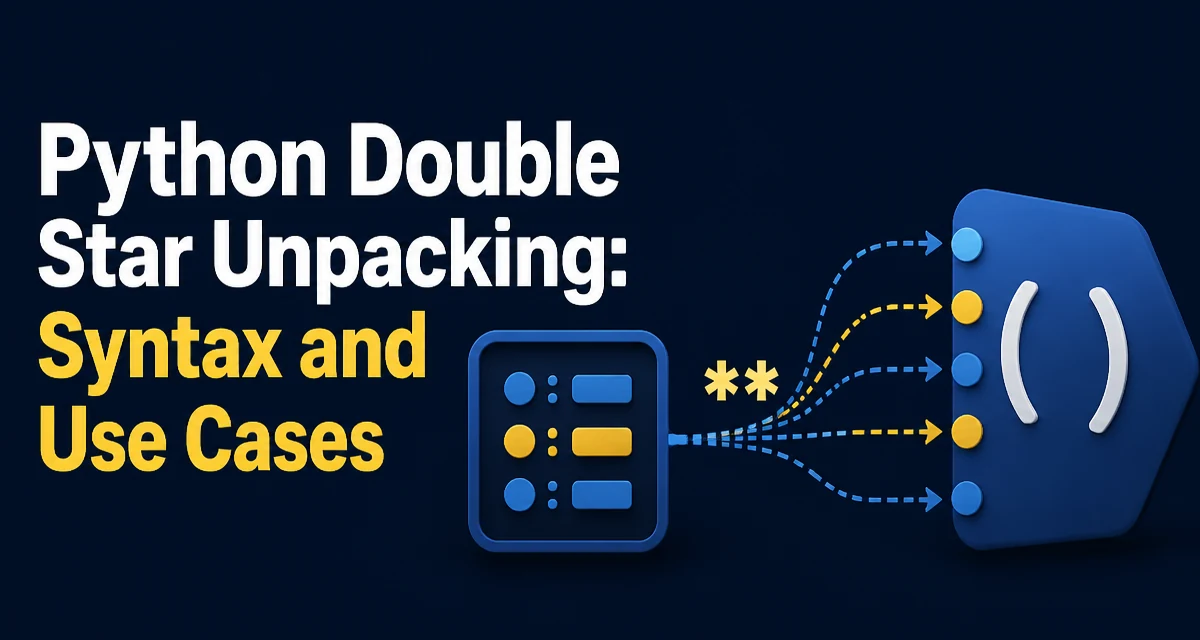
python double star unpacking requires a clear understanding of the core syntax, runtime behavior, and practical implementation patterns demonstrated in the examples below.
What Is Double Star Unpacking?
In Python, the ** operator performs dictionary unpacking. It appears in two primary contexts: in a function call to expand a dictionary into keyword arguments, and in a function definition to collect keyword arguments into a dictionary. Since Python 3.5, it also enables dictionary merging in expressions. Understanding these three uses is essential for writing concise and flexible code.
Consider a function that expects named parameters:
def display(name, age, city):
    print(f"{name}, {age}, {city}")
You can call it with a dictionary using **:
person = {"name": "Alice", "age": 30, "city": "Paris"}
display(**person)
The keys of the dictionary must match the parameter names exactly. If a key is missing or extra, Python raises TypeError. This behavior is the foundation of double star unpacking.
Unpacking Dictionaries in Function Calls
The most common use of ** is to pass a dictionary as keyword arguments. This is useful when you have a configuration dict or when you need to forward arguments from one function to another without listing each one.
def connect(host, port, timeout=30):
    print(f"Connecting to {host}:{port} (timeout={timeout})")

settings = {"host": "localhost", "port": 5432, "timeout": 10}
connect(**settings)
Here, **settings expands the dictionary so that host, port, and timeout receive their corresponding values. The dictionary keys must be strings and must match the parameter names. Non-string keys will cause a TypeError.
This pattern is especially valuable when working with functions that have many optional parameters. Instead of writing a long call with explicit keyword arguments, you can build a dictionary dynamically and unpack it. However, this comes at the cost of losing static visibility: a reader cannot see which arguments are being passed without examining the dictionary.
Collecting Keyword Arguments with **kwargs
In a function definition, **kwargs collects all extra keyword arguments into a dictionary. This is useful for wrappers, decorators, and functions that need to accept arbitrary named parameters.
def log_event(event_type, **kwargs):
    print(f"Event: {event_type}")
    for key, value in kwargs.items():
        print(f"  {key}: {value}")

log_event("login", user="alice", ip="192.168.1.1")
The **kwargs parameter captures user and ip into a dictionary. You can then iterate over it, pass it along, or modify it. This is a standard way to build flexible APIs without hard-coding every possible parameter.
When combined with explicit parameters, **kwargs must appear last in the signature. You can also use **kwargs alongside *args to accept both positional and keyword arguments:
def process(*args, **kwargs):
    print(f"Positional: {args}")
    print(f"Keyword: {kwargs}")
This pattern is common in decorators and framework internals where the exact arguments are unknown in advance.
Merging Dictionaries with **
Python 3.5 introduced the ability to merge dictionaries using ** inside a dictionary literal. This is a concise alternative to dict.update() when you want to create a new dictionary without modifying the originals.
defaults = {"color": "blue", "size": "medium"}
user_prefs = {"color": "red"}
merged = {**defaults, **user_prefs}
print(merged)  # {'color': 'red', 'size': 'medium'}
If the same key appears in multiple dictionaries, the later one wins. This makes ** useful for layering settings: base values first, overrides later.
The syntax also works with any mapping, not just dictionaries. For example, you can unpack a dict subclass or a defaultdict. However, the result is always a plain dict.
a = {"x": 1}
b = {"y": 2}
combined = {**a, **b}
This approach is often more readable than dict(a, **b) and avoids the side effects of mutating an existing dictionary.
Combining * and ** for Mixed Unpacking
You can use both * and ** in the same function call to unpack iterables and dictionaries simultaneously. The * operator unpacks lists, tuples, or any iterable into positional arguments, while ** unpacks dictionaries into keyword arguments.
def make_point(x, y, label=""):
    return f"{label}({x},{y})"

coords = [3, 4]
options = {"label": "A"}
point = make_point(*coords, **options)
Here, *coords supplies x and y, and **options supplies label. The order matters: positional arguments must come before keyword arguments, and the unpacking operators follow that same rule.
This combination is common when forwarding arguments from a wrapper function to a wrapped function. For example, a decorator might receive both positional and keyword arguments and pass them through:
def decorator(func):
    def wrapper(*args, **kwargs):
        return func(*args, **kwargs)
    return wrapper
The *args and **kwargs in the wrapper collect all incoming arguments, and the same operators unpack them into the original function. This preserves the exact call signature without knowing it in advance.
Common Pitfalls and Edge Cases
Double star unpacking is powerful but has several traps that can lead to subtle bugs.
Key order and duplicates: When merging dictionaries, later keys override earlier ones. This is usually what you want, but it can hide unexpected overrides if you are not careful about the order of the operands.
Non-string keys: In a function call, ** requires keys to be strings. If you try to unpack a dictionary with integer keys, Python raises TypeError. In dictionary merging, keys can be any hashable type because you are not binding them to parameter names.
Missing or extra keys: When unpacking into a function, the dictionary must contain exactly the parameters that the function expects. Extra keys cause a TypeError unless the function has a **kwargs parameter. Missing keys also cause a TypeError unless the parameter has a default value.
Mutable defaults: Using **kwargs to capture arguments does not create deep copies. If you pass a mutable object as a keyword argument, the function receives a reference, not a copy. This is consistent with Python's argument passing semantics, but it can lead to accidental mutation if you are not careful.
Performance overhead: Unpacking a dictionary into a function call is a shallow copy operation. For large dictionaries, this can add measurable overhead, especially in hot loops. In most applications the cost is negligible, but if you are calling a function millions of times with a large dictionary, consider passing the dictionary itself and accessing keys inside the function instead.
Maintainability and Readability Considerations
While ** reduces boilerplate, it can also obscure the flow of data. A function call like func(**data) hides which keys are actually used. This makes code harder to trace and refactor, especially when the dictionary is built in another part of the program.
To keep code maintainable, reserve ** for cases where the set of arguments is genuinely dynamic. If the keys are known at development time, writing them explicitly is clearer and allows static analysis tools to catch mistakes. For example, a configuration dictionary passed to a function that expects specific keys is better handled by explicit parameters or by accessing the dictionary inside the function.
In function definitions, **kwargs is essential for extensibility, but it should not be overused. A function that accepts arbitrary keyword arguments is harder to document and test. If you know the possible parameters, list them explicitly and use **kwargs only for truly optional extensions.
When merging dictionaries, ** is often more readable than dict.update() because it creates a new dictionary without mutating the input. However, if you need to merge more than two dictionaries repeatedly, consider whether a loop or a custom function would be clearer.
A practical rule is to use ** when the benefit of conciseness outweighs the loss of explicitness. For one-off scripts and internal helpers, it is usually fine. For public APIs and long-lived code, prefer explicit signatures.
Final Example: Forwarding Configuration with **
To see these concepts together, consider a function that reads configuration from a file and passes it to a service initializer:
def load_config(path):
    # In practice, this might parse JSON or YAML
    return {"host": "localhost", "port": 8080, "verbose": True}

def start_service(host, port, verbose=False):
    print(f"Starting {host}:{port} (verbose={verbose})")

config = load_config("config.json")
start_service(**config)
The ** operator lets you pass the configuration dictionary directly to the function without manually extracting each key. If the configuration file adds a new field that the function does not accept, the call will fail loudly, which is often better than silently ignoring it. This behavior makes ** a safe way to enforce that the configuration matches the expected interface.
When you need to merge configuration layers, ** in dictionary literals provides a clean override mechanism:
base = {"host": "localhost", "port": 80}
overrides = {"port": 443}
final_config = {**base, **overrides}
This pattern is common in applications that load defaults, then apply environment-specific overrides. The order of unpacking directly expresses the precedence, making the code self-documenting.
Double star unpacking is a fundamental Python feature that appears in everything from decorators to configuration handling. Mastering it allows you to write flexible code without sacrificing clarity, provided you understand where its convenience is worth the trade-off.