Python Duck Typing: How It Works and When to Use It
python duck typing: Understand Python duck typing, its runtime behavior, practical examples, and how it compares to type hints for designing flexible APIs.
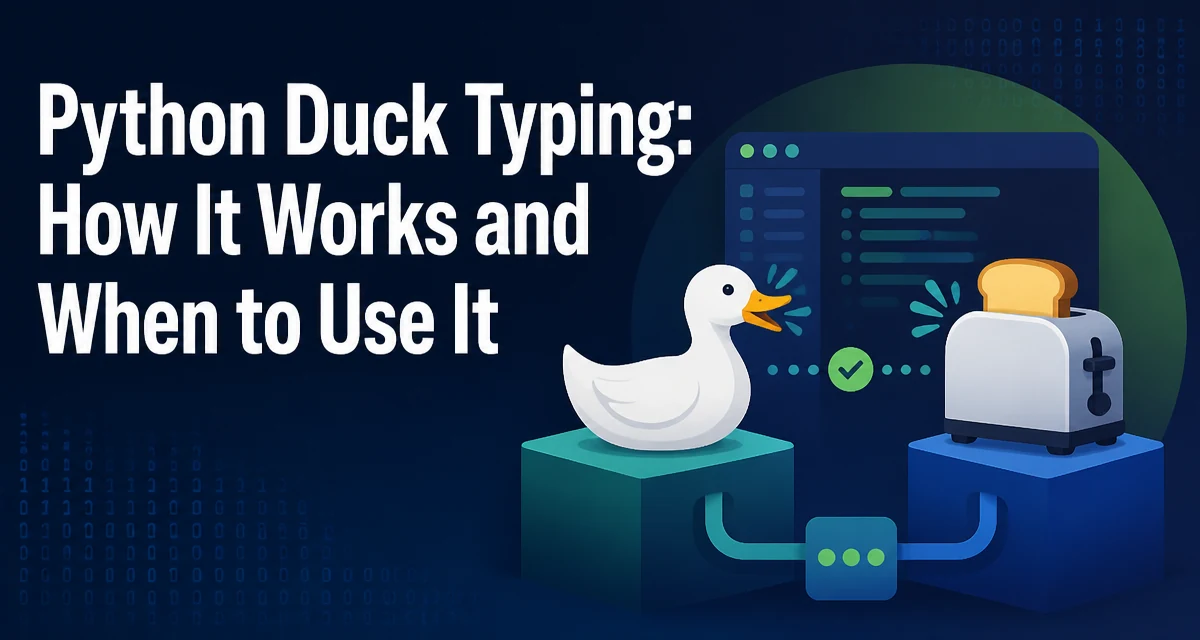
python duck typing requires a clear understanding of the core syntax, runtime behavior, and practical implementation patterns demonstrated in the examples below.
In Python, duck typing is the practice of relying on an object's behavior rather than its declared type. The name comes from the saying: if it walks like a duck and quacks like a duck, then it's a duck. In code, this means that if an object has the methods and attributes you need, you can use it regardless of its actual class. This is a core part of Python's dynamic typing model and directly influences how you design functions, classes, and interfaces.
What Duck Typing Means in Python
Duck typing is not a formal language feature but a programming style that Python's runtime supports naturally. When you call a method on an object, Python does not check the object's type hierarchy. It simply looks up the method by name on the object's class and invokes it if it exists. The object is accepted based on whether it provides the expected behavior, not because it inherits from a specific base class.
This contrasts with static typing languages like Java or C#, where a function parameter must declare a type, and the compiler enforces that only instances of that type or its subclasses are passed. In Python, you can pass any object to a function, and the function will work as long as the object supports the operations the function performs.
A Minimal Example of Duck Typing
Consider a function that processes any object that has a quack method:
def make_it_quack(animal):
    animal.quack()
Now define two unrelated classes:
class Duck:
    def quack(self):
        print("Quack!")

class RobotDuck:
    def quack(self):
        print("Beep boop quack!")
Both can be passed to make_it_quack because both implement quack. The function does not care about the class hierarchy; it only cares that the argument responds to the quack method. This is duck typing in action.
The same principle applies to built-in operations. For example, the len() function works on any object that implements __len__. Lists, strings, dictionaries, and custom classes all work as long as they provide that method. The function does not check for a specific base class; it calls __len__ and expects an integer in return.
How Python Resolves Methods at Runtime
When you call a method on an object, Python performs a lookup in the object's class's __mro__ (method resolution order). This lookup happens at runtime, which is why duck typing is possible. The interpreter does not know or care what type the object is supposed to be; it only cares whether the attribute exists when the call is made.
This runtime resolution has implications for error handling. If an object does not have the expected method, Python raises AttributeError at the point of call. The error message tells you the method name and the object type, but it does not tell you where the method should have been defined. This can make debugging more challenging, especially in large codebases.
Because method resolution is dynamic, you can also add methods to an object after it is created, or use __getattr__ to provide behavior on demand. This flexibility is powerful but requires discipline to keep code maintainable.
Duck Typing vs. Type Hints and Static Checking
Python's type hints (typing module) and static checkers like mypy do not replace duck typing; they complement it. Type hints allow you to annotate function parameters with expected types, but the runtime still uses duck typing. The annotations are for static analysis and documentation, not for runtime enforcement.
For example, you can annotate a parameter as Iterable, which is a protocol type:
from typing import Iterable

def process(items: Iterable[str]) -> None:
    for item in items:
        print(item)
This annotation tells static checkers that items should support iteration, but at runtime, any object with __iter__ or __getitem__ will work. The annotation does not restrict the actual type; it only helps tools catch mistakes before execution.
Protocols in typing (introduced in Python 3.8) formalize duck typing for static analysis. You can define a Protocol class that lists the required methods, and then use it as an annotation. Static checkers will verify that an object has those methods, but the runtime behavior remains unchanged. This gives you the safety of static checking while preserving the flexibility of duck typing.
Common Pitfalls and How to Avoid Them
Duck typing can lead to subtle bugs if you are not careful. The most common pitfall is assuming an object has a method that it does not, which results in AttributeError at runtime. To mitigate this, you can use hasattr to check for the method before calling it, but this adds boilerplate and can hide design issues.
Another pitfall is relying on internal attributes that are not part of a public interface. For example, if you access obj._data directly, you are coupling your code to an implementation detail. If the class changes its internal representation, your code breaks even though the public interface remains the same.
A better approach is to define explicit protocols or use abstract base classes when you need to enforce a contract. The abc module lets you create abstract base classes that require subclasses to implement certain methods. This gives you the benefits of duck typing while making the expected interface explicit.
Consider this example:
from abc import ABC, abstractmethod

class Quacker(ABC):
    @abstractmethod
    def quack(self):
        pass

class Duck(Quacker):
    def quack(self):
        print("Quack!")
Now Duck is explicitly a Quacker, but you can still pass any object with a quack method to functions that expect a Quacker, because Python's runtime does not enforce the abstract base class unless you use isinstance checks. This hybrid approach is common in large codebases.
Designing APIs with Duck Typing in Mind
When you design a function or a class, think about what behaviors you actually need from the inputs. Instead of requiring a specific class, require the minimum set of methods or attributes. This makes your API more flexible and easier to test.
For example, a function that saves data to a file might accept any object that has a write method. This could be a file object, a io.StringIO, or a custom writer. By relying on duck typing, you avoid forcing callers to create a specific type.
def save_data(data, output):
    output.write(data)
This function works with any object that implements write. It is simple, but it places the responsibility on the caller to pass something suitable. If you want to provide clearer error messages, you can add a runtime check:
def save_data(data, output):
    if not hasattr(output, 'write'):
        raise TypeError("output must have a write method")
    output.write(data)
This check is optional and adds a small overhead, but it can make debugging easier. However, overusing such checks can make your code verbose and reduce the flexibility that duck typing provides. Use them only when the failure mode is common and the error message adds value.
Performance and Maintainability Considerations
Duck typing has no inherent performance penalty compared to explicit type checks. Method lookups happen at runtime regardless of whether you use duck typing or explicit type checks. The cost of a method call is the same whether the object is a specific class or a duck-typed object. The only overhead comes from optional checks like hasattr or isinstance, which are negligible in most applications.
The larger impact is on maintainability. Duck typing can make code harder to understand because the expected interface is not explicit. A function that accepts any object with a quack method does not document that requirement in its signature. This forces readers to examine the function body to understand what methods are called.
To mitigate this, use type hints and protocols to document the expected behavior. Even if you do not run a static checker, the annotations serve as documentation for other developers. For example:
from typing import Protocol

class Quacker(Protocol):
    def quack(self) -> None: ...

def make_it_quack(animal: Quacker) -> None:
    animal.quack()
This tells anyone reading the code that animal must have a quack method. It does not enforce anything at runtime, but it makes the contract clear.
In production systems, the main risk is that a change to a class can break a caller that relies on duck typing without any warning. Static type checking with protocols can catch such breaks at development time, but only if you run the checker as part of your build process. For teams that rely heavily on duck typing, adopting a static checker is a practical way to keep the flexibility while reducing regressions.
When you are designing a library or framework, consider whether duck typing is the right abstraction. For small, internal functions, duck typing is often the most Pythonic choice. For public APIs that will be used by many developers, explicit protocols or abstract base classes can provide better documentation and error messages. The decision depends on how much control you need over the interface and how important it is to catch mistakes early.