Python Duck Typing vs Inheritance
python duck typing vs inheritance: Compare duck typing and inheritance in Python with practical examples, tradeoffs, and guidance for choosing the right approach.
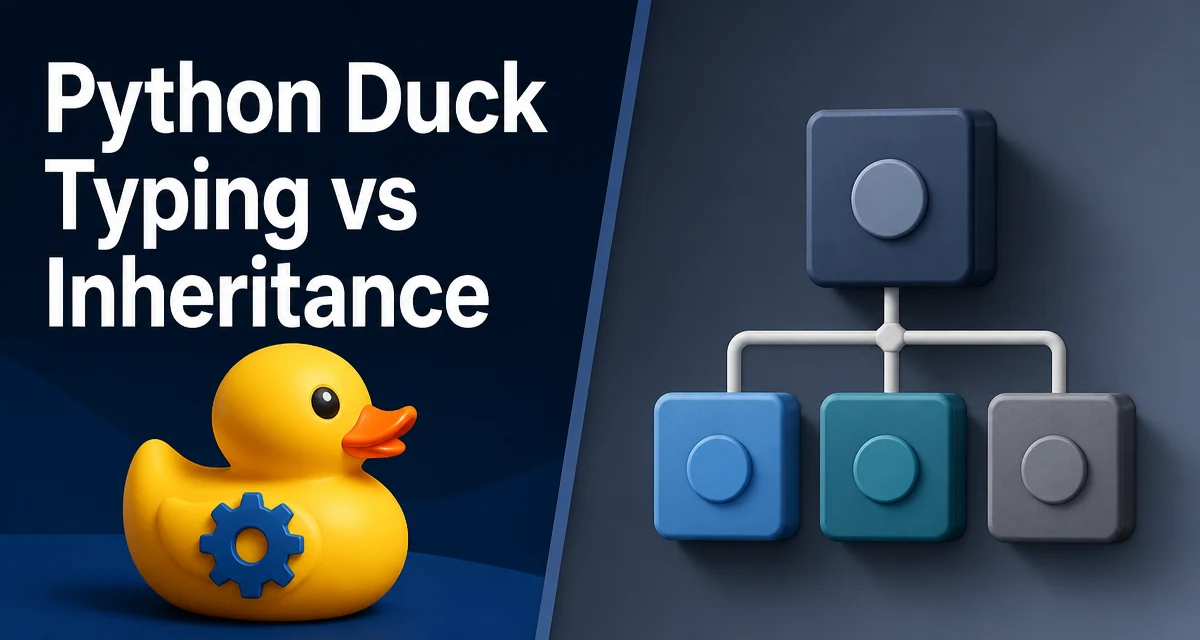
When you define a function that expects an object with a quack() method, Python does not care whether the object is a Duck instance or a class that simply happens to implement quack(). This is the essence of duck typing, and it often competes with inheritance as the default way to share behavior. Understanding the difference between python duck typing vs inheritance is not about choosing one over the other; it's about knowing when each approach reduces friction and when it creates hidden coupling.
What Duck Typing Actually Means in Python
Duck typing relies on the presence of methods and attributes rather than explicit type relationships. Consider a function that processes any object with a speak() method:
class Dog:
    def speak(self):
        return "Woof"

class Cat:
    def speak(self):
        return "Meow"

def make_sound(animal):
    return animal.speak()

print(make_sound(Dog()))  # Woof
print(make_sound(Cat()))  # Meow
make_sound does not check whether animal is an instance of a common base class. It simply calls speak() and relies on the object providing that method. If you pass an object without speak(), Python raises an AttributeError at runtime. This is a flexible contract, but it is implicit.
How Inheritance Changes the Contract
Inheritance makes the contract explicit. You define a base class that declares the method, and subclasses inherit or override it. The same example with inheritance looks like this:
class Animal:
    def speak(self):n        raise NotImplementedError

class Dog(Animal):
    def speak(self):
        return "Woof"

class Cat(Animal):
    def speak(self):
        return "Meow"

def make_sound(animal: Animal):
    return animal.speak()
Now make_sound declares that its argument must be an Animal. This gives you a clear type to reference in documentation and type hints. However, it also forces every object passed to the function to be a subclass of Animal, even if it has a perfectly valid speak() method but does not inherit from that class.
Comparing Behavior at Runtime
At runtime, both approaches perform dynamic method lookup. When you call animal.speak(), Python searches the object's class for the method, following the method resolution order (MRO) if inheritance is involved. Duck typing does not add an extra lookup step; it simply calls the attribute. Inheritance adds the MRO traversal, but the cost is negligible for typical applications.
The real difference appears when you pass an incompatible object. With duck typing, you get an AttributeError only when the method is called. With inheritance, you might catch the problem earlier if you use isinstance() or if the type checker flags it, but Python itself does not enforce the inheritance at runtime unless you explicitly check it.
Type Safety and Static Analysis
Duck typing and inheritance interact differently with static type checkers like mypy. If you annotate a parameter as Animal, only instances of Animal or its subclasses are accepted. This is safe but rigid. Duck typing can be expressed statically using typing.Protocol:
from typing import Protocol

class Speaker(Protocol):
    def speak(self) -> str: ...

def make_sound(animal: Speaker) -> str:
    return animal.speak()
Speaker is a protocol. Any class with a matching speak method is considered a structural subtype, even if it does not inherit from Speaker. This gives you the flexibility of duck typing with the safety of static analysis. In contrast, an abstract base class (ABC) requires explicit inheritance:
from abc import ABC, abstractmethod

class Animal(ABC):
    @abstractmethod
    def speak(self) -> str: ...

class Dog(Animal):
    def speak(self) -> str:
        return "Woof"
ABCs enforce the contract at instantiation time. You cannot create an instance of a class that inherits from Animal without implementing speak. Protocols do not enforce anything at runtime; they are purely for the type checker.
Maintainability and Code Evolution
Duck typing makes code easier to extend without modifying existing classes. You can write a function that accepts any object with the required behavior, and new classes can be added without touching the function or a shared base class. This reduces coupling and encourages small, focused interfaces.
Inheritance, on the other hand, creates a rigid hierarchy. Changing a base class method can affect all subclasses, and adding a new method to the base class forces every subclass to implement it if it is abstract. This can be useful when you want to guarantee a common implementation or share code, but it can also lead to fragile hierarchies and the yo-yo problem where you have to trace behavior through multiple levels.
Consider a function that needs an object with save() and load() methods. With duck typing, you can pass a DatabaseConnection, a FileStorage, or a Cache as long as they have those methods. With inheritance, you would need to create a common base class, which might not be semantically appropriate for all those types.
When to Choose Duck Typing
Use duck typing when:
- You are writing small scripts or prototypes where speed of iteration matters.
- The set of objects that will be passed is not fully known in advance.
- You want to avoid forcing unrelated classes into a shared hierarchy.
- You are working with data from external sources, such as JSON payloads, where the structure is dynamic.
A typical example is a function that serializes an object to a dictionary. Instead of requiring a base class, you can call to_dict() on any object that provides it. This is common in web frameworks and data processing pipelines.
When to Choose Inheritance
Inheritance is the better choice when:
- You need to share concrete implementation across multiple classes.
- You want to enforce a strict contract that all subclasses must follow.
- You are building a framework where users are expected to extend a base class.
- You need to use
isinstance()checks to distinguish between types in business logic.
For example, a plugin system might define an abstract Plugin class with methods like run() and stop(). Users subclass Plugin and override those methods. This gives you a clear extension point and allows the framework to manage plugins uniformly.
Combining Both with Protocols and ABCs
You do not have to choose one exclusively. Python's typing.Protocol lets you define structural interfaces without inheritance, while abc.ABC gives you nominal interfaces with runtime enforcement. You can even use both in the same codebase. For instance, you might define a protocol for a Reader that requires a read() method, and also have an ABC FileReader that implements common file handling logic. Classes that do not inherit from FileReader but have a read() method can still be used where a Reader is expected, thanks to the protocol.
This combination is particularly useful in large codebases where you want the safety of static typing without forcing a rigid hierarchy. It also aligns with the principle of programming to an interface rather than an implementation.
Performance and Overhead
There is no meaningful performance difference between duck typing and inheritance for method calls. Both use Python's attribute lookup mechanism. The only potential overhead is an explicit isinstance() check, which you would add manually if you want to validate types at runtime. That check is O(1) for the MRO, but it is still a runtime cost. Duck typing avoids that cost because it does not perform such checks.
Inheritance can introduce a slightly longer MRO when you have deep hierarchies, but the impact is negligible unless you are calling methods millions of times in a tight loop. In practice, the choice between duck typing and inheritance should be driven by design and maintainability, not by micro-optimizations.
Common Pitfalls and How to Avoid Them
Duck typing can lead to obscure errors when an object lacks the expected method. The error occurs at the call site, which might be far from the object's definition. To mitigate this, use protocols with type hints so that static analysis catches the problem before runtime.
Inheritance can lead to the fragile base class problem. If a base class changes a method's signature, all subclasses may break. This is especially risky in public APIs. To avoid it, keep base classes small and stable, and prefer composition over inheritance when the relationship is not a true "is-a" relationship.
Another pitfall is overusing isinstance() checks, which can make code rigid and defeat the purpose of duck typing. If you find yourself checking the type of an argument frequently, consider whether a protocol or a common interface would be cleaner.
Decision Criteria by Project Context
The table below summarizes the key differences and typical use cases.
| Criterion | Duck Typing | Inheritance |
|---|---|---|
| Contract enforcement | Implicit, at call time | Explicit, at class definition |
| Static type checking | Requires Protocol | Works with normal class types |
| Runtime type checking | None unless added | Possible via isinstance() |
| Code reuse | No shared implementation | Shared implementation via base class |
| Flexibility | High; any object with the right methods | Low; must inherit from base class |
| Best suited for | Dynamic data, small scripts, APIs | Frameworks, plugin systems, strict contracts |
When you are designing a public API, ask whether consumers are likely to have their own classes that already implement the required methods. If yes, a protocol or duck typing avoids forcing them to inherit from your base class. If you need to provide a default implementation or manage shared state, inheritance is more direct.
In a codebase where type safety is a priority, use protocols to get the flexibility of duck typing with static checks. Reserve inheritance for cases where you genuinely need to share code or enforce a nominal type relationship. The two approaches are not mutually exclusive; a well-designed system often uses both, selecting the one that fits each specific boundary.