Python Floor Division: Behavior and Edge Cases
python floor division: Understand how Python's floor division rounds toward negative infinity, its relationship with modulo, and when to use it over true division.
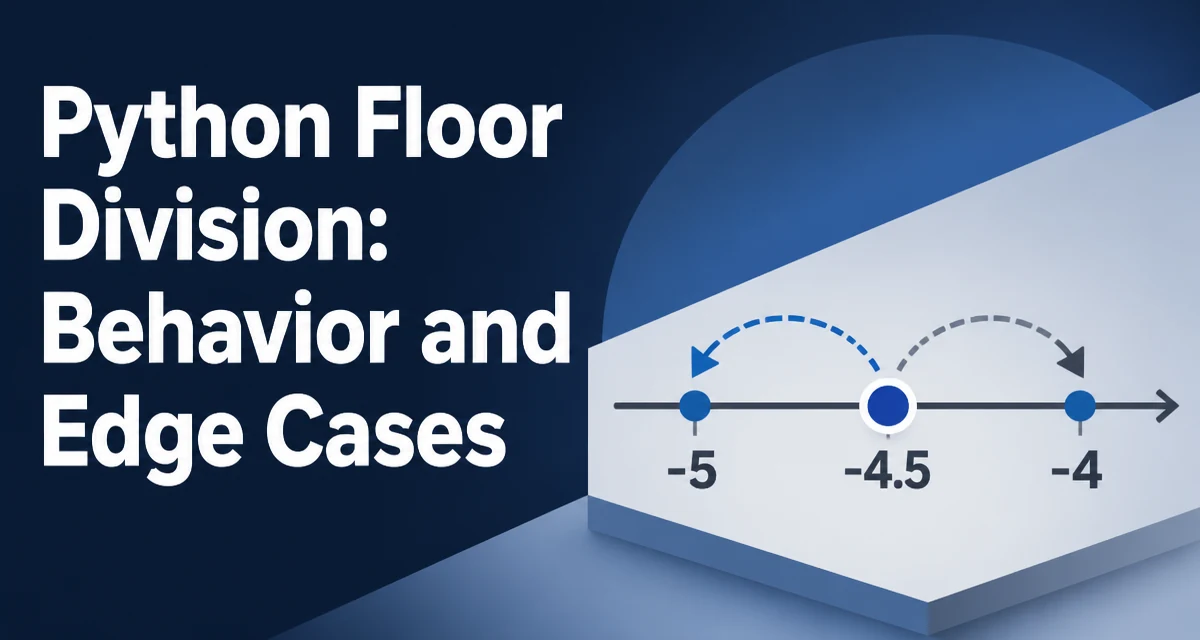
python floor division requires a clear understanding of the core syntax, runtime behavior, and practical implementation patterns demonstrated in the examples below.
Python's floor division operator // is straightforward when both operands are positive: 7 // 2 returns 3, discarding the fractional part. The behavior becomes less obvious when negative numbers are involved, and many developers assume that // simply truncates toward zero. It does not. Floor division rounds toward negative infinity, which means the result is the largest integer less than or equal to the exact quotient. This distinction matters in algorithms that depend on consistent rounding, especially when indices, pagination, or interval calculations are involved.
Floor Division Rounds Toward Negative Infinity
The name "floor" comes from the mathematical floor function, which maps a real number to the greatest integer less than or equal to it. In Python, a // b computes the floor of the exact quotient a / b. For positive operands, this matches truncation. For example, 9 // 2 is 4 because 4.5 floors to 4. But with negative operands, the result differs from truncation. Consider -9 // 2. The exact quotient is -4.5. Truncation would give -4, but floor division gives -5 because -5 is the largest integer less than or equal to -4.5. This is a common source of confusion, and it directly affects code that calculates offsets or partitions data.
The same rule applies when the divisor is negative. 9 // -2 yields -5 because -4.5 floors to -5. Similarly, -9 // -2 gives 4 because the quotient is 4.5, which floors to 4. The sign of the operands does not change the rounding rule; only the mathematical value of the quotient matters.
The Difference Between Floor and Truncation
Many programming languages, such as C, Java, and JavaScript, use truncation for integer division when both operands are integers. In those languages, -9 / 2 evaluates to -4 because the fractional part is simply discarded. Python's // deliberately chooses floor semantics to maintain a useful invariant with the modulo operator. This design decision means that code ported from another language may behave differently when negative numbers are involved. If you need truncation toward zero in Python, you can use int(a / b) for floats, but that introduces float precision issues for large integers. Alternatively, you can define a helper function that uses abs and math.copysign to mimic C-style division, but this is rarely necessary because floor semantics are usually the correct choice for indexing and counting.
Understanding the difference is critical when you are implementing algorithms that assume a particular rounding mode. For example, binary search that calculates the midpoint with (low + high) // 2 works correctly with floor division because the midpoint is always rounded down, which is the intended behavior. If you used truncation, the midpoint would be rounded toward zero, which can cause infinite loops when low is negative. The floor behavior guarantees that the midpoint is never greater than the true midpoint, preserving the loop invariant.
How Floor Division and Modulo Are Related
Python's % operator is defined in terms of floor division. The identity a == (a // b) * b + (a % b) holds for all integers a and nonzero b. This means the remainder always has the same sign as the divisor, not the dividend. For example, -9 % 2 returns 1 because -9 // 2 is -5, and -5 * 2 + 1 equals -9. This is different from languages that define modulo to follow the sign of the dividend. The consistency between // and % is a deliberate design choice that makes it easy to reason about cyclic operations, such as rotating through a list or computing array indices.
The relationship also means that a % b can be derived from a - (a // b) * b. If you ever need to implement a custom division algorithm, you must preserve this invariant to avoid subtle bugs. The sign of the remainder is often the source of off-by-one errors when porting code from a language that uses truncation. For instance, in Java, -9 % 2 is -1, but in Python it is 1. If you are converting an algorithm that relies on the sign of the remainder, you need to adjust the logic accordingly.
Using Floor Division with Floats
Floor division is not limited to integers. In Python 3, // works with floats and returns a float, but the result is still the floor of the division. For example, 7.0 // 2.0 returns 3.0, and -7.0 // 2.0 returns -4.0. The result type is always a float when either operand is a float, even if the value is mathematically an integer. This can lead to subtle type-related bugs if you expect an integer result. For instance, len(items) // 2 returns an integer, but len(items) // 2.0 returns a float. If you later use that value as a list index, Python will raise a TypeError because list indices must be integers. This is a common mistake when mixing numeric types.
Another float-related edge case is division by zero. Both // and / raise ZeroDivisionError when the divisor is zero, regardless of operand type. However, floating-point division by zero in some contexts can produce inf or nan if you use the math functions, but the operator itself always raises an exception. This is consistent and predictable.
Practical Examples of Floor Division
Floor division is useful in many everyday programming tasks. Pagination is a classic example: to determine the page number for a given item index, you use index // page_size. This works correctly for negative indices as well, which is useful when implementing circular buffers or reverse iteration. For instance, (-1) // 10 gives -1, meaning that index -1 belongs to the page before the first page. If you used truncation, you would get 0, which would incorrectly place the item on the first page.
Another common use is splitting a list into chunks. The chunk index for an element is i // chunk_size. This is straightforward for positive indices, but it also works for negative indices if you are iterating from the end. The floor behavior ensures that the chunk boundaries align correctly with the mathematical grouping.
Floor division also appears in algorithms that need to compute the number of full groups. For example, total_items // items_per_group gives the number of complete groups, and total_items % items_per_group gives the remainder. This pair of operations is fundamental to many data-processing pipelines.
Common Mistakes and Compatibility Notes
One common mistake is assuming that // is equivalent to int(a / b) for integers. For positive numbers, they agree, but for negative numbers, int(a / b) truncates toward zero, so the results differ. For example, int(-9 / 2) is -4, while -9 // 2 is -5. This discrepancy can cause subtle bugs if you use int() to perform integer division in a codebase that expects floor semantics. Always use // when you need floor division.
Another compatibility note concerns Python 2. In Python 2, the / operator performed floor division on integers, but in Python 3 it performs true division. If you are maintaining legacy code, you need to be aware that a / b in Python 2 is equivalent to a // b in Python 3 when both are integers. This change is a common source of migration issues. The // operator was introduced in Python 2.2 and works consistently in both versions, so using it explicitly avoids ambiguity.
Finally, be careful when mixing // with very large integers. Python's integers are arbitrary precision, so there is no overflow risk, but the floor operation itself is exact. For floats, the result may lose precision if the operands are extremely large, but that is inherent to floating-point representation, not specific to floor division.
When to Prefer Floor Division Over True Division
Choose floor division when you need an integer result and the rounding direction matters. This includes indexing, counting, and any operation where you want to partition a range into discrete buckets. True division (/) is appropriate when you need the exact quotient as a float, such as in scientific calculations or when you need to preserve the fractional part. Using // on floats is often a mistake because it discards the fractional part, but there are cases where you intentionally want to round down a float to the nearest whole number. In those cases, math.floor() is clearer than // because it explicitly communicates the intent. However, // is more concise and works directly with integers.
The decision also depends on whether you need the modulo result. If you need both the quotient and the remainder, using // and % together is the idiomatic Python approach. If you only need the quotient and the operands are integers, // is the correct choice. If you need to mimic truncation for compatibility with another language, you should write a helper function and document the difference, because Python's built-in operators do not provide truncating division.
In summary, floor division is a fundamental operator that behaves predictably once you understand its rounding rule. It is not a bug or an inconsistency; it is a deliberate design that keeps modulo and division consistent. By using // intentionally and being aware of its behavior with negative numbers and floats, you can avoid a class of subtle errors that often appear in production code.