Python Floor Division Operator Explained
python floor division operator: Understand how Python's floor division operator (//) works, including negative numbers, floats, and practical use cases for accurate ro...
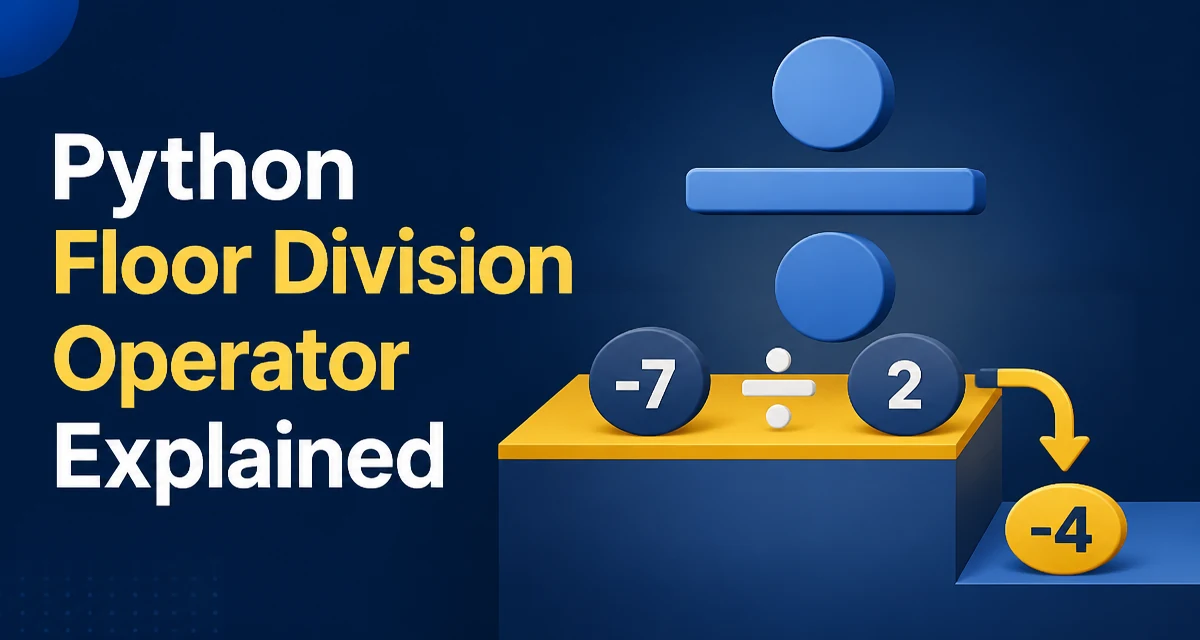
The python floor division operator (//) divides two numbers and rounds the result down to the nearest integer. It is a core arithmetic operator, but its behavior with negative numbers and floats often surprises developers coming from languages that truncate toward zero. This article explains exactly how it works, where it differs from true division, and how to use it correctly in real code.
How the Floor Division Operator Works
Floor division returns the largest integer less than or equal to the exact quotient. For positive operands, this behaves like integer division in many languages:
print(7 // 2)   # 3
print(8 // 2)   # 4
print(9 // 3)   # 3
The operator works on integers and floats. When both operands are integers, the result is an integer. If either operand is a float, the result is a float, but still rounded down to an integer value:
print(7.0 // 2)   # 3.0
print(7 // 2.0)   # 3.0
print(7.5 // 2)   # 3.0
The key point is that the result is always rounded down, not truncated. This distinction becomes critical with negative numbers.
Floor Division with Negative Numbers
The most common source of confusion is how // handles negative operands. Consider:
print(-7 // 2)   # -4
print(7 // -2)   # -4
print(-7 // -2)  # 3
Many developers expect -7 // 2 to return -3 because truncation toward zero would give -3. Instead, floor division rounds down to the nearest lower integer, so -3.5 becomes -4. This is consistent with the mathematical definition of floor: the largest integer less than or equal to the value.
This behavior is not a bug; it is intentional and matches the semantics of math.floor(). For example:
import math
print(math.floor(-7 / 2))   # -4
print(-7 // 2)              # -4
If you need truncation toward zero, use int() on the true division result:
print(int(-7 / 2)) # -3
But note that int() truncates toward zero for floats, which is different from floor for negative numbers.
Difference Between Floor Division and True Division
True division (/) always returns a float, even when the operands are integers. Floor division (//) returns an integer or float depending on the operands, but always rounds down. Here is a side-by-side comparison:
| Expression | True Division (/) | Floor Division (//) |
|---|---|---|
7 / 2 | 3.5 | 3 |
-7 / 2 | -3.5 | -4 |
7 / -2 | -3.5 | -4 |
8 / 2 | 4.0 | 4 |
True division is the standard mathematical division. Floor division is useful when you need an integer result and are certain that rounding down is the desired behavior. For example, when computing indices, counts, or steps where you want to discard the remainder.
Floor Division with Floats and Large Numbers
When either operand is a float, the result is a float, but the value is still the floor of the division. This can lead to floating-point precision issues, especially with very large numbers:
print(10.0 // 3)   # 3.0
print(1e18 // 3)   # 3.333333333333333e+17? Actually, let's check.
In practice, floating-point representation can cause unexpected results. For example:
print(0.1 // 0.01) # 9.0 (not 10.0)
Because 0.1 and 0.01 are not exact binary fractions, the division yields a value slightly less than 10, and floor rounds down to 9. If you need exact decimal arithmetic, use the decimal module or work with integers.
For large integers, // works exactly and efficiently because Python's integers are arbitrary precision:
print(10**30 // 7) # 142857142857142857142857142857
Using Floor Division with math.floor and int()
You might wonder when to use // versus math.floor() or int(). The operator is more concise and avoids an extra function call. However, math.floor() works on any real number and returns an integer, while // returns a float if any operand is a float. Consider:
import math

print(math.floor(7.5))   # 7
print(7.5 // 1)          # 7.0
If you need an integer type, use int() around // when floats are involved:
print(int(7.5 // 1)) # 7
But for most cases, // is the idiomatic choice for integer floor division. math.floor() is more appropriate when you already have a float and want the mathematical floor, not necessarily division.
Common Pitfalls and Practical Considerations
One common mistake is assuming // is the same as int(a / b). As shown, they differ for negative numbers. Another pitfall is mixing // with the modulo operator %. In Python, a // b and a % b satisfy the identity a == (a // b) * b + (a % b), which means the sign of the remainder follows the divisor. This is useful for algorithms that rely on consistent rounding, such as circular indexing.
For example, to get a positive index for negative values:
def wrap_index(i, n):
    return i % n

print(wrap_index(-1, 5))   # 4
Here, % uses floor division semantics, so the result is always in [0, n-1].
Performance-wise, // is implemented at the C level and is as fast as any arithmetic operation. There is no need to micro-optimize; the main concern is correctness with negative numbers and floats.
Floor Division in Real-World Code
Floor division appears in many practical scenarios. Pagination is a classic example: given a list and a page size, you compute the page number for an index:
def page_number(index, page_size):
    return index // page_size

print(page_number(15, 10))   # 1
print(page_number(20, 10))   # 2
Another use is converting seconds to minutes and hours:
total_seconds = 3675
minutes = total_seconds // 60
seconds = total_seconds % 60
print(f"{minutes} minutes and {seconds} seconds")   # 61 minutes and 15 seconds
In algorithms like binary search, // is used to compute midpoints without overflow:
def binary_search(arr, target):
    low, high = 0, len(arr) - 1
    while low <= high:
        mid = (low + high) // 2
        if arr[mid] == target:
            return mid
        elif arr[mid] < target:
            low = mid + 1
        else:
            high = mid - 1
    return -1
These examples show that // is not just a syntax quirk; it is a tool for writing clear, correct code when you need to round down.