Python Function vs Callable Object: Key Differences
python function vs callable object: Understand the difference between Python functions and callable objects, when to use each, and how they affect code design and perf...
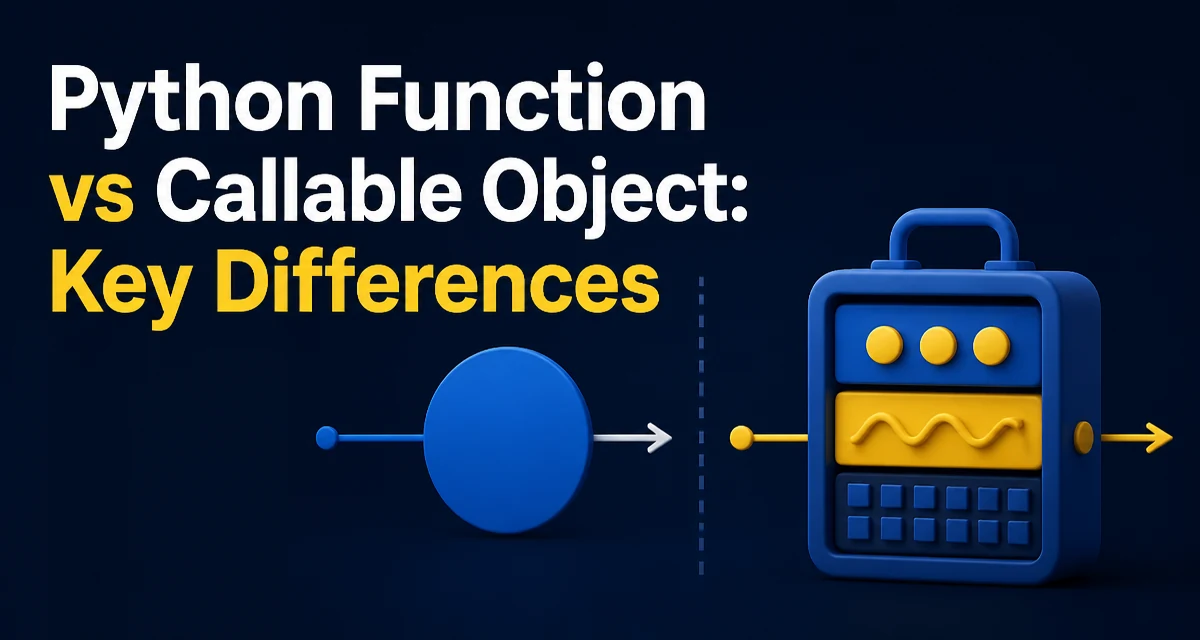
In Python, the phrase python function vs callable object points to a distinction that is both subtle and practically important. Every function is a callable object, but not every callable object is a function. The language defines a callable as anything that can be invoked with the call operator (). This includes functions, classes, and instances of classes that implement __call__. Understanding the difference matters when you need to choose between a plain function and a custom callable object for a particular design.
What Makes an Object Callable in Python
An object is callable if it has a __call__ method in its class. When you write obj(), Python looks up __call__ on the type of obj and invokes it. For functions, this method is defined on the function type itself. For classes, the class object is callable because its metaclass (usually type) defines __call__, which creates a new instance. For instances, you can define __call__ directly on the class.
The built-in callable() function checks whether an object is callable. It returns True for functions, methods, classes, and instances with __call__. This check is cheap and can be used to validate arguments before invoking them.
def greet(name):
    return f"Hello, {name}"

class Greeter:
    def __call__(self, name):
        return f"Hello, {name}"

print(callable(greet))       # True
print(callable(Greeter))     # True
print(callable(Greeter()))   # True
The function greet and the instance Greeter() are both callable, but they behave differently in terms of state and identity.
Functions Are Callable Objects
A function in Python is an object created by a def statement or a lambda expression. It has attributes like __name__, __doc__, and __code__. It can be passed as an argument, stored in a data structure, and returned from another function. This first-class nature makes functions the simplest way to package behavior.
def add(a, b):
    return a + b

operations = {"add": add, "sub": lambda a, b: a - b}
result = operations["add"](3, 4)
Functions are stateless by default. Each call uses only the arguments and any global or closure variables. If you need to carry state between calls, you typically rely on closures, mutable defaults, or global variables. These approaches work but can become awkward when the state is complex or needs to be reset.
Creating Callable Instances with __call__
A class can define __call__ to make its instances callable. This allows the instance to hold state across calls, while still being invoked like a function. The __call__ method receives the same arguments that appear in the call expression.
class Counter:
    def __init__(self, start=0):
        self.count = start

    def __call__(self):
        self.count += 1
        return self.count

counter = Counter()
print(counter())  # 1
print(counter())  # 2
```n
Here, `counter` is an instance of `Counter`, and each call mutates its internal `count` attribute. This is a clean way to encapsulate state that would otherwise require a closure with a mutable container.

Callable instances also allow you to define additional methods and attributes, which can make the object more expressive than a bare function. For example, you can add a `reset()` method to the counter class.

```python
class Counter:
    def __init__(self, start=0):
        self.count = start

    def __call__(self):
        self.count += 1
        return self.count

    def reset(self):
        self.count = 0
This combination of callable behavior and auxiliary methods is one of the main reasons to choose a callable object over a plain function.
Comparing Function and Callable Object Behavior
At the call site, a function and a callable instance are used identically: both are invoked with parentheses and arguments. The difference lies in what happens before and after the call.
| Aspect | Function | Callable Object |
|---|---|---|
| State | Stateless by default | Can hold state in attributes |
| Identity | Same object every time | New instance can be created |
| Additional methods | Not possible without wrapping | Can define extra methods |
| Introspection | __name__, __code__ | Custom attributes |
| Creation cost | Low, defined once | Requires class instantiation |
Functions are lightweight and ideal for stateless operations. Callable objects are heavier but provide a natural home for state and related behavior.
One subtle difference is how they appear in error messages and debugging. A function has a __name__ that appears in tracebacks. A callable instance does not have a __name__ unless you define it. This can make debugging slightly harder for callable objects, but you can mitigate it by setting a __name__ attribute in __init__.
class Adder:
    def __init__(self, n):
        self.n = n
        self.__name__ = f"Adder({n})"

    def __call__(self, x):
        return x + self.n
When to Use a Function vs a Callable Object
The choice depends on whether you need to carry state or additional behavior alongside the callable action.
Use a plain function when:
- The operation is stateless and depends only on its arguments.
- You need a simple, reusable piece of logic that fits in a few lines.
- The function will be passed to higher-order functions like
maporfilter. - You want the least amount of boilerplate and the fastest creation.
Use a callable object when:
- The operation needs to remember information between calls.
- You want to bundle the callable with related helper methods.
- You need to configure the callable with parameters that remain fixed across calls.
- You are building a small state machine or a configurable callback.
For example, a function that multiplies by a fixed factor can be written as a closure:
def multiplier(factor):
    def multiply(x):
        return x * factor
    return multiply
But a callable object can expose the factor as an attribute and allow it to be changed later:
class Multiplier:
    def __init__(self, factor):
        self.factor = factor

    def __call__(self, x):
        return x * self.factor

    def set_factor(self, factor):
        self.factor = factor
The callable object is more explicit when the configuration is part of the object's identity.
Performance and Memory Considerations
Functions are generally faster to create and call than callable instances because they involve less machinery. A function call is a direct lookup of the function object and execution of its code. A callable instance call goes through the instance's __call__ method, which adds an extra attribute lookup and method call. In tight loops, this overhead can be measurable, but it is usually negligible compared to the actual work done inside the callable.
Memory usage also differs. A function object is created once and shared. Each callable instance occupies its own memory, including its state attributes. If you create many instances, the memory footprint grows. For long-lived callbacks that are created once and reused, the difference is minimal. For per-request callbacks in a web server, using a function might be more memory-efficient.
If performance is critical, you can profile the code. The built-in timeit module can compare the two approaches. However, the overhead of a callable instance is typically in the microsecond range, so it rarely becomes the bottleneck.
Common Pitfalls and Compatibility Notes
One common mistake is assuming that a callable instance is the same as a function when it comes to decorators or introspection. Some libraries check for __name__ or __code__ attributes. If your callable object lacks these, it may break tools that expect a function. Adding a __name__ attribute helps, but it does not make the object a function.
Another pitfall is using mutable state in a callable object without considering thread safety. If the same instance is called from multiple threads, the state updates can race. Functions that rely on global state have the same issue, but callable objects make the shared state more explicit. If you need thread safety, use locks or avoid mutable state altogether.
Compatibility with Python versions is generally stable. The __call__ protocol has existed since early Python 2 and remains unchanged in Python 3. The callable() built-in is available in all Python 3 versions. There are no version-specific behaviors to worry about for the basic pattern.
Finally, remember that classes themselves are callable because they create instances. This is why MyClass() works. When you see a callable, it could be a function, a class, or an instance with __call__. The distinction is important when you need to control state or behavior. Choosing between a function and a callable object is a design decision that affects readability, maintainability, and runtime behavior.