Python Generator Expression vs List Comprehension
python generator expression vs list comprehension: Understand the differences between generator expressions and list comprehensions in Python, including memory usage,...
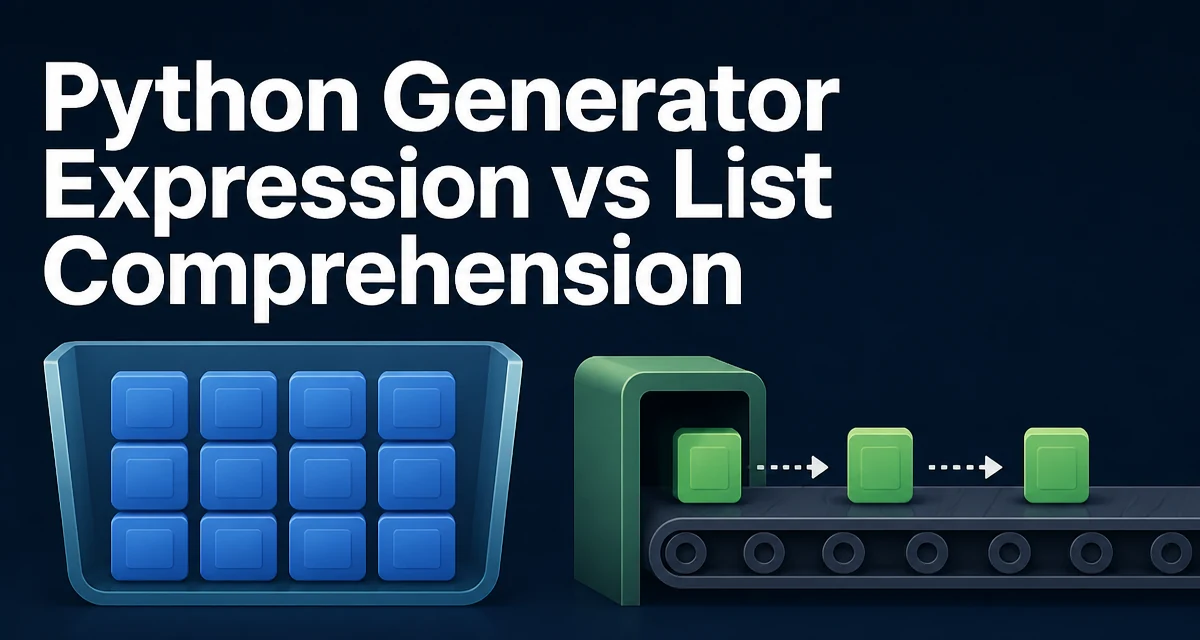
When comparing python generator expression vs list comprehension, the decision often comes down to whether you need all results at once or can process them one at a time. Both syntaxes produce iterable objects, but they differ fundamentally in when values are computed and how memory is used.
The Core Difference: Lazy vs Eager Evaluation
A list comprehension builds the entire list in memory immediately. Every element is computed and stored before the list is returned. A generator expression, on the other hand, returns a generator object that yields one value at a time. The values are produced lazily, meaning they are computed only when requested, and the generator does not store the full sequence.
This distinction matters most when working with large datasets. If you create a list of a million numbers, all million numbers exist in memory at once. If you create a generator for the same sequence, only one number exists at a time, and the previous value is discarded after you move to the next.
Syntax and Basic Examples
The syntax difference is subtle: list comprehensions use square brackets, generator expressions use parentheses. For example:
# List comprehension
squares_list = [x * x for x in range(10)]

# Generator expression
squares_gen = (x * x for x in range(10))
The list comprehension returns a list containing the squares of 0 through 9. The generator expression returns a generator object. To get the values from the generator, you iterate over it:
for value in squares_gen:
    print(value)
You can also convert a generator to a list, but that defeats the purpose of lazy evaluation:
squares_list_from_gen = list(squares_gen)
When a generator expression is the sole argument to a function, the parentheses can be omitted:
sum(x * x for x in range(10))
This is a common pattern for functions like sum(), max(), and min().
Memory Behavior and Large Data
Memory usage is the most significant practical difference. A list comprehension allocates memory for the entire result. For a large input, this can lead to high memory consumption or even MemoryError. A generator expression uses a constant amount of memory because it only holds the current state and the next value.
Consider reading a large file and processing lines:
# List comprehension - loads all lines into memory
lines = [line.strip() for line in open('large_file.txt')]

# Generator expression - processes lines one at a time
lines_gen = (line.strip() for line in open('large_file.txt'))
The list version stores every stripped line. The generator version yields one line at a time, so the file is read incrementally. If you only need to process each line once, the generator is the memory-efficient choice.
However, the generator does not give you random access. You cannot index into it or check its length. If you need to access elements by position or iterate multiple times, a list is necessary.
Performance Considerations
The performance tradeoff is not purely one-sided. List comprehensions are implemented in C and can be faster than an equivalent generator expression when the entire result is needed and memory is not a constraint. This is because a list comprehension builds the list in a tight loop with less per-item overhead. A generator expression has the overhead of a yield and a next() call for each item, which adds a small cost.
On the other hand, if you are iterating over a large sequence and only need one value at a time, the generator avoids the memory allocation cost that a list would incur. The time saved by not allocating a large list can outweigh the per-item generator overhead.
The exact performance depends on the workload, the size of the data, and the operations performed. There is no universal winner. For small datasets, a list comprehension is usually faster. For large datasets where memory pressure is a concern, a generator is often a better choice, even if each iteration is slightly slower.
When to Use Each
The choice should be guided by how the result will be used:
- Use a list comprehension when you need to access elements by index, iterate multiple times, or pass the result to code that expects a sequence (like
len()or slicing). - Use a generator expression when you are processing a stream of data once, when the dataset is large or potentially infinite, or when you want to avoid building a full list for memory reasons.
- If you need to combine multiple generator expressions, you can chain them, but be aware that each generator is single-use.
A common pattern is to use a generator expression as an intermediate step and then consume it with a function that returns a concrete result, such as sum() or max(). This gives you the memory benefit without having to store the entire sequence.
Common Pitfalls and Edge Cases
One important pitfall is that a generator is single-use. Once you iterate over it, it is exhausted. Trying to iterate again yields nothing. For example:
gen = (x for x in range(5))
print(list(gen))  # [0, 1, 2, 3, 4]
print(list(gen))  # []
If you need to iterate multiple times, you must create a new generator each time or convert it to a list.
Another edge case is that a generator expression does not have a length. Calling len() on a generator raises a TypeError. Similarly, you cannot index into a generator. If you need these operations, you must convert it to a list first.
Also, be careful when a generator expression captures variables from an enclosing scope. The values are evaluated lazily, so if the variable changes before the generator is consumed, the generator sees the new value. For example:
x = 1

gen = (x + i for i in range(3))

x = 10

print(list(gen))  # [10, 11, 12]
This can lead to surprising behavior if you are not aware of it.
Compatibility and Maintainability
Both list comprehensions and generator expressions are supported in all modern Python versions (3.x). There is no compatibility concern between them. From a maintainability perspective, the choice can affect readability. List comprehensions are often more familiar to developers and are easier to debug because you can inspect the resulting list. Generator expressions are more compact but can be harder to reason about when the logic is complex.
If the expression is long or has multiple clauses, a generator expression can become less readable. In such cases, using a named generator function or a regular loop may be clearer. For example:
# Complex generator expression
data = ((x, y) for x in range(10) for y in range(x) if x * y % 2 == 0)

# Alternative: generator function
def generate_pairs():
    for x in range(10):
        for y in range(x):
            if x * y % 2 == 0:
                yield (x, y)
The generator function is more verbose but easier to follow, especially if the logic grows.
A Practical Scenario: Processing a Large File
Consider a log file with millions of lines. You need to count the number of lines that contain the word "error". A list comprehension would read the entire file into memory, which is wasteful. A generator expression processes lines lazily:
with open('app.log') as f:
    error_count = sum(1 for line in f if 'error' in line)
The generator expression yields 1 for each matching line, and sum() adds them up. The file is read line by line, and memory usage stays low. This is a typical use case where the generator expression is clearly the right choice.
If you needed to store the matching lines for later processing, you would use a list comprehension:
with open('app.log') as f:
    error_lines = [line for line in f if 'error' in line]
This list can then be indexed, passed to other functions, or iterated multiple times.
The decision between python generator expression vs list comprehension is not about which is better overall, but about matching the tool to the data size and usage pattern. For small, finite datasets where you need a list, use a list comprehension. For large or infinite streams where you only need to iterate once, use a generator expression. Understanding the tradeoff helps you write code that is both memory-efficient and performant.