Python Generator vs List Comprehension: How to Choose
python generator vs list comprehension: Understand the differences between Python generators and list comprehensions, including memory usage, laziness, and when to use...
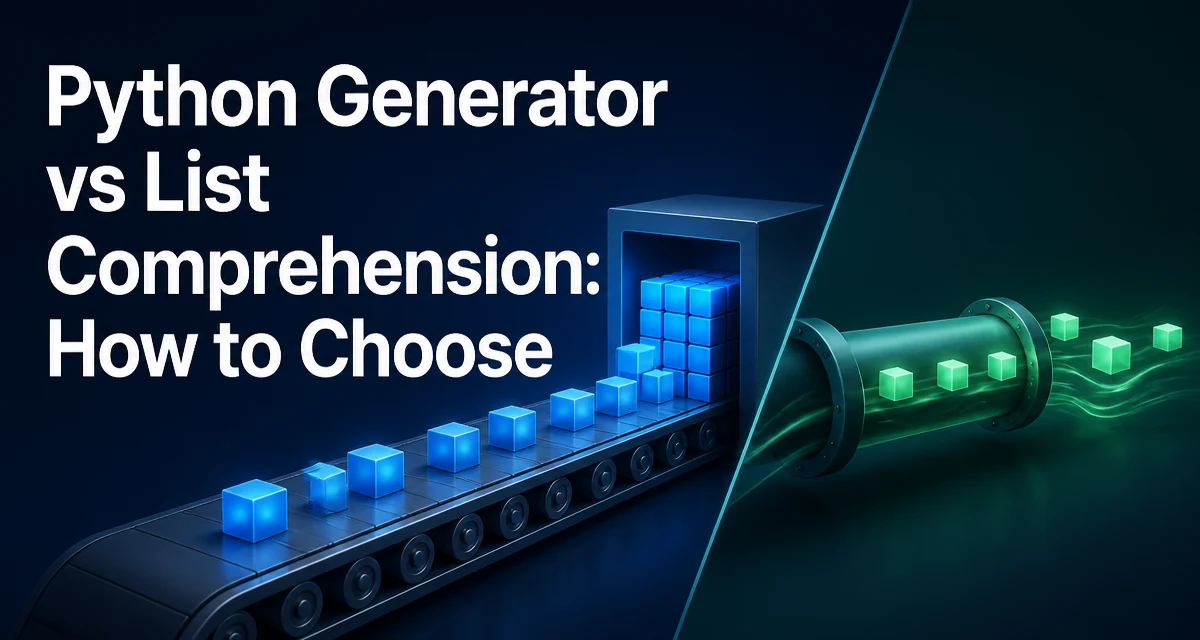
When you need to transform a sequence in Python, you often choose between a list comprehension and a generator expression. Both use similar syntax, but they behave very differently in memory usage and execution. The decision between a python generator vs list comprehension comes down to whether you need all results at once or can process them lazily.
Syntax and Basic Behavior
A list comprehension produces a list immediately:
squares = [x**2 for x in range(10)]
print(squares)  # [0, 1, 4, 9, 16, 25, 36, 49, 64, 81]
A generator expression uses parentheses and returns an iterator:
squares_gen = (x**2 for x in range(10))
print(squares_gen)  # <generator object <genexpr> at 0x...>
You can iterate over it with a for loop or convert it to a list, but the generator itself does not store the values. It computes each value on demand.
Memory Usage and Laziness
The core difference is eagerness versus laziness. A list comprehension builds the entire list in memory before you can use it. For a large range, that can consume significant memory. A generator expression creates an iterator that yields one item at a time. Only the current item exists in memory at any moment.
Consider processing a file with millions of lines:
lines = [line.strip() for line in open('large.log')] # reads all lines into memory
vs
lines = (line.strip() for line in open('large.log')) # lazy, one line at a time
The generator version allows you to start processing the first line before the file is fully read, and it never holds more than one line in memory.
Performance Characteristics
Performance is not simply "generators are faster." It depends on what you measure. List comprehensions are often faster for small to moderate datasets because they avoid the overhead of a generator's __next__ call and the iterator protocol. However, the memory footprint of a list can become a bottleneck for large data, causing swapping or even MemoryError.
Generators can be slower per iteration due to the overhead of yielding, but they allow you to work with data sets that would not fit in memory. For example, summing a range of a billion numbers works with a generator:
total = sum(x for x in range(1_000_000_000))
A list comprehension for the same range would attempt to allocate a list of a billion integers, likely exhausting memory.
The choice also affects the time to first result. With a generator, you get the first item almost immediately; with a list, you must wait for the entire list to be built.
When to Use a List Comprehension
Use a list comprehension when you need:
- Random access to elements by index.
- To iterate over the result multiple times.
- To pass the result to a function that expects a list or sequence.
- To modify the list in place (though comprehensions produce new lists).
- When the data set is small enough that memory is not a concern.
A list comprehension is also useful for debugging, because you can inspect the full result immediately.
When to Use a Generator Expression
Use a generator expression for:
- Large or infinite sequences that cannot fit in memory.
- Single-pass iteration, such as feeding data into a pipeline or aggregator.
- Streaming data from files, network sockets, or database cursors.
- Chaining multiple transformations without intermediate lists.
Generators are also composable. You can pass a generator to sum(), min(), max(), or any() without building an intermediate list.
Common Pitfalls and Misconceptions
A generator is single-use. Once exhausted, you cannot iterate over it again without recreating it. This often surprises developers who expect list-like behavior.
gen = (x for x in range(3))
list(gen)  # [0, 1, 2]
list(gen)  # []
Another misconception is that generator expressions are always more memory efficient. That is true for the values themselves, but if you convert the generator to a list later, you lose the benefit. Also, if you need to sort or reverse the data, you must materialize it into a list anyway.
There is also a small overhead in creating a generator object compared to a list comprehension, but that is negligible for most workloads.
Making the Choice
The decision depends on the size of the data and how you intend to use it. A practical rule: if you only need to iterate once and the data set is large or unbounded, use a generator expression. If you need to access elements repeatedly or require a concrete list, use a list comprehension.
| Consideration | List Comprehension | Generator Expression |
|---|---|---|
| Memory usage | Stores all elements | Stores one at a time |
| Time to first result | After full build | Immediately |
| Random access | Yes | No |
| Multiple passes | Yes | No (single-use) |
| Typical use | Small/medium data | Large/streaming data |
In performance-sensitive code, measure with your actual data. The theoretical differences become real when the list size approaches memory limits. For most everyday tasks, both are readable and idiomatic; the choice is about resource constraints and iteration patterns.