Python if elif else: Syntax, Behavior, and Alternatives
python if elif else: Understand Python's if, elif, and else chain: how evaluation works, common mistakes, and when a dictionary mapping is a better choice.
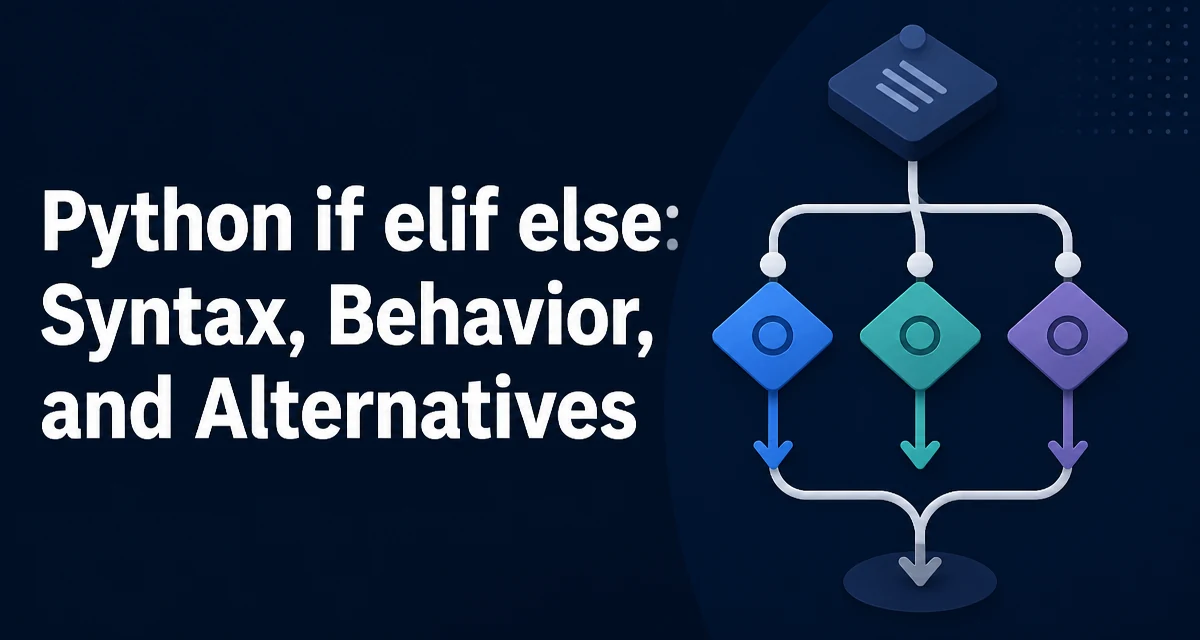
The python if elif else chain is the primary way to express conditional branching in Python. It evaluates conditions in order and executes the first block whose condition is true. Understanding exactly how this evaluation works matters because it affects both correctness and readability of your code.
Basic Syntax of if, elif, and else
The syntax is straightforward:
if condition1:
    # block 1
elif condition2:
    # block 2
else:
    # fallback
elif is short for else if. You can include any number of elif blocks between if and else. The else block is optional and runs only when none of the preceding conditions are true. Each block is indented consistently, typically with four spaces.
How Python Evaluates the Chain
Python evaluates the conditions from top to bottom. The first condition that evaluates to true triggers its block, and the rest of the chain is skipped. If no condition is true, the else block runs if it exists. This short-circuit behavior is important when conditions have side effects. For example, if a condition calls a function that modifies state, that function is not called if an earlier condition already matched.
def expensive_check():
    print("called")
    return True

if False:
    pass
elif expensive_check():
    pass
In this example, expensive_check() is called because the first condition is false. If the first condition were true, the function would not be called at all.
Practical Example: Mapping a Score to a Grade
A common use case is converting a numeric score to a letter grade:
def grade(score):
    if score >= 90:
        return "A"
    elif score >= 80:
        return "B"
    elif score >= 70:
        return "C"
    elif score >= 60:
        return "D"
    else:
        return "F"
The order of conditions is critical. Because each condition is checked in sequence, score >= 90 is evaluated first. If you placed score >= 60 first, every score above 60 would return "D", and the later branches would never run. The elif structure ensures only one branch executes, which is more efficient and clearer than a series of independent if statements.
Common Mistakes with elif Chains
One frequent error is using multiple if statements instead of elif when the branches are mutually exclusive. Consider:
if score >= 90:
    result = "A"
if score >= 80:
    result = "B"
If score is 95, both conditions are true, and result ends up as "B". Using elif prevents this because the second condition is only evaluated if the first is false.
Another mistake is placing else before an elif, which is invalid syntax. The else must always be last. Also, forgetting the else can leave a variable unbound if no condition matches, leading to a NameError later. Ordering conditions from most specific to least specific is a good habit.
When to Use a Dictionary Instead of if elif else
For simple equality checks, a dictionary lookup is often more concise and faster. For example, mapping status strings to HTTP codes:
status_codes = {
    "ok": 200,
    "not_found": 404,
    "server_error": 500,
}
code = status_codes.get(status, 400)
This is O(1) on average, while an if elif else chain is O(n) in the worst case. However, a dictionary only works for exact matches on hashable keys. If you need range comparisons, like score >= 90, or conditions that combine multiple variables, if elif else is the appropriate tool. The choice depends on the nature of the conditions and the expected number of branches.
Performance and Maintainability Considerations
For a small number of conditions, the performance difference between an if elif else chain and a dictionary is negligible. The real cost comes from evaluating each condition. If a condition involves an expensive function call, ordering the chain to check cheap conditions first can reduce work. Long chains can also become hard to read and maintain. When you find yourself repeating similar patterns, consider refactoring into a data structure or a lookup table. For instance, a list of tuples with a predicate and a result can replace a long chain:
rules = [
    (lambda x: x > 100, "high"),
    (lambda x: x > 50, "medium"),
    (lambda x: x > 0, "low"),
]
for predicate, result in rules:
    if predicate(value):
        return result
return "none"
This approach centralizes the logic and makes it easier to add or remove rules, though it may be less readable for simple cases.
Handling Complex Conditions and Nested Logic
Sometimes you need to combine multiple variables. You can nest if statements inside branches, but that can increase indentation depth and reduce readability. Flattening with logical operators often improves clarity:
if user.is_active and user.role == "admin":
    # admin actions
elif user.is_active and user.role == "editor":
    # editor actions
else:
    # inactive or unknown role
This avoids deep nesting and makes the conditions explicit. However, if the logic is genuinely hierarchical, nested if blocks may be more natural. Use the structure that matches the decision tree you are implementing.
Edge Cases: Truthiness and Empty Conditions
Python evaluates conditions using truthiness, not just True and False. An empty list, string, or None is falsy. This can lead to subtle bugs:
items = []
if items:
    process(items)
else:
    handle_empty()
The if items branch is skipped because an empty list is falsy. Similarly, if not items is true for empty collections. The elif conditions are only evaluated if all previous conditions are false, so you can rely on that ordering for side-effect-free checks.
Compatibility Notes
The if elif else syntax is stable across all Python 3.x versions and behaves identically in Python 2.7 (aside from the print statement difference, which is unrelated). No special imports or flags are needed. It is a core language feature that has not changed since its introduction. When writing code that must run on both Python 2 and 3, this construct is safe to use without modification.