Python itertools takewhile: Stop Iteration at a Boundary
python itertools takewhile: Learn how itertools.takewhile stops iteration at the first failing predicate, with syntax, examples, and comparisons to filter and dropwhile.
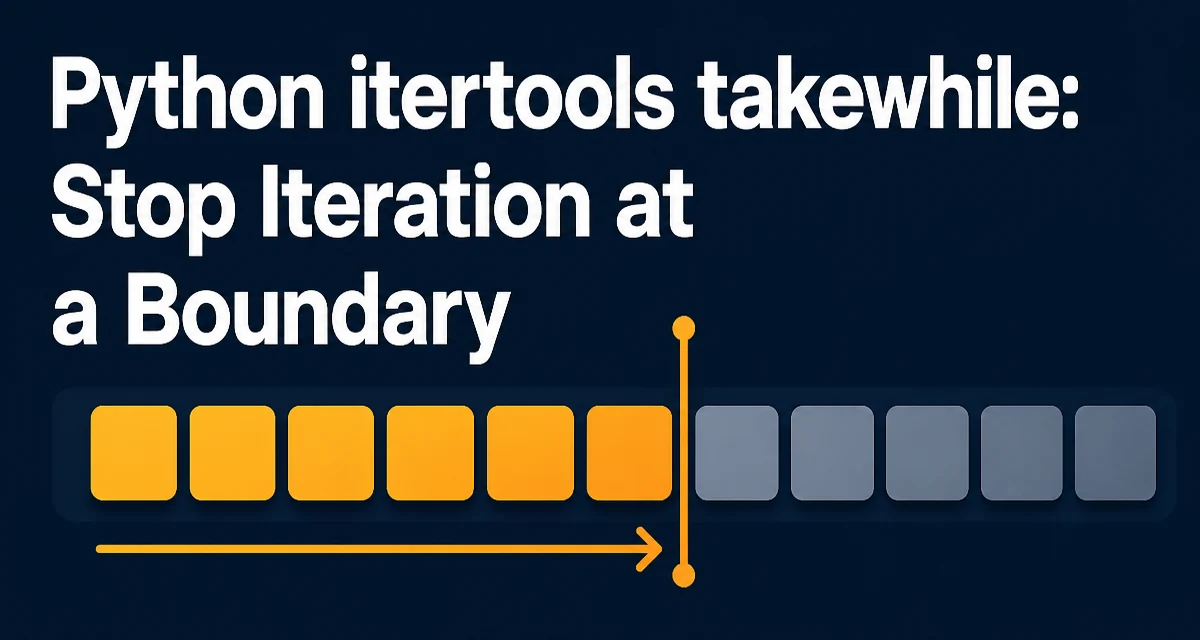
python itertools takewhile requires a clear understanding of the core syntax, runtime behavior, and practical implementation patterns demonstrated in the examples below.
What takewhile Does
Python's itertools.takewhile is a lazy iterator combinator from the standard library itertools module. It accepts a predicate function and an iterable, and yields items from the iterable only as long as the predicate returns a truthy value. The moment the predicate returns False, takewhile stops permanently and yields nothing further.
The key behavior is the stopping condition: takewhile does not scan the entire iterable. It evaluates the predicate item by item, and the first failing item terminates the iteration. Items after that failing item are never consumed from the underlying iterable.
Basic Syntax and a Minimal Example
The signature is:
itertools.takewhile(predicate, iterable)
predicate is a callable that accepts one item and returns a truthy or falsy value. iterable can be any iterable: a list, a generator, an open file, a range, or another iterator.
from itertools import takewhile

numbers = [1, 2, 3, 4, 5, 1, 2]
result = list(takewhile(lambda x: x < 5, numbers))
print(result)  # [1, 2, 3, 4]
The predicate x < 5 returns True for 1, 2, 3, and 4. When it reaches 5, the predicate returns False, and takewhile stops. The remaining items 1 and 2 are never examined.
How takewhile Differs from filter()
A common point of confusion is filter(). Both accept a predicate and an iterable, but their behavior differs fundamentally.
filter() evaluates the predicate against every item in the iterable and returns all items for which the predicate is truthy. It never stops early.
numbers = [1, 2, 3, 4, 5, 1, 2]
filtered = list(filter(lambda x: x < 5, numbers))
print(filtered)  # [1, 2, 3, 4, 1, 2]
takewhile stops at the first failing item, while filter continues past it. The choice depends on whether you want a prefix of the iterable or a full scan.
Use takewhile when the iterable is ordered and you want everything up to a boundary. Use filter when you want every matching item regardless of position.
Reading a Prefix from a Stream
A practical use case is reading from a file or stream until a marker line appears.
from itertools import takewhile

with open("config.txt") as f:
    header = list(takewhile(lambda line: not line.startswith("# END"), f))
This reads lines until the first line starting with # END. Because takewhile is lazy, it stops reading the file at that point. The file handle remains positioned at the marker line, which can be useful if you need to process the remainder separately.
The same pattern works with a generator that produces sensor readings, log entries, or network packets where the data is sorted or time-ordered and you want the prefix up to a threshold.
Common Mistakes and Edge Cases
One mistake is assuming takewhile resumes after the predicate fails. It does not. Once the predicate returns False, the iterator is exhausted. There is no way to restart it.
Another mistake is using takewhile on unsorted data while expecting a threshold-style result. If the predicate fails early, items that would have matched later are skipped.
data = [5, 1, 2, 3]
list(takewhile(lambda x: x < 5, data))  # [] — fails on the first item
Edge cases to be aware of:
- An empty iterable produces an empty result.
- A predicate that fails on the first item produces an empty result.
- The underlying iterable is not fully consumed. If you pass a generator, it retains its position at the first failing item.
Runtime and Memory Behavior
takewhile is lazy. It pulls one item at a time from the underlying iterable and evaluates the predicate on demand. This means it can operate on infinite or very large iterables without materializing them in memory.
The memory cost of takewhile itself is constant: it holds the predicate and the underlying iterator, but not the accumulated results. If you wrap the result in list(), the list holds the items, but that is your choice, not takewhile's.
The runtime cost is one predicate evaluation per item until the first failure. Items after the failure are not evaluated at all. This is the main performance advantage over filter() when the boundary appears early in a large iterable.
Choosing Between takewhile and Alternatives
| Approach | Behavior | Best fit |
|---|---|---|
takewhile | Stops at first failing item | Ordered data, prefix extraction |
filter | Evaluates all items | Unordered data, full scan |
dropwhile | Skips items until predicate fails, then yields the rest | Removing a leading prefix |
Manual loop with break | Full control over stopping and side effects | Complex stopping logic |
dropwhile is the complement of takewhile: it discards items while the predicate is truthy and then yields everything after the first failing item.
from itertools import dropwhile

data = [1, 2, 3, 4, 5, 1]
list(dropwhile(lambda x: x < 4, data))  # [4, 5, 1]
A manual loop is preferable when the stopping condition depends on state accumulated across iterations, because takewhile's predicate is stateless and receives only the current item.
total = 0
for x in numbers:
    if total + x > 100:
        break
    total += x
This loop stops based on a running total, which takewhile cannot express directly without wrapping the predicate in a mutable closure.
Compatibility and Version Considerations
itertools.takewhile has been part of the standard library since Python 2.4 and remains available in all current Python 3 releases. No third-party package is required. The function accepts any callable as the predicate, including lambdas, bound methods, and functions defined with def.
One version-related detail: takewhile returns an iterator, not a list. If you need a list, wrap it with list(). This behavior is consistent across all supported Python versions and is worth remembering when comparing output with filter(), which also returns an iterator in Python 3.
The main compatibility concern is not the function itself but the predicate. If the predicate relies on behavior that changed between Python versions, that change affects takewhile the same way it affects any other consumer of the predicate.