Python List Comprehension vs Generator Expression
python list comprehension vs generator expression: Understand the runtime differences between list comprehensions and generator expressions in Python, and learn when t...
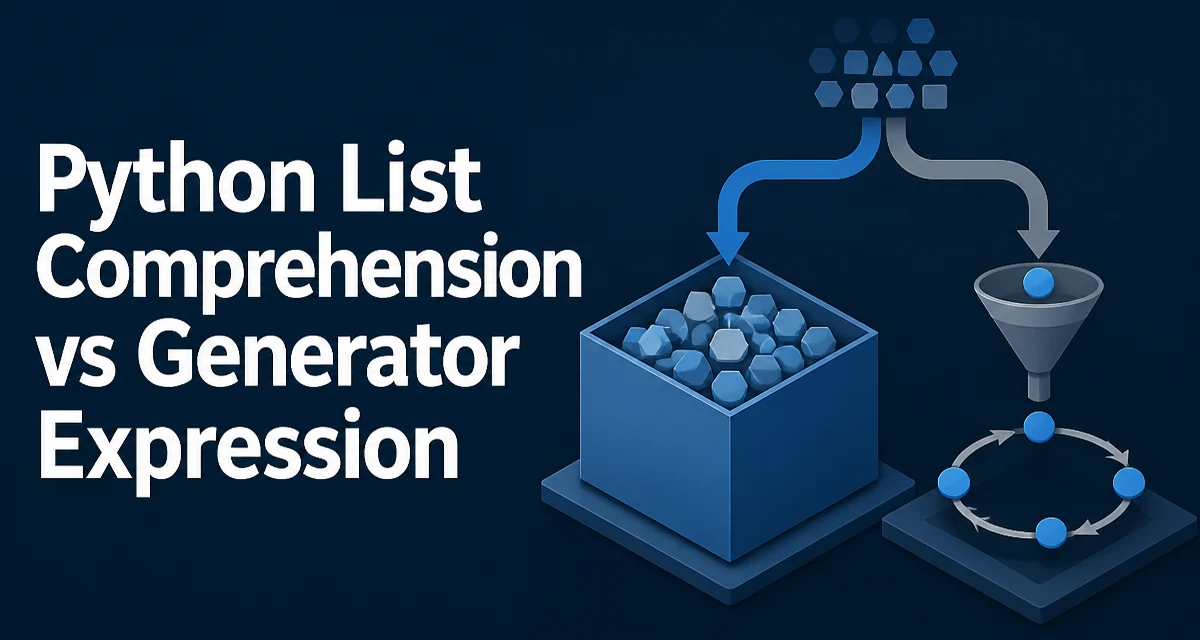
When you need to transform a sequence in Python, you can write either a list comprehension or a generator expression. The syntax looks nearly identical, but the runtime behavior differs in a way that matters for memory and performance. This article explains the difference between python list comprehension vs generator expression and gives concrete guidance on choosing the right one.
List Comprehension: Eager Construction
A list comprehension builds a new list in memory, evaluating every element immediately. The result is a concrete list object that you can index, slice, or reuse multiple times.
squares = [x * x for x in range(10)]
Here, squares is a list of ten integers. The comprehension iterates over range(10), computes x * x for each value, and stores every result in a new list. The entire list exists in memory as soon as the expression finishes.
This eager behavior is useful when you need random access to the elements or when you must pass the result to code that expects a list, such as a function that calls len() or indexes by position.
Generator Expression: Lazy Evaluation
A generator expression looks like a list comprehension but uses parentheses instead of square brackets. It does not build a list. Instead, it returns a generator object that yields values one at a time as you iterate.
squares_gen = (x * x for x in range(10))
square_gen is a generator. No multiplication happens until you iterate over it. For example, list(squares_gen) would consume the generator and produce the same list as the comprehension, but the generator itself holds no data.
The lazy behavior means a generator expression can represent an infinite sequence without exhausting memory. You can also chain generators, each adding a transformation step without materializing intermediate collections.
Key Differences Between the Two
| Aspect | List Comprehension | Generator Expression |
|---|---|---|
| Syntax | Square brackets [] | Parentheses () |
| Return type | List | Generator object |
| Evaluation | Eager, all elements computed immediately | Lazy, elements computed on demand |
| Memory usage | Stores all elements in memory | Stores one element at a time |
| Reusability | Can be iterated multiple times | Single-use, exhausted after iteration |
| Indexing and slicing | Supported | Not supported |
| Best for | Small or finite data, repeated access | Large or infinite streams, one-pass use |
These differences are not just theoretical. They affect how your program behaves under memory pressure and how you structure data pipelines.
Memory Usage and Performance
A list comprehension allocates memory for the entire result before you can use any element. For a large input, that can mean a significant memory spike. A generator expression avoids that by producing one value at a time and discarding it after each iteration step.
Consider processing a large file line by line. A list comprehension would read every line into memory at once:
lines = [line.strip() for line in open('data.txt')]
If the file is huge, this can exhaust available RAM. A generator expression processes one line at a time:
lines_gen = (line.strip() for line in open('data.txt'))
for line in lines_gen:
    process(line)
Here, the generator holds only the current line and the file handle. The file is still read lazily, and memory usage stays roughly constant regardless of file size.
Performance is not always faster with generators. The lazy evaluation adds a small per-item overhead because each yield involves a generator frame. For small collections, a list comprehension may be faster because it avoids that overhead. For large collections, the memory savings of a generator often outweigh the CPU cost, and in some cases the reduced cache pressure can make the generator faster overall. Without benchmarking a specific workload, the safe claim is that generators use less memory and can handle larger data, while list comprehensions are simpler for small, finite data.
When to Use a List Comprehension
Use a list comprehension when you actually need a list. Common situations include:
- You need to index or slice the result.
- You need to iterate over the result multiple times.
- You are passing the result to a function that expects a list, such as
len(),sorted(), or a JSON serializer. - The data set is small enough that memory is not a concern.
For example, building a list of configuration values to pass to a validation function is a natural fit:
ports = [int(p) for p in config['ports']]
validate_ports(ports)
Here, ports must be a list because validate_ports may iterate it multiple times or inspect its length.
When to Use a Generator Expression
Choose a generator expression when you are only going to iterate once and the data set is large, or when you want to avoid building an intermediate collection. Typical cases include:
- Summing, multiplying, or reducing a sequence with
sum(),min(),max(),any(), orall(). - Streaming data from a file or network socket.
- Building a pipeline where each stage transforms the output of the previous stage.
- Representing an infinite sequence.
For example, computing the total size of all files in a directory without storing the list of sizes:
total = sum(os.path.getsize(f) for f in os.listdir('.'))
This passes a generator to sum(), which iterates it once and discards each value. The memory footprint is independent of the number of files.
Common Pitfalls and Edge Cases
One frequent mistake is assuming a generator expression can be reused. After you iterate over a generator, it is exhausted. If you need to iterate again, you must create a new generator. A list comprehension does not have this limitation.
Another pitfall is using a generator expression when you need to know the length. Generators do not support len(). If you need the number of elements, you must either materialize the sequence or count during iteration.
Also be careful with variable scoping in generator expressions. In Python 3, the iteration variable does not leak into the surrounding scope, just like in list comprehensions. This is a change from Python 2, where list comprehensions leaked the variable. If you are maintaining legacy code, verify the Python version to avoid unexpected behavior.
Finally, a generator expression that is passed to a function as the sole argument does not need extra parentheses. For example, sum(x * x for x in range(10)) is valid. But if you need to pass it along with other arguments, you must wrap it in parentheses to avoid a syntax error.
Advanced Usage: Chaining and Infinite Streams
Generator expressions can be composed to form lazy pipelines. Each generator reads from the previous one, and no intermediate list is created.
evens = (x for x in range(100) if x % 2 == 0)
squared = (x * x for x in evens)
result = sum(squared)
Here, evens yields even numbers, squared squares them, and sum() consumes the final generator. At any moment, only one value exists in memory. This pattern scales to arbitrarily large inputs.
Because generators are lazy, they can represent infinite sequences. For example, a generator of all square numbers:
def squares():
    n = 0
    while True:
        yield n * n
        n += 1
A generator expression can do the same with itertools.count:
squares_inf = (n * n for n in itertools.count())
You can then take only the first few values with itertools.islice:
first_five = list(itertools.islice(squares_inf, 5))
This approach avoids allocating a list of infinite size and gives you control over how much data you consume.
Choosing Based on Your Actual Need
The decision between a list comprehension and a generator expression comes down to whether you need the result as a list or just need to iterate once. If you are only going to loop over the result and then discard it, a generator expression is usually the better choice because it uses less memory and can handle larger data. If you need random access, multiple iterations, or a concrete list for a function that requires one, use a list comprehension.
There is no universal winner. The right choice depends on the size of your data, how many times you need to traverse the result, and whether the consumer expects a list or simply an iterable. By understanding the eager versus lazy behavior, you can avoid unnecessary memory usage and write code that scales gracefully with input size.