Python List Iterator: How It Works and When to Use It
python list iterator: Learn how Python list iterators work, how for loops use them, and when to prefer iterators over indexing for cleaner, more efficient code.
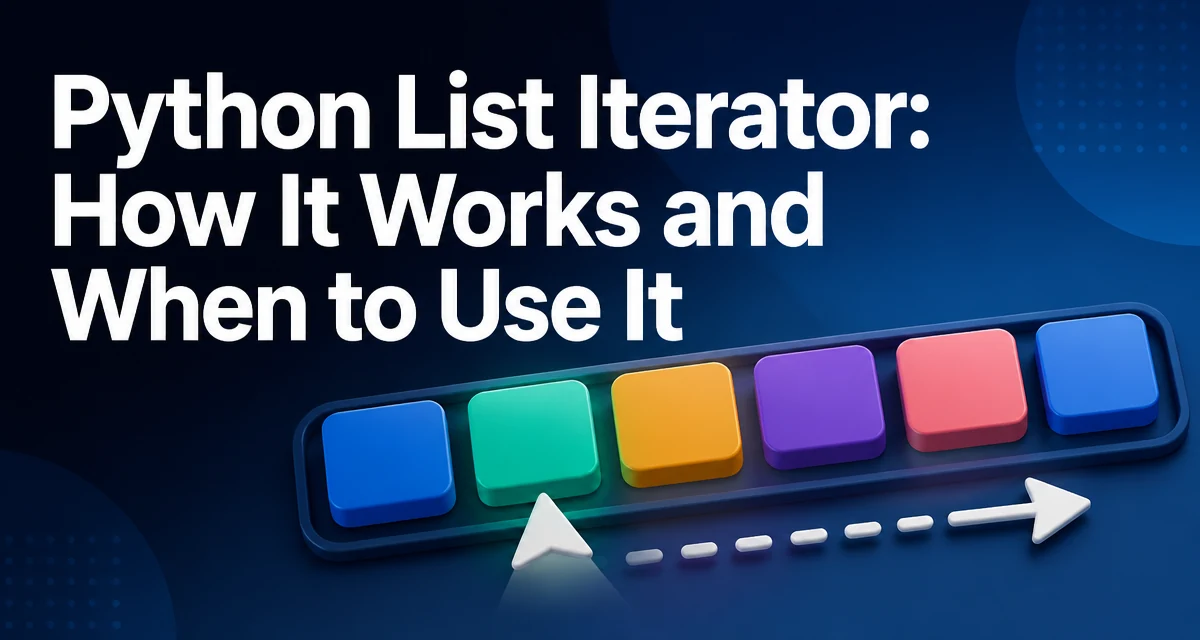
python list iterator requires a clear understanding of the core syntax, runtime behavior, and practical implementation patterns demonstrated in the examples below.
A list iterator is the object Python creates when you call iter() on a list. It implements the iterator protocol: it has a __next__() method that returns the next element, and raises StopIteration when the list is exhausted. Understanding how this object behaves explains why for loops, comprehensions, and many built-in functions treat lists as iterable.
Creating and Using a List Iterator
You can create an iterator from a list with iter(). Then call next() to fetch elements one by one. When the iterator is exhausted, next() raises StopIteration. This is the manual way to control iteration.
fruits = ["apple", "banana", "cherry"]
it = iter(fruits)
print(next(it))  # apple
print(next(it))  # banana
print(next(it))  # cherry
# next(it) would raise StopIteration
The iterator keeps an internal index that advances each time you call next(). It does not copy the list; it references the original list. If the list is modified during iteration, behavior depends on the modification.
How For Loops Use List Iterators
When you write for item in my_list:, Python internally calls iter(my_list) to get an iterator, then repeatedly calls next() until StopIteration is raised. This is why any object with __iter__() and __next__() can be used in a for loop.
for fruit in fruits:
    print(fruit)
The loop handles the StopIteration exception automatically. This abstraction lets you write code that works with any iterable, not just lists.
Memory and Performance Characteristics
List iterators are lightweight. They store a reference to the list and an index, so they add minimal overhead. Iterating with an iterator avoids the overhead of indexing and bounds checking that you get with a while loop using an index. However, because the list is already materialized in memory, iterating over it does not save memory compared to a generator that yields values lazily.
If you need to process a list once, using an iterator is idiomatic and often faster than manual indexing. But if you need random access, an iterator is not suitable because it only moves forward.
Common Mistakes and Edge Cases
One common mistake is trying to reuse an iterator after it is exhausted. Once StopIteration is raised, the iterator is done; calling next() again will keep raising it. To iterate again, you must create a new iterator with iter().
Another edge case is modifying the list while iterating. If you append or remove elements, the iterator's internal index may become invalid, leading to skipped elements or IndexError in some cases. The safest approach is to iterate over a copy or collect changes separately.
Also, note that iter() on a list returns an iterator, but the list itself is not an iterator. The list has an __iter__() method that returns a new iterator each time, which is why you can iterate over a list multiple times.
When to Use an Iterator Instead of Indexing
Indexing with list[i] is useful when you need the index itself or need to access elements non-sequentially. An iterator is better when you only need to process each element once and want to write code that works with any iterable, such as a tuple, set, or generator. Functions like map(), filter(), and zip() accept iterables, so passing an iterator can be more flexible.
For example, if you have a function that expects an iterable, you can pass an iterator directly, but you must be aware that it is consumed once.
Compatibility with Other Iterable Types
The iterator protocol is not specific to lists. Any object that implements __iter__() and __next__() can be used in the same way. This means you can write a function that accepts any iterable and use it with lists, tuples, strings, dictionaries, sets, or custom iterators. Understanding list iterators gives you a foundation for working with all iterables in Python.