Python Loop Else: How For and While Else Clauses Work
python loop else: Understand how Python's for and while else clauses execute only when the loop finishes without break, with practical examples.
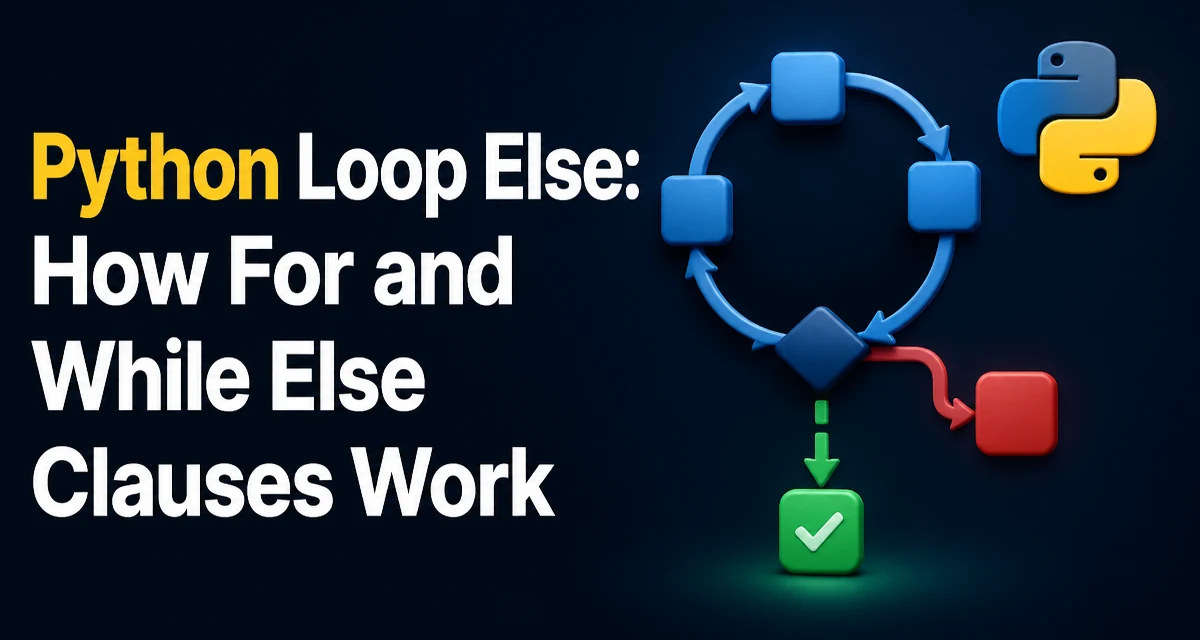
The python loop else clause attaches an else block to a for or while loop. That block runs only when the loop completes normally, meaning it finishes all iterations without hitting a break statement. If the loop exits via break, the else block is skipped. This behavior is a source of confusion because the word else suggests an alternative path, but in this context it means "no break occurred."
How the Else Block Executes
Consider a simple for loop:
for i in range(3):
    print(i)
else:
    print("Loop finished without break")
This prints 0, 1, 2, and then Loop finished without break. The else block runs after the last iteration because no break interrupted the sequence.
Now add a break condition:
for i in range(3):
    if i == 1:
        break
    print(i)
else:
    print("Loop finished without break")
This prints 0 only. The else block is not executed because break terminated the loop early. The same rule applies to while loops.
The else block is part of the loop syntax, not an if statement. It is indented at the same level as the for or while keyword, after the loop body. Python's parser treats it as a loop attribute, not as an if branch.
Using Loop Else for Search Operations
A common use case is searching a collection for an item. Without else, you often set a flag or use a separate variable to track whether the item was found. With loop else, the code becomes more direct:
def find_index(items, target):
    for i, item in enumerate(items):
        if item == target:
            print(f"Found at {i}")
            break
    else:
        print("Not found")
If target exists, the break executes and the else is skipped. If the loop exhausts all items without finding target, the else runs. This pattern is concise and keeps the "not found" handling close to the loop logic.
Another example is validating that all elements pass a condition:
values = [2, 4, 6]
for v in values:
    if v % 2 != 0:
        print("Odd value found")
        break
else:
    print("All values are even")
This avoids a separate boolean flag and makes the intent explicit.
While Loops and the Else Clause
The else clause works with while loops identically. It runs when the condition becomes false naturally, not when break is called.
count = 0
while count < 5:
    if count == 3:
        break
    count += 1
else:
    print("Completed all iterations")
Here count reaches 3, break fires, and else is skipped. Without the break, the loop would run until count is 5, then else would execute.
One subtlety: if the while condition is false from the start, the loop body never runs, but the else still executes. For example:
x = 10
while x < 5:
    print("This never runs")
else:
    print("Condition was false initially")
This prints Condition was false initially. The else is tied to the loop's natural completion, which includes the case where the loop body is never entered. This is often surprising but is consistent with the rule: else runs if no break occurred.
Nested Loops and Break Behavior
A break inside a nested loop only affects the innermost loop. The else clause of an outer loop is not influenced by a break in an inner loop unless the inner loop itself has an else that somehow propagates. Consider:
for i in range(3):
    for j in range(3):
        if j == 1:
            break
    else:
        print(f"Inner loop for i={i} completed without break")
    print(f"Outer iteration {i} done")
else:
    print("Outer loop completed without break")
The inner break only stops the inner loop. The inner else is skipped for each i because the inner loop breaks. The outer loop runs all three iterations, so its else executes. This behavior can be used to detect whether an inner loop found something, but it requires careful indentation.
If you need to break out of an outer loop based on an inner condition, you typically use a flag or a function return. The else clause does not provide a direct mechanism to break multiple levels.
Alternatives to Loop Else: Flag Variables
Before relying on loop else, consider whether a flag variable might be clearer in your specific context. For example:
found = False
for item in items:
    if item == target:
        found = True
        break
if found:
    print("Found")
else:
    print("Not found")
This is more verbose but also more explicit. Some developers find the else clause non-obvious because the word else does not match its semantic meaning. In a codebase where team members are unfamiliar with this feature, a flag might reduce confusion.
However, loop else is a built-in idiom that, once understood, is more concise and keeps the "not found" logic inside the loop construct. The choice depends on your team's familiarity and the surrounding code style.
Maintainability and Readability Considerations
The loop else clause can improve maintainability by eliminating the need for a separate state variable. It also reduces the risk of forgetting to reset a flag in a function that runs multiple times. Because the else block is directly attached to the loop, it is clear that it relates to the loop's completion.
On the other hand, the feature is often misunderstood. A developer who does not know the rule might expect the else to run when the loop condition is false, which is not exactly true. This can lead to bugs when someone refactors code and moves a break into a helper function or changes the loop structure.
To avoid pitfalls, use loop else only when the loop's primary purpose is to determine whether a break was triggered. For loops that have multiple exit points or complex conditions, a flag or a dedicated function may be more readable.
Edge Cases and Common Misconceptions
One common misconception is that else runs when the loop condition fails. That is only true if no break occurred. For a while loop, the condition can fail initially, and the else still runs. For a for loop over an empty iterable, the else also runs because the loop completes zero iterations without breaking.
for x in []:
    print("Never")
else:
    print("Empty iterable, else runs")
This prints Empty iterable, else runs. This is consistent with the rule: no break was executed.
Another misconception is that else is related to if statements inside the loop. It is not. The else belongs to the loop itself. You can have if statements inside the loop body, but their else clauses are separate.
Finally, else works with try blocks too, but that is a different construct. Do not confuse the two. The try/else runs when no exception occurs, while the loop else runs when no break occurs. They are independent features.
When using loop else, always test the behavior with a break and without a break to confirm your expectations. Because the feature is subtle, a quick unit test can prevent logic errors in production code.