Python map vs List Comprehension: How to Choose
python map vs list comprehension: Compare Python's map() function and list comprehensions for transforming iterables, covering syntax, laziness, memory behavior, and w...
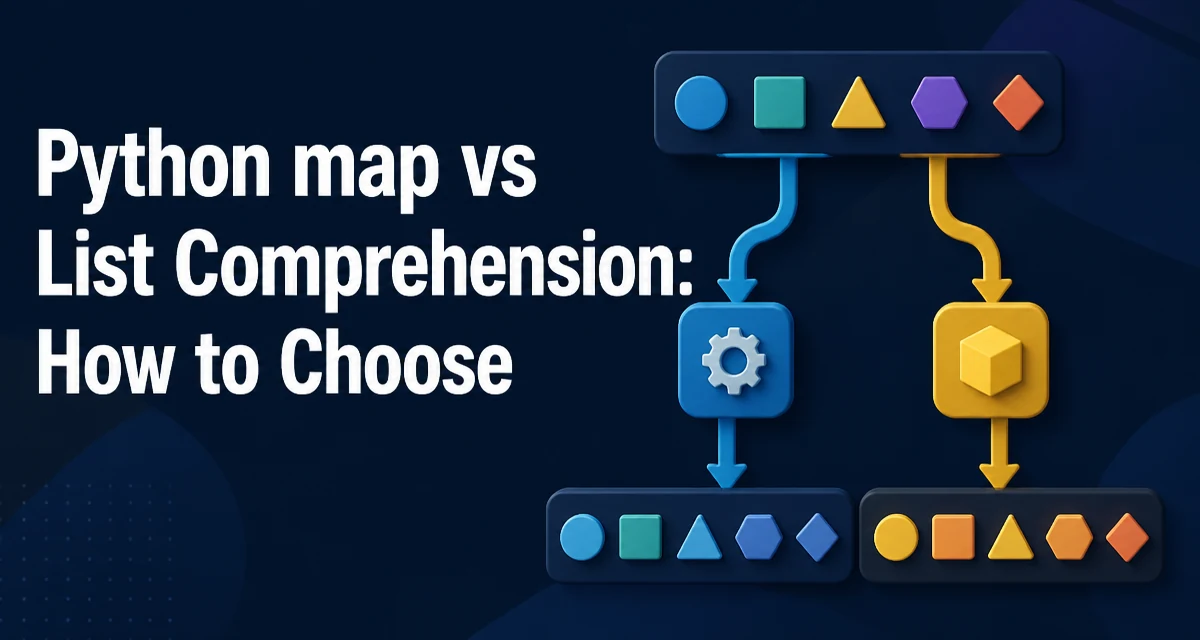
When developers weigh python map vs list comprehension, the practical question is rarely which one is faster in the abstract. Both transform one iterable into another, but they behave differently at the moment of evaluation. map() returns a lazy iterator, also called a map object, that produces values one at a time as you iterate over it. A list comprehension evaluates the entire expression immediately and returns a fully materialized list.
numbers = [1, 2, 3, 4, 5]

squared_map = map(lambda x: x * x, numbers)
squared_list = [x * x for x in numbers]

print(type(squared_map))   # <class 'map'>
print(type(squared_list))  # <class 'list'>
The map object is not a list. If you need the results as a list, you must wrap it: list(map(...)). That extra conversion step is often the first sign that a list comprehension is the more direct tool.
Syntax and Readability Tradeoffs
For a simple transformation, the list comprehension reads more naturally:
# List comprehension
stripped = [s.strip() for s in lines]

# map with lambda
stripped = list(map(lambda s: s.strip(), lines))
The comprehension keeps the transformation expression in the same visual space as the iteration, so a reader can see exactly what happens to each element without switching between the lambda body and the function call. When the transformation is complex enough to require a lambda with multiple statements or nested logic, the comprehension becomes even more clearly preferable.
When map() Is the Better Choice
map() earns its place when you already have a named function or built-in that does exactly what you need. In that case, the call site stays short and the intent is obvious:
cleaned = list(map(str.strip, lines))
lengths = list(map(len, words))
Passing str.strip or len directly avoids the lambda entirely. The function name documents the operation better than a re-implemented lambda body would.
map() also accepts multiple iterables and passes corresponding elements to the function as separate arguments:
import operator

totals = list(map(operator.add, prices, quantities))
The equivalent comprehension requires zip():
totals = [p + q for p, q in zip(prices, quantities)]
Both are valid, but the map() version states the pairing more directly when the function already accepts two arguments.
Performance: What Actually Differs at Runtime
The runtime difference between map() and a list comprehension comes from where the iteration loop executes. When you pass a built-in function such as str.strip or len to map(), the iteration and the function call both happen inside C code. A list comprehension evaluates its expression in Python bytecode, so each element goes through the Python evaluation loop.
When you pass a lambda to map(), that advantage mostly disappears. The lambda is still a Python function object, and map() calls it once per element through the Python call machinery. The comprehension, meanwhile, evaluates the expression inline without a function-call boundary. In that common case, the comprehension tends to be at least as fast as map() with a lambda, and often faster.
No single number applies across Python versions, hardware, or workload sizes. The practical rule is: use map() with a built-in or C-implemented callable when you want the C-level loop, and use a comprehension when the transformation is a Python expression.
Laziness and Memory Behavior
Because map() is lazy, it does not allocate a result list until you consume it. This matters when the input iterable is large or when you only need a few values:
large = range(10_000_000)
squares = map(lambda x: x * x, large)

first_five = [next(squares) for _ in range(5)]
The map object holds no more than the current element and the iterator state. A list comprehension over the same range would allocate a list of ten million integers immediately.
The flip side is that laziness can surprise you. If you create a map() object and never iterate it, the transformation never runs. Side effects inside the mapped function are deferred until consumption, which can reorder observable behavior in a program that expects eager evaluation.
Common Mistakes and Edge Cases
The most frequent mistake is treating a map() object as if it were already a list. Indexing, len(), and in checks fail on a map object. You must convert explicitly.
Another mistake is using map() with a lambda when the comprehension is clearer, which usually happens when the transformation involves conditional logic:
# Awkward with map
result = list(map(lambda x: x * 2 if x > 0 else x, values))

# Natural as a comprehension
result = [x * 2 if x > 0 else x for x in values]
Conditional expressions inside a lambda are hard to read, and the comprehension form keeps the condition attached to the element it transforms.
Edge case: map() stops at the shortest iterable when given multiple inputs. If prices and quantities have different lengths, map() silently truncates. A zip()-based comprehension does the same, but being explicit about the truncation behavior helps avoid subtle bugs.
Choosing by Scenario
| Scenario | Prefer | Reason |
|---|---|---|
| Transformation with an existing built-in or named function | map() | C-level loop, concise call site |
| Transformation with a lambda or inline expression | list comprehension | More readable, no function-call overhead |
| Large input where results are consumed partially | map() | Lazy, no full list allocation |
| Results needed as a list immediately | list comprehension | Direct, no conversion step |
| Multiple iterables paired element-wise | map() | Function receives arguments directly |
| Conditional logic inside the transformation | list comprehension | Condition stays in the expression |
The decision is rarely about raw speed alone. It is about whether the transformation reads clearly, whether you need the result eagerly, and whether the iteration can run in C. When those factors conflict, readability and memory behavior usually outweigh a marginal performance difference that you have not measured in your own workload.