Python Negative List Indexing: Syntax and Pitfalls
python negative list indexing: Learn how Python negative list indexing works, including its mapping to positive indices, slicing behavior, and common edge cases that c...
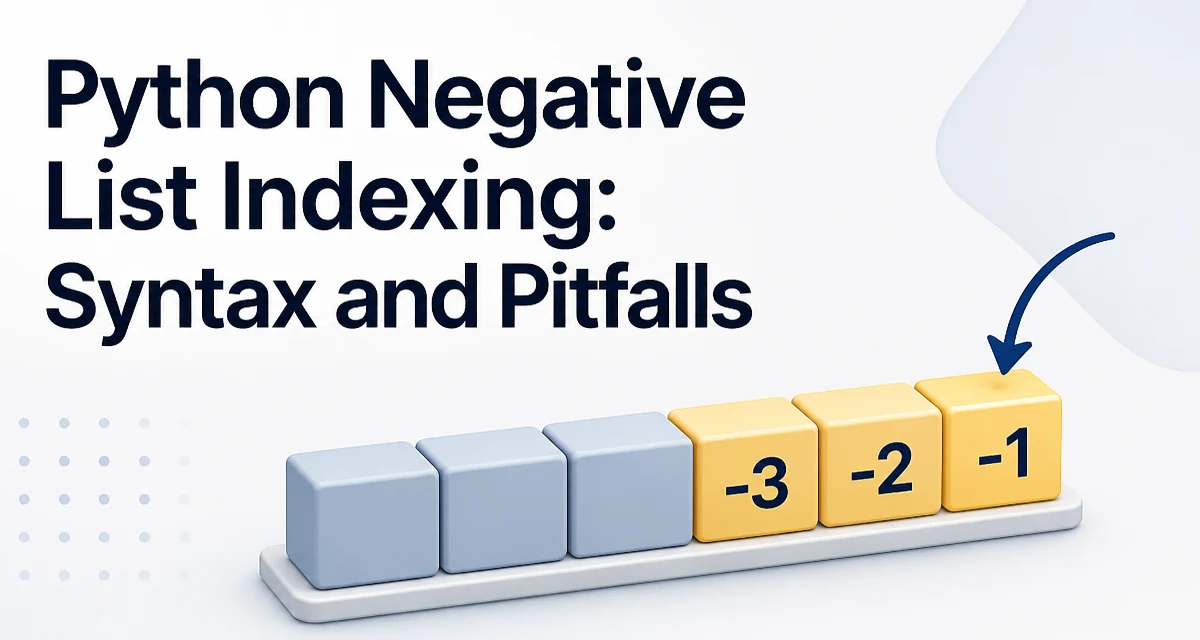
Python negative list indexing lets you access elements from the end of a list without calculating the length first. For example, my_list[-1] returns the last item, and my_list[-2] returns the second-to-last. This feature is part of Python's sequence protocol and applies to lists, tuples, strings, and any object that implements __getitem__ with negative index support. Understanding how negative indices map to positive ones is essential for writing correct, readable code and avoiding off-by-one errors.
How Negative Indices Map to Positive Ones
Internally, Python converts a negative index -i to len(sequence) - i. So -1 becomes len - 1, -2 becomes len - 2, and -len becomes 0. This conversion happens automatically in the __getitem__ method of list objects. Consider this list:
fruits = ["apple", "banana", "cherry", "date"]
print(fruits[-1])  # date
print(fruits[-2])  # cherry
print(fruits[-4])  # apple
The expression fruits[-4] is equivalent to fruits[0] because len(fruits) - 4 = 0. This mapping is consistent across all Python sequences. If you need to verify the positive index, you can always compute len(my_list) + negative_index.
Negative Indexing in Slicing
Negative indices work in slice notation as well. The slice my_list[-3:] returns the last three elements, while my_list[:-1] returns all elements except the last. This is often used to process a list while excluding the final item.
numbers = [10, 20, 30, 40, 50]
print(numbers[-3:])  # [30, 40, 50]
print(numbers[:-1])  # [10, 20, 30, 40]
When you include a step, negative indices still follow the same mapping. A step of -1 reverses the list:
print(numbers[::-1]) # [50, 40, 30, 20, 10]
Be careful when combining negative start and stop with a negative step. For example, numbers[-1:-4:-1] gives [50, 40, 30]. The start and stop are mapped to 4 and 1 respectively, and the step moves backward. If you mix signs incorrectly, you may get an empty list. Always test slice expressions with a small list to verify the boundaries.
Common Mistakes and Edge Cases
One subtle issue is that -0 is the same as 0 in Python. So my_list[-0] returns the first element, not the last. This catches many developers off guard because they expect -0 to behave like -1 but with a zero offset. There is no negative zero in Python's integer representation.
Another common mistake is using a negative index on an empty list. empty_list[-1] raises an IndexError: list index out of range. This is expected because there is no element to reference. Always check if the list is empty before accessing a negative index, especially when the list comes from user input or a database query.
Out-of-range negative indices also raise IndexError. For a list of length n, valid negative indices are from -n to -1. Using -n-1 or smaller is invalid. For example:
try:
    print([1, 2, 3][-4])
except IndexError as e:
    print(e)  # list index out of range
This behavior is identical to positive indices that exceed n-1.
Performance and Readability Trade-offs
Negative indexing does not introduce any measurable performance overhead. The conversion to a positive index is a simple arithmetic operation that happens in C code. There is no extra memory allocation or function call. From a performance perspective, my_list[-1] is equivalent to my_list[len(my_list)-1].
Readability is where negative indexing shines. my_list[-1] clearly communicates "the last element" without requiring the reader to parse len(my_list)-1. This is especially valuable in complex expressions or when the list is a function argument. However, if you need the positive index for another operation, such as tracking the position in a loop, using len(my_list) - 1 may be clearer because it exposes the index value explicitly.
Practical Use Cases in Real Code
Negative indexing is common in algorithms that work from the end of a sequence. For example, when implementing a stack, you often need to peek at the top element without popping it:
stack = []
stack.append(1)
stack.append(2)
print(stack[-1])  # 2, the top of the stack
In data processing, you might want to compare the last two elements of a list:
def is_increasing(seq):
    return all(seq[i] < seq[i+1] for i in range(len(seq)-1))
But you can also use negative indexing to compare from the end:
def last_two_are_equal(seq):
    return len(seq) >= 2 and seq[-1] == seq[-2]
Negative indexing is also useful when parsing file lines or log entries where the most recent entry is at the end.
When to Prefer Explicit Index Calculation
While negative indexing is idiomatic, there are situations where len(seq) - 1 is more appropriate. If you need to pass the index to another function that expects a non-negative integer, or if you are writing code that must be compatible with older Python versions (though negative indexing has existed since Python 1.4), explicit calculation might be clearer. For instance, when implementing binary search on a list, you typically maintain low and high as positive indices. Using negative indices there would obscure the algorithm's logic.
Another case is when you are working with a custom sequence type that may not implement negative indexing correctly. Most built-in types do, but third-party containers might not. In such cases, using len(seq) - 1 is safer because it relies only on len() and normal positive indexing.
Finally, if you find yourself writing seq[-1] repeatedly in a loop, consider whether you actually need the last element each time or whether you could restructure the loop to avoid repeated indexing. For example, iterating over reversed(seq) is often more readable than manually managing negative indices in a for loop.
Handling Negative Indexes in Custom Classes
If you are implementing a class that mimics a sequence, you need to handle negative indices explicitly in your __getitem__ method. The Python data model expects that obj[-i] works for i from 1 to the length of the sequence. You can implement this by converting the index to a positive one:
class MySequence:
    def __init__(self, data):
        self.data = data

    def __getitem__(self, index):
        if index < 0:
            index += len(self.data)
        if index < 0 or index >= len(self.data):
            raise IndexError("list index out of range")
        return self.data[index]
This mirrors the built-in behavior. If you are using a subclass of list, you inherit negative indexing automatically, so you rarely need to override it. But for custom containers, implementing this conversion ensures consistency with Python's standard sequence interface.