Python Optional vs Union: Choosing the Right Type Hint
python optional vs union: Understand the difference between Optional and Union in Python typing, how they relate, and when to use each for clear type hints.
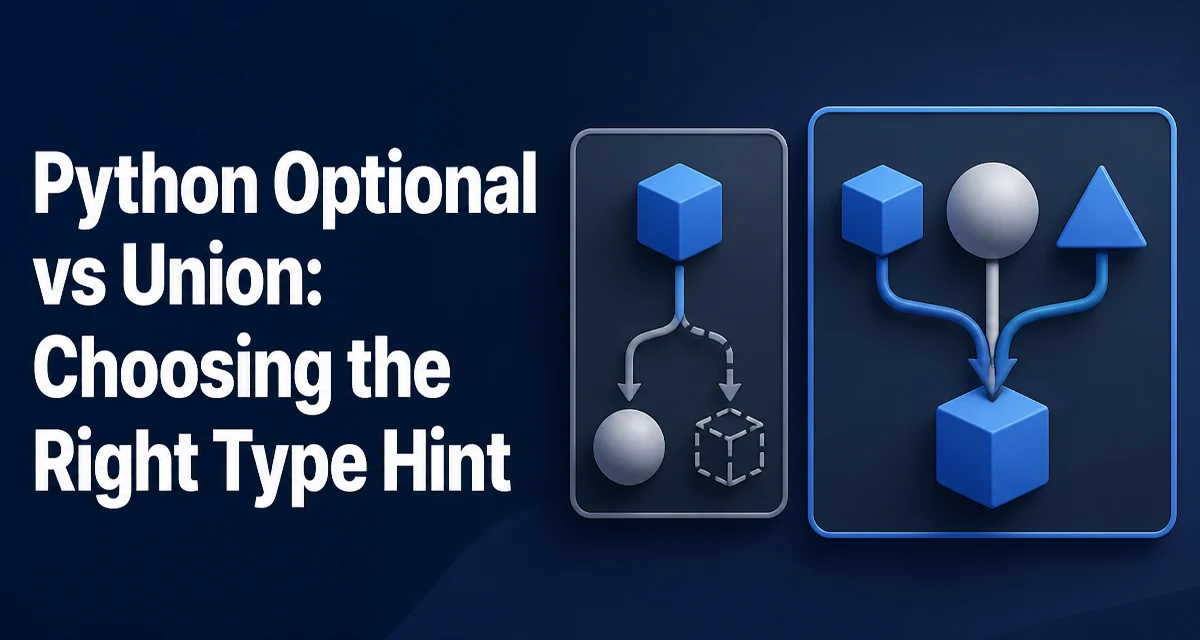
python optional vs union requires a clear understanding of the core syntax, runtime behavior, and practical implementation patterns demonstrated in the examples below.
When you write type hints in Python, you often need to express that a variable can be either a specific type or None. The typing module provides two ways to do this: Optional[T] and Union[T, None]. The relationship between them is simple—Optional[T] is a shorthand for Union[T, None]—but the choice between them affects readability and sometimes tooling behavior. This article explains the practical differences, when to use each, and how they behave in type checking and runtime contexts.
The Relationship Between Optional and Union
Optional is defined as a special case of Union. In the typing module, Optional[X] is equivalent to Union[X, None]. This means the following two type hints are identical:
from typing import Optional, Union

def fetch_user(user_id: int) -> Optional[str]:
    ...

def fetch_user(user_id: int) -> Union[str, None]:
    ...
Both functions return either a string or None. The type checker treats them the same way. The difference is purely stylistic and semantic. Optional signals that the value can be omitted or absent, typically because the operation may fail or the data may not exist. Union signals that the value can be one of several distinct types, where None is just one of the possibilities.
When to Use Optional
Use Optional[T] when the only alternative to a value of type T is None. This is common for function parameters that may be omitted, return values that may not exist, or attributes that are uninitialized. For example:
from typing import Optional

def find_user(email: str) -> Optional[dict]:
    # Returns a user dict or None if not found
    ...

def send_email(to: str, subject: str, body: Optional[str] = None) -> None:
    # body is optional, defaults to None
    ...
Optional makes the intent explicit: the value is either present or explicitly None. It reads naturally in function signatures and is the preferred choice when None is the only alternative. Most type checkers, including mypy and pyright, recommend Optional over Union[T, None] for this case because it is shorter and clearer.
When to Use Union
Use Union when a value can be one of several distinct types, and None is not necessarily the only alternative. For example, a function that accepts an identifier that could be an integer or a string:
from typing import Union

def lookup(value: Union[int, str]) -> str:
    ...
Union is also appropriate when None is one of several possible values, but the other types are not all related to a single concept. For instance, a function that returns a parsed result, an error code, or None:
from typing import Union

def parse_input(raw: str) -> Union[dict, str, None]:
    # Returns dict on success, error message on failure, or None if empty
    ...
Here, Optional[dict] would be insufficient because the function can also return a string. Union accurately describes the full set of possible return types. When the set includes more than one non-None type, Union is the correct choice.
Type Checking Behavior and Tooling
From the perspective of static type checkers, Optional[T] and Union[T, None] are interchangeable. Mypy, pyright, and other tools treat them as equivalent. However, there are subtle differences in how they appear in error messages and in some advanced type inference scenarios.
For example, when a type checker reports a problem with a value that can be None, it often displays the type as Optional[T] regardless of how you wrote it. This is because the checker normalizes the representation internally. In practice, you can switch between the two without changing the behavior of the type checker.
One difference is that Optional is only valid for a single type argument. You cannot write Optional[Union[int, str]]; instead you would use Union[int, str, None]. This is a syntactic limitation, not a semantic one. If you need to express a union of multiple types plus None, you must use Union.
Another consideration is that some tools, like Pydantic, use Optional to trigger special validation behavior. In Pydantic, a field annotated with Optional[T] will allow None as input, whereas Union[T, None] behaves the same but may affect how the schema is generated. If you are using a runtime validation library, check its documentation to see if it distinguishes between the two.
Common Pitfalls and Misconceptions
A frequent misunderstanding is that Optional[T] means the argument itself is optional in the sense that it can be omitted from a function call. This is not true. Optional[T] only indicates that the value can be None; it does not affect whether the argument has a default value. For example:
from typing import Optional

def greet(name: Optional[str]) -> str:
    return f"Hello, {name or 'there'}"

greet()  # TypeError: missing required argument
Even though name is Optional[str], the function still requires an argument. To make the argument optional, you must provide a default value, typically None:
def greet(name: Optional[str] = None) -> str:
    ...
Another misconception is that Optional is a distinct type from Union. In Python's runtime, both are just typing.Union instances. You can verify this:
from typing import Optional, Union

print(Optional[int] == Union[int, None])  # True
There is no runtime difference. The choice is purely about code clarity and intent.
Runtime Behavior and Performance
Type hints are not enforced at runtime by default. They are used by static type checkers and IDEs. At runtime, Optional[T] and Union[T, None] have no performance impact because they are just objects from the typing module. The only cost is the import and creation of the type hint itself, which is negligible and happens once at module load time.
If you use runtime type checkers like typeguard or pydantic, the annotations are inspected and validated. In that case, the choice between Optional and Union can affect how validation is performed. For example, Pydantic treats Optional[T] as allowing None but also allowing T, which is the same as Union[T, None]. However, the generated JSON schema may represent them differently. If you are building APIs with Pydantic, you might see a difference in the OpenAPI schema output.
For most applications, the runtime behavior is identical. The performance difference is zero. The real impact is on code readability and maintainability.
Maintainability and Code Clarity
The primary reason to choose between Optional and Union is clarity. Optional[T] is shorter and immediately signals that None is a valid value. It reduces visual noise, especially in complex signatures. Union[T, None] is more verbose but makes it explicit that None is just one of several possible types.
A consistent style across a codebase helps developers understand intent quickly. If you use Optional only for the None case and Union for multi-type cases, the type hints become self-documenting. For example:
from typing import Optional, Union

# Clear: value is either a string or None
def get_config(key: str) -> Optional[str]: ...

# Clear: value is one of three distinct types
def parse_data(raw: str) -> Union[dict, list, None]: ...
When you see Optional, you know the function returns a single type or None. When you see Union, you know there are multiple possible types, and None is just one of them. This distinction improves code review and reduces the chance of misinterpreting a function's contract.
Some teams adopt a rule to always use Optional for None alternatives, even in unions with multiple types, by writing Union[dict, list, None] as Optional[Union[dict, list]]. This is valid and can be clearer if the primary type is a union and None is an add-on. For example:
from typing import Optional, Union

def load_data() -> Optional[Union[dict, list]]:
    ...
This reads as "a dict or list, or None". It separates the union of meaningful types from the absence of data. Both forms are acceptable; choose the one that is more readable in your context.
Edge Cases and Advanced Usage
When you have a type that is already a Union, adding None with Optional can be tricky. For example, Optional[Union[int, str]] is equivalent to Union[int, str, None]. This is fine, but it can be confusing because the Optional wraps the entire union. In such cases, you might prefer to write Union[int, str, None] to keep all types on the same level.
Another edge case is when you need to use None as a distinct type in a union, not just as an absence marker. For instance, a function that returns None to indicate a special condition, but also returns other types. Union gives you the flexibility to treat None as a first-class value.
Finally, consider the impact on type narrowing. When you use if x is None to check for None, type checkers narrow the type correctly regardless of whether you used Optional or Union. The behavior is identical. However, if you use Union with multiple types, you may need to narrow each type explicitly. Optional narrows to the single type or None, which is simpler.
In practice, the choice between Optional and Union is about expressing intent. Use Optional when None is the only alternative and the concept is best described as "an optional value." Use Union when the value can be one of several distinct types, and None is just one possibility. This simple rule keeps type hints readable and maintainable across a codebase.