Python Reverse Sequence Slicing: Syntax and Behavior
python reverse sequence slicing: Learn how to reverse sequences in Python using slice notation with negative steps, including practical examples and common pitfalls.
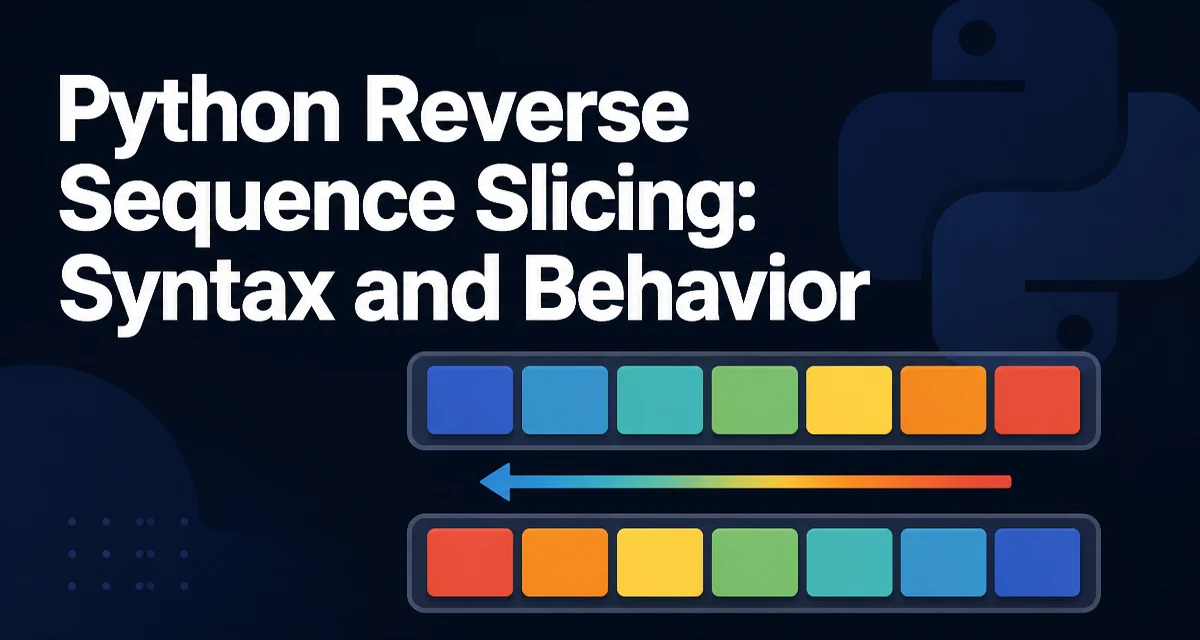
Python's slice notation is often used to extract substrings or sublists, but it also provides a direct way to reverse a sequence. The expression seq[::-1] is the canonical form of python reverse sequence slicing. It works on lists, strings, tuples, and any other sequence type that supports slicing. Understanding how the step parameter interacts with start and stop indices is essential for using this technique correctly, especially when you need partial reversals or non-standard step sizes.
How Slice Notation Handles Negative Steps
A slice in Python is written as start:stop:step. When the step is negative, the slice is taken in reverse order. The start and stop indices are interpreted relative to the sequence's end, and the default values change. For seq[::-1], both start and stop are omitted, so Python uses the entire sequence with a step of -1, effectively producing a reversed copy.
numbers = [1, 2, 3, 4, 5]
reversed_numbers = numbers[::-1]
print(reversed_numbers)  # [5, 4, 3, 2, 1]
The original list remains unchanged because slicing always creates a new object. This is a key distinction from in-place reversal methods like list.reverse(), which modifies the original list and returns None.
Reversing Strings and Tuples
The same syntax applies to any sequence type. Strings and tuples are immutable, so slicing is the only way to get a reversed copy without converting to a list first.
text = "hello"
reversed_text = text[::-1]
print(reversed_text)  # "olleh"

point = (1, 2, 3)
reversed_point = point[::-1]
print(reversed_point)  # (3, 2, 1)
For strings, this is often used in palindrome checks or when processing text in reverse. For tuples, it is useful when you need to iterate over elements in reverse order without converting to a list.
Using Negative Steps for Partial Reversal
You can combine a negative step with explicit start and stop indices to reverse only a portion of a sequence. The start and stop indices are interpreted in the normal index space, but the traversal moves backward from start to stop, exclusive.
data = [0, 1, 2, 3, 4, 5, 6]
# Reverse from index 5 down to index 2 (exclusive)
partial = data[5:2:-1]
print(partial)  # [5, 4, 3]
Notice that the start index must be greater than the stop index when the step is negative. If you use a positive step with start > stop, you get an empty slice. This is a common source of confusion for developers new to negative steps.
Step Sizes Other Than -1
You can use any negative integer as the step to skip elements while reversing. For example, a step of -2 returns every second element starting from the end.
values = [10, 20, 30, 40, 50, 60]
reversed_skip = values[::-2]
print(reversed_skip)  # [60, 40, 20]
This is equivalent to first reversing the sequence and then taking every second element, but it does so in a single pass. The step magnitude determines the stride, and the sign determines the direction.
Common Mistakes and Edge Cases
Several pitfalls can lead to unexpected results. The most common is forgetting that the stop index is exclusive. When reversing a substring, you must specify the stop as one less than the index where you want the slice to end.
word = "abcdef"
# Reverse from index 4 to index 1 (exclusive)
print(word[4:1:-1])  # "edc"
Another edge case is an empty sequence. Slicing an empty sequence with [::-1] returns an empty sequence, which is correct. A step of zero raises ValueError: slice step cannot be zero, so never use seq[::0].
Also, be aware that when you specify start and stop with a negative step, the start index must be greater than the stop index. If you reverse the order, you get an empty slice, not an error. This behavior is consistent with how Python interprets slice bounds.
Performance and Memory Considerations
Slicing always creates a new sequence, so seq[::-1] allocates a full copy of the original. For small sequences this is irrelevant, but for large lists or strings it can double memory usage temporarily. If you only need to iterate over the elements in reverse order, the reversed() built-in function is more memory-efficient because it returns an iterator that yields elements one at a time without copying.
for item in reversed(large_list):
    process(item)
reversed() works on any sequence that implements __len__ and __getitem__, and it does not create a new list. It is the preferred choice when you do not need the reversed sequence as a materialized object.
Choosing Between Slicing and reversed()
The decision depends on whether you need a reversed copy or just a reverse traversal. Use seq[::-1] when you need to store the reversed sequence, pass it to a function that expects a list or string, or modify the reversed version independently. Use reversed(seq) when you only need to iterate once, want to avoid the memory overhead of a copy, or are working with a generator that does not support slicing.
For example, if you are building a reversed string for output, slicing is direct:
reversed_text = text[::-1]
If you are summing numbers in reverse order and do not need the list, reversed() is better:
total = sum(reversed(numbers))
In CPython, reversed() is implemented as an iterator and does not allocate a new sequence, making it the more memory-conscious option for large data. Slicing, on the other hand, is a one-liner that is often more readable when the reversed sequence is the final goal.
Compatibility and Maintainability
The slice syntax with a negative step is part of the Python language specification and works consistently across all Python 3 versions. It also works on any object that implements the sequence protocol, including custom classes that define __getitem__ with slice support. When writing code that others will maintain, prefer seq[::-1] for clarity over more verbose alternatives like list(reversed(seq)) when you need a list, because the intent is immediately recognizable to most Python developers.
One subtle maintainability issue is that seq[::-1] is not obvious to beginners. If your codebase has many such slices, consider wrapping the reversal in a small helper function with a descriptive name, especially if the slice includes non-trivial start and stop indices. This reduces the chance of off-by-one errors and makes the code self-documenting.
For partial reversal with negative steps, always comment the start and stop indices to clarify the range. The exclusive stop behavior is a frequent source of bugs, and a short comment can save future debugging time.
A final note on performance: while slicing is implemented in C and is fast, it still copies memory. For extremely large sequences, consider whether you can avoid the copy entirely by using reversed() or by reversing the data in place with list.reverse() if you own the list and do not need the original order afterward. The right choice depends on whether you need the reversed result as a new object or just need to process elements in reverse order.