Python String Title: Using str.title() Correctly
python string title: Learn how Python's str.title() method converts strings to title case, including word boundaries, apostrophe handling, Unicode behavior, and when t...
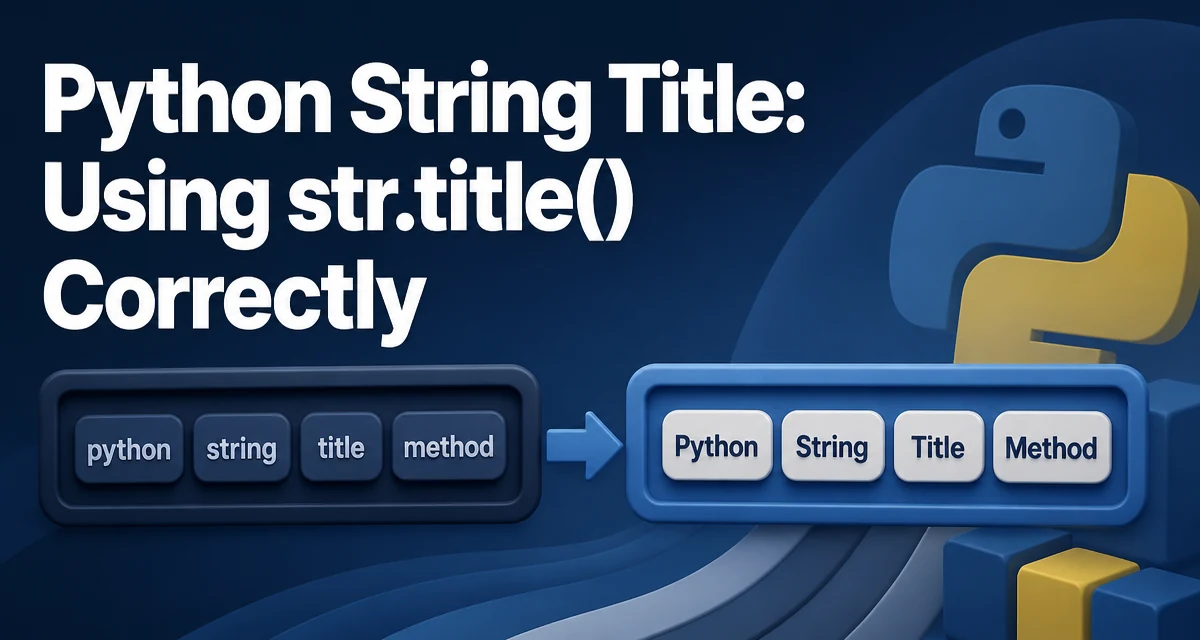
python string title requires a clear understanding of the core syntax, runtime behavior, and practical implementation patterns demonstrated in the examples below.
The str.title() method is the standard way to convert a Python string to title case. It returns a copy of the string where each word begins with an uppercase letter and all remaining characters are lowercase. For example, "hello world".title() produces "Hello World". The method is built into every Python string, requires no imports, and behaves consistently across Python 3.x releases.
How str.title() Determines Word Boundaries
The title() method does not split on spaces alone. It treats any sequence of characters that are not letters as a word boundary. This means punctuation, digits, and whitespace all act as separators. Consider:
text = "hello, world! how are you?"
print(text.title())
# Hello, World! How Are You?
The comma, exclamation point, and spaces each create a boundary, so every word gets capitalized independently. This differs from a naive split-on-space approach, which would leave punctuation attached to the preceding word and require separate handling to produce the same result.
What Happens with Apostrophes and Contractions
A common surprise is how title() handles apostrophes. Since an apostrophe is not a letter, it creates a word boundary. This means the letter after the apostrophe gets capitalized:
text = "don't stop"
print(text.title())
# Don'T Stop
The output "Don'T" is rarely what a developer wants. The method treats don and t as separate words because the apostrophe breaks the sequence of letters. If you are converting user input that contains contractions, title() will produce awkward results. There is no built-in parameter to change this behavior, so you would need a custom approach for such cases.
Numbers and Mixed Alphanumeric Strings
Digits also act as boundaries. A string like "version 2.0 released" becomes "Version 2.0 Released". The digit 2 ends the word version, and the period creates another boundary before 0. In practice, this means title casing does not preserve camelCase or other mixed-format identifiers:
text = "userID and orderID"
print(text.title())
# Userid And Orderid
The lowercase d in userID gets converted to lowercase d, producing Userid. If you need to preserve acronyms or mixed-case identifiers, title() is not the right tool.
Unicode and Non-English Text
The title() method respects Unicode letter categories. It will capitalize accented characters and letters from non-Latin scripts according to their Unicode case mappings. For example:
text = "élève français"
print(text.title())
# Élève Français
The accented é is capitalized to É, and the lowercase è remains lowercase. This works because Python's string methods operate on Unicode code points rather than ASCII bytes. However, the same apostrophe issue applies to Unicode text: a right single quotation mark (') is also a non-letter, so it will create a word boundary.
Comparing title(), capitalize(), and upper()
These three methods serve different purposes, and choosing the wrong one is a common mistake.
| Method | Behavior | Example Input | Example Output |
|---|---|---|---|
title() | Capitalizes first letter of each word | "hello world" | "Hello World" |
capitalize() | Capitalizes first letter, lowercases the rest | "hello world" | "Hello world" |
upper() | Uppercases every character | "hello world" | "HELLO WORLD" |
capitalize() is appropriate when you want only the first letter of the entire string capitalized, such as for a sentence. upper() is for all-caps output. title() is for headings, names, or display labels where each word should be capitalized.
When Title Case Is Appropriate in Real Code
Title casing is useful for display formatting, such as converting a slug or a database field into a human-readable heading. For example, a product name stored as "wireless mouse" can be displayed as "Wireless Mouse" in a UI. It is also useful for normalizing names in reports or logs where consistent capitalization matters.
However, title() is not appropriate for proper names that contain internal capitalization, such as "McDonald" or "iPhone". The method will lowercase the internal uppercase letters, producing "Mcdonald" and "Iphone". If you are processing user-entered names, you should not rely on title() to produce correct proper nouns.
Runtime Behavior and Performance
The title() method creates a new string and iterates over the original once. Its time complexity is O(n), where n is the length of the input string. For typical display strings this is negligible. If you are calling title() on very large text repeatedly in a loop, the allocation cost of creating a new string on each call is the main consideration. Reusing the result instead of recomputing it for the same input avoids unnecessary allocation.
There is no in-place variant of title(). Strings are immutable in Python, so the method always returns a new string object. Calling it on an already title-cased string still creates a new object, which is worth remembering if you are checking whether a string is already in title case.
Handling the Apostrophe Problem in Practice
If you need title casing that respects contractions, you can implement a small helper that capitalizes the first letter of each word while leaving the rest untouched:
import re

def smart_title(text):
    return re.sub(r"\w+", lambda m: m.group(0)[0].upper() + m.group(0)[1:], text)

print(smart_title("don't stop"))
# Don't Stop
This regular expression matches each sequence of word characters and uppercases only the first character of each match. The apostrophe remains attached to the preceding word because it is not a word character. This approach is not as simple as calling title(), but it produces more natural output for English contractions. It still does not preserve internal caps like "iPhone", so you would need a separate rule for brand names.