Python Symmetric Difference Operator: Syntax and Use Cases
python symmetric difference operator: Learn how to use the Python symmetric difference operator (^) and the symmetric_difference() method to find elements unique to ea...
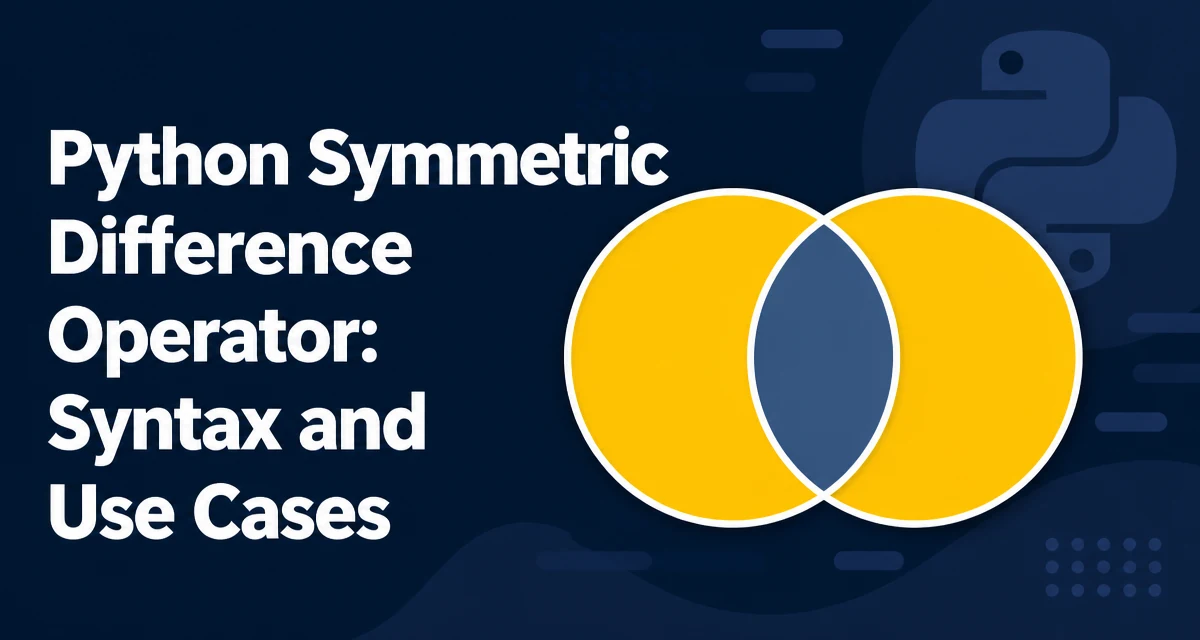
The Python symmetric difference operator, written as ^, returns the elements that appear in exactly one of two sets. For sets a and b, a ^ b is equivalent to (a - b) | (b - a). This operation is useful whenever you need to identify what is unique to each group, such as comparing configuration flags, tracking changes between snapshots, or finding elements that belong to only one category.
Here is the basic syntax:
left = {1, 2, 3}
right = {3, 4, 5}
result = left ^ right
print(result)  # {1, 2, 4, 5}
The result contains 1, 2, 4, and 5 because those appear in only one set. The common element 3 is excluded.
What the Symmetric Difference Operator Does
The symmetric difference operator works on set and frozenset objects. It creates a new set containing all elements from either operand that are not present in both. The operation is commutative: a ^ b and b ^ a produce the same set. It is also associative, so chaining the operator across multiple sets behaves consistently.
The operator is distinct from the union (|), intersection (&), and difference (-) operators. Union combines all elements, intersection keeps only common ones, and difference keeps elements from the left set that are not in the right set. Symmetric difference is the logical XOR for sets: an element is included if it belongs to an odd number of the input sets.
Operator vs. Method: Two Ways to Get the Same Result
Python provides both an operator and a method for symmetric difference. The ^ operator requires both operands to be sets or frozensets. The symmetric_difference() method is more flexible: it accepts any iterable as the argument and returns a new set.
base = {1, 2, 3}
other = [3, 4]  # list, not a set
result = base.symmetric_difference(other)
print(result)  # {1, 2, 4}
The method converts the iterable to a set internally, so you can pass lists, tuples, or even strings. The operator does not perform this conversion; using base ^ other with a list raises a TypeError.
There is also an in-place variant, symmetric_difference_update(), which modifies the original set instead of returning a new one. This method accepts any iterable and is useful when you want to update a set without creating an extra object.
How the Operator Handles Multiple Sets
Because ^ is left-associative, a ^ b ^ c is evaluated as (a ^ b) ^ c. Since symmetric difference is associative, the result is the same regardless of grouping. The resulting set contains elements that appear in an odd number of the input sets.
a = {1, 2, 3}
b = {2, 3, 4}
c = {3, 4, 5}
result = a ^ b ^ c
print(result)  # {1, 3, 5}
Element 1 appears only in a, 3 appears in all three (odd count), and 5 appears only in c. Elements 2 and 4 appear in two sets, so they are excluded.
For large numbers of sets, consider using a loop or functools.reduce to apply the operation iteratively. The operator itself does not accept a list of sets directly.
Behavior with Non-Set Iterables
The ^ operator is strict about operand types. Both sides must be instances of set or frozenset. If you try to use a list or tuple, Python raises a TypeError:
{1, 2} ^ [2, 3] # TypeError: unsupported operand type(s) for ^: 'set' and 'list'
The symmetric_difference() method avoids this limitation by accepting any iterable. This distinction matters when you are working with data that is not already stored as a set. You can either convert the iterable explicitly with set() or use the method directly.
If you frequently alternate between operators and methods, remember that the method does not modify the original set unless you use symmetric_difference_update(). The operator always returns a new set.
Performance and Memory Considerations
The symmetric difference operation runs in linear time relative to the total size of the inputs. For sets a and b, the time complexity is O(len(a) + len(b)). This is because Python internally iterates over both sets to build the result. The memory usage is also O(len(result)), which is at most the sum of the input sizes.
In practice, the operator and method have similar performance. The method may have slight overhead when it converts an iterable argument to a set, but that conversion is also O(n). If you are working with large collections, the dominant factor is the size of the inputs, not the choice between operator and method.
One subtle performance point: using symmetric_difference_update() avoids creating a new set, which can reduce memory pressure in loops that repeatedly update a set. For example, when processing a stream of items where you need to toggle membership, the in-place method is more efficient than repeatedly assigning set = set ^ new_items.
Common Mistakes and Edge Cases
A frequent mistake is assuming that ^ works on lists or other iterables. As shown earlier, the operator raises a TypeError unless both operands are sets. Developers coming from other languages sometimes expect ^ to behave like a bitwise XOR on integers; in Python, ^ on integers performs bitwise XOR, but on sets it performs symmetric difference. The behavior depends entirely on the operand types.
Another edge case is using an empty set. The symmetric difference of any set with an empty set is the original set itself:
{1, 2} ^ set() # {1, 2}
Similarly, the symmetric difference of a set with itself is an empty set:
{1, 2} ^ {1, 2} # set()
When working with frozenset, the operator returns a frozenset if both operands are frozenset. If one operand is a regular set and the other is a frozenset, the result is a set. This type behavior can affect code that expects a specific immutable type.
When to Prefer Symmetric Difference Over Other Set Operations
Choose symmetric difference when you need to find elements that are exclusive to each group, such as detecting changes between two versions of a collection. If you need all elements from both sets, use union. If you need only common elements, use intersection. If you need elements from one set that are missing from the other, use difference.
The decision often comes down to the logical meaning of the result. For example, when comparing two configuration dictionaries converted to sets of keys, symmetric difference reveals keys that exist in only one configuration. This is more useful than union or intersection for identifying mismatches.
For performance-sensitive code that repeatedly toggles membership, prefer symmetric_difference_update() over the operator. For one-off calculations, the operator is concise and readable. The method is the better choice when the second operand is not already a set, because it avoids an explicit conversion step.