Python Try Except Finally: Execution Order and Cleanup
python try except finally: Understand how Python's try/except/finally block executes, including the order of cleanup, exception propagation, and common pitfalls.
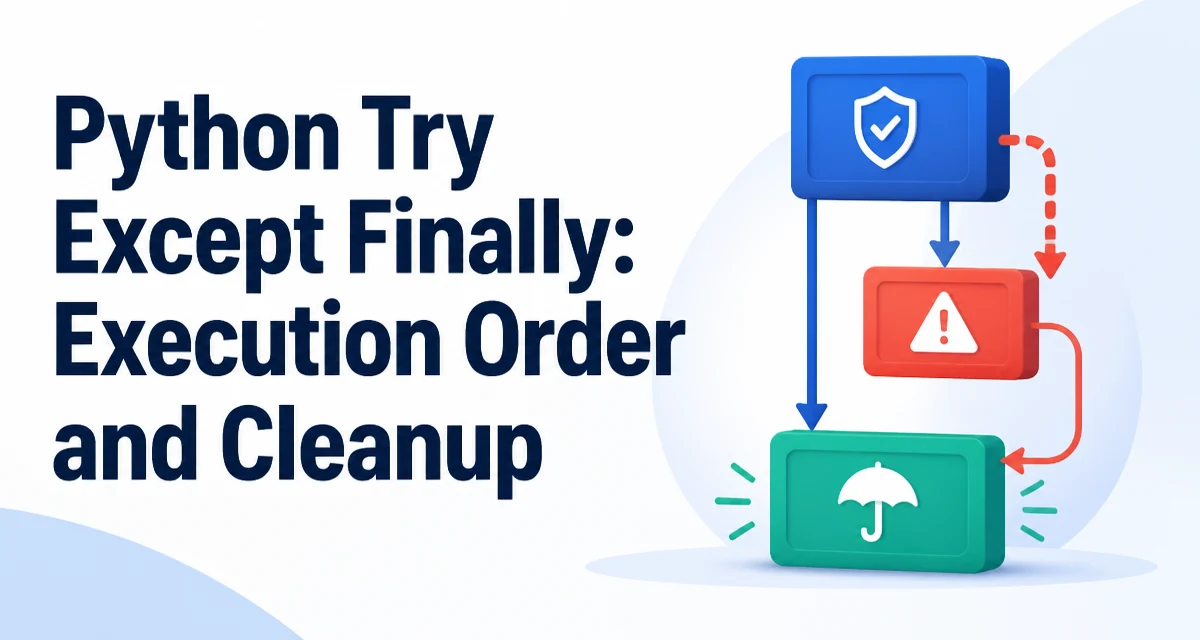
The try/except/finally block is the core of exception handling in Python. It lets you catch runtime errors, execute fallback logic, and guarantee cleanup code runs regardless of what happens in between. The python try except finally pattern is often misunderstood because the order of execution changes depending on whether an exception is raised, caught, or propagated.
The Basic Syntax and Execution Order
A complete try statement can include up to four clauses: try, except, else, and finally. The try block contains the code that may raise an exception. One or more except blocks handle specific exception types. An optional else block runs only if the try block completes without an exception. The finally block always runs, whether an exception occurred or not.
try:
    risky_operation()
except ValueError as exc:
    handle_value_error(exc)
except (TypeError, KeyError):
    handle_type_or_key_error()
else:
    print("No exception raised")
finally:
    cleanup()
Python executes these clauses in a deterministic order. The try block runs first. If it raises an exception, the matching except block runs. If no exception occurs, the else block runs. Regardless of which path was taken, the finally block runs last, before control leaves the statement entirely. This order is guaranteed by the language specification.
What Happens When an Exception Is Raised
The behavior of try/except/finally depends on whether the exception is caught locally or propagates outward. If the try block raises an exception and a matching except block exists, execution jumps to that block. After the except block finishes, the finally block runs, and then the program continues with the next statement after the try statement.
try:
    value = int("not a number")
except ValueError:
    print("Caught ValueError")
finally:
    print("Finally always runs")

print("After try statement")
If no matching except block exists, the exception is not handled locally. The finally block still runs, but the exception continues to propagate after finally completes. This means cleanup code executes even when the exception is not caught, which is critical for releasing resources before an error reaches the caller.
def read_config(path):
    file = open(path)
    try:
        return file.read()
    finally:
        file.close()
In this example, if file.read() raises an exception, file.close() runs before the exception propagates. Without the finally block, the file would remain open until garbage collection, which may not happen promptly.
Using the else Clause for Successful Paths
The else clause is often overlooked but serves a distinct purpose. It runs only when the try block completes without raising an exception. This is useful when you want to separate code that should run only on success from code that handles errors.
try:
    result = divide(a, b)
except ZeroDivisionError:
    print("Division by zero")
else:
    print(f"Result: {result}")
finally:
    print("Operation complete")
Placing success-only logic in else prevents it from accidentally catching exceptions that are not related to the operation. For example, if divide itself raises a different exception, the else block will not run, which is often the desired behavior. This keeps the error-handling scope narrow and makes the control flow explicit.
finally for Resource Cleanup
The primary use of finally is to guarantee cleanup. Files, network connections, database sessions, and locks all need to be released even when an error occurs. The finally block is the language-level mechanism for that guarantee.
connection = create_connection()
try:
    connection.send(data)
finally:
    connection.close()
This pattern works for any resource that has a close() method. However, Python's context managers and the with statement provide a more concise and safer way to manage many resources. The with statement calls __enter__ and __exit__ automatically, and the __exit__ method is guaranteed to run even if the body raises an exception.
with create_connection() as connection:
    connection.send(data)
For objects that implement the context manager protocol, with is usually preferable to an explicit try/finally. It reduces boilerplate and eliminates the risk of forgetting the cleanup call. But not all resources are context managers, and sometimes you need cleanup logic that is not tied to a single object. In those cases, try/finally remains the direct tool.
Common Mistakes and Misunderstandings
One frequent mistake is placing cleanup code in the except block instead of finally. If no exception occurs, the cleanup never runs. Another mistake is returning from inside a try or except block without considering that finally still executes. The finally block runs before the return value is delivered to the caller, which can override a return value if finally itself contains a return statement.
def example():
    try:
        return 1
    finally:
        return 2
This function returns 2, not 1. The finally block's return overrides the earlier one. This behavior is surprising and should be avoided. A finally block should contain cleanup statements, not return or break statements, unless you fully understand the consequences.
Another misconception is that except without an exception type catches everything. It does, but it also catches KeyboardInterrupt and SystemExit, which are usually not meant to be swallowed. Prefer catching specific exceptions or using except Exception when you need a broad fallback.
Performance and Maintainability Considerations
Using try/except has a negligible performance cost when no exception is raised. Modern Python optimizes the common path. The cost of an exception is only paid when one is actually raised, and even then it consists of stack unwinding and object construction. The bigger concern is maintainability.
Overusing try/except to control normal flow, such as using exceptions for validation, makes code harder to read and slower when exceptions are frequent. Reserve exceptions for exceptional conditions. For example, checking whether a key exists in a dictionary with if key in d is clearer and faster than catching a KeyError in a try block.
When you do need cleanup, prefer context managers when available. They make the resource lifetime explicit and reduce the amount of nested code. If you must use try/finally, keep the finally block short and focused on cleanup. Long-running operations inside finally can delay exception propagation and make debugging harder.
When to Prefer Context Managers Over try/finally
The with statement is the idiomatic way to manage resources in Python. It guarantees that the __exit__ method is called, which typically handles cleanup. This is more concise than a try/finally block and less error-prone because you cannot forget to call close().
with open("file.txt") as f:
    data = f.read()
```n
This is equivalent to:

```python
f = open("file.txt")
try:
    data = f.read()
finally:
    f.close()
The context manager version is shorter and clearly scopes the resource to the block. Use try/finally when you need to clean up multiple resources that do not share a single context manager, or when the cleanup logic is not tied to a single object's lifecycle. For example, if you need to close two independent connections and the cleanup order matters, a try/finally block gives you explicit control.
Another case is when you need to handle an exception and then re-raise it after cleanup. The finally block runs before the exception propagates, so you can log or modify state there. Context managers can also do this via __exit__, but the code is often less direct.
Understanding the exact execution order of try, except, else, and finally allows you to write predictable error-handling code. The finally block is the safety net that ensures resources are released and invariants are restored, even when the unexpected happens. Keep cleanup logic simple, avoid returning from finally, and prefer context managers when they fit the resource you are managing.