Python Tuple Conversion: Lists, Sets, Dictionaries
python tuple conversion: Learn how to convert Python tuples to lists, sets, dictionaries, and strings, and back, with clear examples and performance considerations.
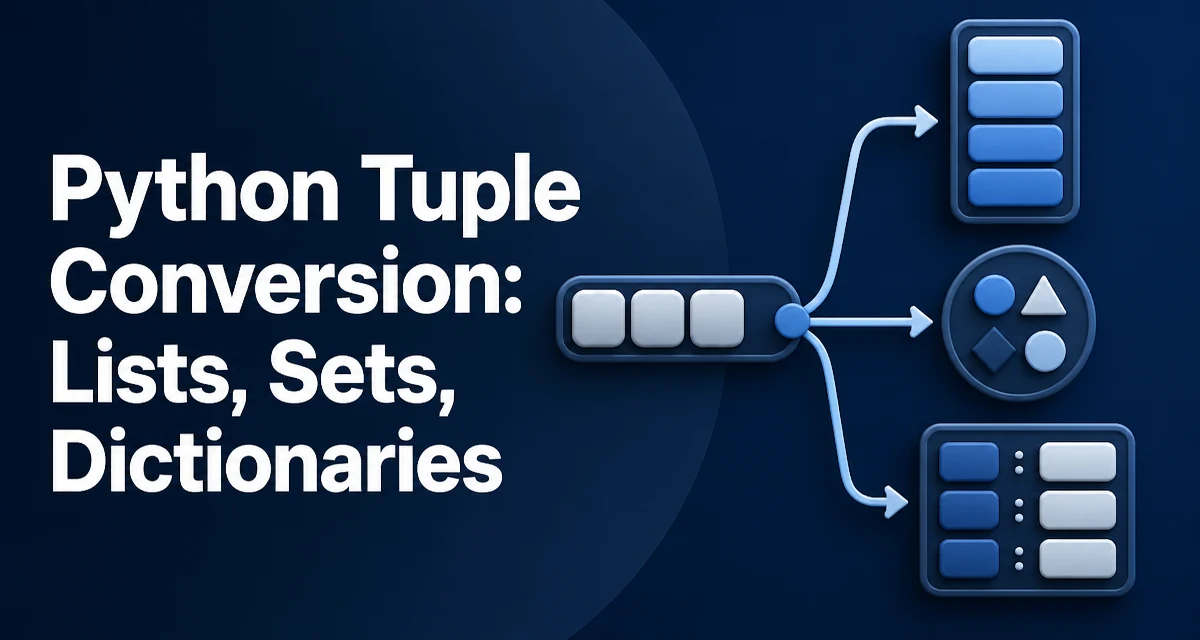
Python tuple conversion is a routine operation when you need to turn a tuple into a mutable list, a unique set, or a dictionary. Because tuples are immutable, you often convert them to other structures to modify, deduplicate, or map data. This article covers the common conversion patterns, their syntax, and the tradeoffs you should consider.
Why Convert a Tuple?
Tuples are immutable, hashable, and memory-efficient, but that immutability is also their main limitation. You cannot append, remove, or replace elements in a tuple. When you need to modify a sequence after creation, converting it to a list is the standard approach. Similarly, if you need to eliminate duplicate values, a set is the natural target. For key-value mapping, you might convert a tuple of pairs into a dictionary. Each conversion has specific syntax and behavior that matters in real code.
Converting a Tuple to a List
The most direct conversion is list(tuple). This creates a new list containing the same elements in the same order. The original tuple remains unchanged.
coordinates = (10, 20, 30)
coords_list = list(coordinates)
print(coords_list)  # [10, 20, 30]
This is useful when you need to sort, modify, or append to the data. The list is a shallow copy; if the tuple contains mutable objects, those objects are shared, not duplicated.
tuple_of_lists = ([1, 2], [3, 4])
list_of_lists = list(tuple_of_lists)
list_of_lists[0].append(99)
print(tuple_of_lists)  # ([1, 2, 99], [3, 4]) — the inner list is shared
Be aware of this sharing when modifying nested structures.
Converting a List to a Tuple
The reverse operation, tuple(list), creates an immutable tuple from a list. This is often done to protect data from accidental modification or to make it usable as a dictionary key.
user_ids = [101, 102, 103]
ids_tuple = tuple(user_ids)
print(ids_tuple)  # (101, 102, 103)
Because the tuple is immutable, you cannot later change it. This conversion is a common way to pass a read-only view of a list to functions that should not modify the underlying data.
Converting a Tuple to a Set
set(tuple) removes duplicates and returns a set with unique elements. The order is not preserved because sets are unordered.
status_codes = (200, 404, 200, 500, 404)
unique_codes = set(status_codes)
print(unique_codes)  # {200, 404, 500}
This is useful for deduplication or membership tests. To convert back to a tuple, use tuple(unique_codes). Note that the resulting tuple order is arbitrary, so do not rely on it for sequence-sensitive logic.
Converting a Tuple to a Dictionary
There are two common scenarios. If the tuple contains key-value pairs, you can pass it directly to dict():
pairs = (("name", "Alice"), ("age", 30))
person = dict(pairs)
print(person)  # {'name': 'Alice', 'age': 30}
If you have two separate tuples for keys and values, use zip():
keys = ("id", "role")
values = (42, "admin")
result = dict(zip(keys, values))
print(result)  # {'id': 42, 'role': 'admin'}
Both approaches create a new dictionary. The tuple itself is not modified. If the tuple contains more than two elements per item, dict() will raise a ValueError.
Converting a Tuple to a String
If the tuple contains strings, you can join them into a single string using str.join():
words = ("hello", "world")
sentence = " ".join(words)
print(sentence)  # hello world
For a tuple of non-strings, str(tuple) returns a string representation like (1, 2, 3). This is useful for logging or display, but not for parsing back into a tuple without eval() or ast.literal_eval(). Prefer ast.literal_eval() for safe parsing.
import ast
raw = "(1, 2, 3)"
parsed = ast.literal_eval(raw)
print(parsed)  # (1, 2, 3)
Performance and Memory Considerations
Converting a tuple to a list or set creates a new object and copies references to the elements. For large tuples, this is an O(n) operation in both time and memory. Tuples themselves are slightly more memory-efficient than lists because they do not over-allocate capacity. If you only need to iterate or test membership, consider keeping the tuple and using in or enumerate directly rather than converting to a list.
When you convert a tuple to a set, you pay the cost of hashing each element. This is also O(n), but the resulting set uses more memory than the tuple due to its hash table structure. If you need to perform many membership checks, the set's O(1) average lookup can be worth the conversion cost, but for a one-off check, scanning the tuple with in may be faster.
Edge Cases and Common Mistakes
One common mistake is assuming that converting a tuple of tuples to a dictionary works when the inner tuples have more than two elements. It does not; dict() expects exactly two-element sequences. Another mistake is forgetting that set() loses order, so converting a tuple of ordered data to a set and back changes the sequence.
Also, when converting a tuple to a list, remember that the list is a shallow copy. If the tuple contains mutable objects, modifications to those objects inside the list will affect the tuple's contents as well. This can lead to surprising side effects if you expect the tuple to remain unchanged.
Finally, when converting a tuple to a string with join(), all elements must be strings. If you have mixed types, you need to convert each element first, for example with a generator expression:
mixed = (1, "two", 3.0)
joined = ", ".join(str(item) for item in mixed)
print(joined)  # 1, two, 3.0
This pattern is safe and avoids TypeError.
Understanding these conversion patterns and their edge cases helps you choose the right structure for the task without introducing subtle bugs.