Python Unpacking vs Indexing: When to Use Each
python unpacking vs indexing: Learn when to use unpacking instead of indexing in Python, including loops, function returns, and error handling, with practical examples.
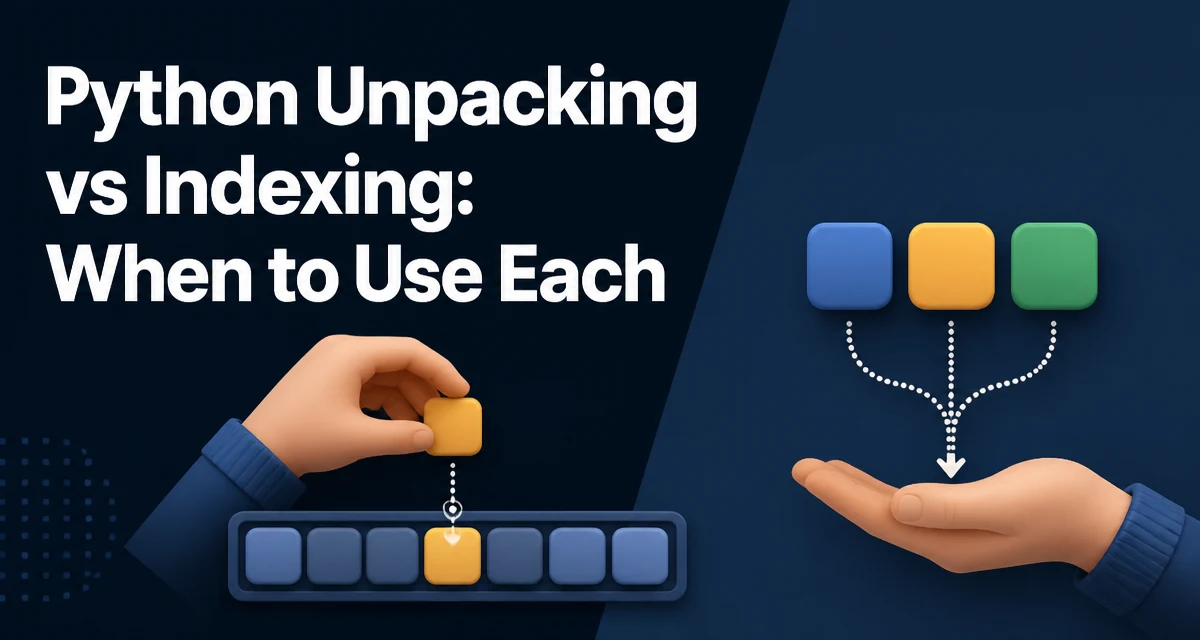
When working with sequences in Python, unpacking and indexing are two common ways to access elements. The choice between them affects readability, error handling, and how clearly the code expresses intent. This article compares python unpacking vs indexing and explains when each approach is the better fit.
The Core Difference: Positional Access vs Element Extraction
Indexing retrieves a single element by its position using square brackets:
point = (3, 4)
x = point[0]
y = point[1]
Unpacking assigns multiple elements to variables in one statement:
point = (3, 4)
x, y = point
Both approaches access the same values, but they differ in how the code communicates intent. Indexing says "give me the element at this specific position." Unpacking says "this sequence has a known structure, and I want to bind its parts to named variables." That distinction drives most practical decisions.
When Unpacking Is the Clear Choice
Use unpacking when the sequence has a fixed, known length and you need all or most of its elements. This is common with tuples returned from functions, coordinate pairs, or small records.
status_code, message = get_response()
width, height = dimensions
Unpacking makes the code self-documenting. The variable names describe the meaning of each position, whereas indexing requires you to remember that result[0] is the status code and result[1] is the message. If the sequence structure changes, unpacking will raise a ValueError immediately, which is often preferable to silently using the wrong element.
Unpacking in Loops and Function Returns
Iterating over a list of sequences is one of the most common places where unpacking shines. Compare these two loops:
pairs = [(1, 'one'), (2, 'two')]

# Indexing
for pair in pairs:
    number = pair[0]
    name = pair[1]

# Unpacking
for number, name in pairs:
    pass
The unpacking version is shorter and makes the loop variable names immediately clear. It also prevents accidental off-by-one errors when the sequence length changes.
Function returns benefit the same way. A function that returns multiple values is naturally consumed with unpacking:
def min_max(numbers):
    return min(numbers), max(numbers)

low, high = min_max(data)
Indexing would work here too, but it obscures the relationship between the returned values and their meaning.
Indexing for Dynamic and Partial Access
Indexing is the right tool when you need one element at a variable position, or when the sequence length is not known at compile time. For example, accessing the first or last element of a list of unknown size:
items = get_items()
first = items[0]
last = items[-1]
Indexing is also necessary when the index is computed dynamically, such as inside a loop that processes a sliding window or when you need to skip elements based on a condition.
for i in range(0, len(data), 2):
    print(data[i])
Unpacking cannot express this kind of partial or computed access. It requires the target variable count to match the sequence length exactly (unless you use star expressions, which we cover later).
Performance and Readability Tradeoffs
There is no meaningful performance difference between unpacking and indexing for typical sequence sizes. Both operations are O(1) for lists and tuples. The real tradeoff is readability and error behavior.
Unpacking fails loudly when the sequence length does not match the number of variables. This is usually a feature: it catches structural changes early. Indexing, on the other hand, silently returns a value even if the sequence is shorter than expected, leading to an IndexError only when you actually access the missing element. In a long function, that error can appear far from the source of the problem.
For maintainability, unpacking often wins because it reduces the number of statements and makes the data shape explicit. However, overusing unpacking on large or variable-length sequences can make the code brittle. If the sequence is expected to grow, indexing with explicit bounds checks might be more appropriate.
Common Mistakes and Edge Cases
A frequent mistake is assuming unpacking works when the sequence length is not guaranteed. For example:
coordinates = get_coordinates()  # might be empty
x, y = coordinates  # ValueError if length is not 2
If the length is unknown, use a star expression to capture the rest:
first, *rest = data
This is useful for splitting a sequence into a head and tail, but it can obscure the number of elements you actually care about. Use it sparingly.
Another edge case is unpacking a single-element sequence. You need a trailing comma:
value, = (42,)
This is easy to misread, so consider indexing instead for clarity.
Choosing the Right Approach for Your Code
The decision between unpacking and indexing depends on the stability of the sequence structure and how many elements you need.
Use unpacking when:
- The sequence has a fixed, known length.
- You need all or most of the elements.
- The element order has semantic meaning that variable names can capture.
- You want to fail early if the structure changes.
Use indexing when:
- You need one element at a computed or variable position.
- The sequence length is dynamic and you only need a subset.
- You are working with large sequences where unpacking would create too many variables.
- The code is part of a performance-critical loop where the overhead of unpacking is measurable (though rare).
In practice, most Python code benefits from unpacking in function returns and loops over fixed-size records. Indexing remains essential for generic sequence processing, such as implementing algorithms that rely on positional access. Understanding the tradeoff helps you write code that is both correct and clear.