SQLAlchemy Lazy vs Eager Loading: joinedload and selectinload
python sqlalchemy lazy loading eager loading joinedload and selectinload: Understand SQLAlchemy lazy loading, why it causes N+1 queries, and how joinedload and selecti...
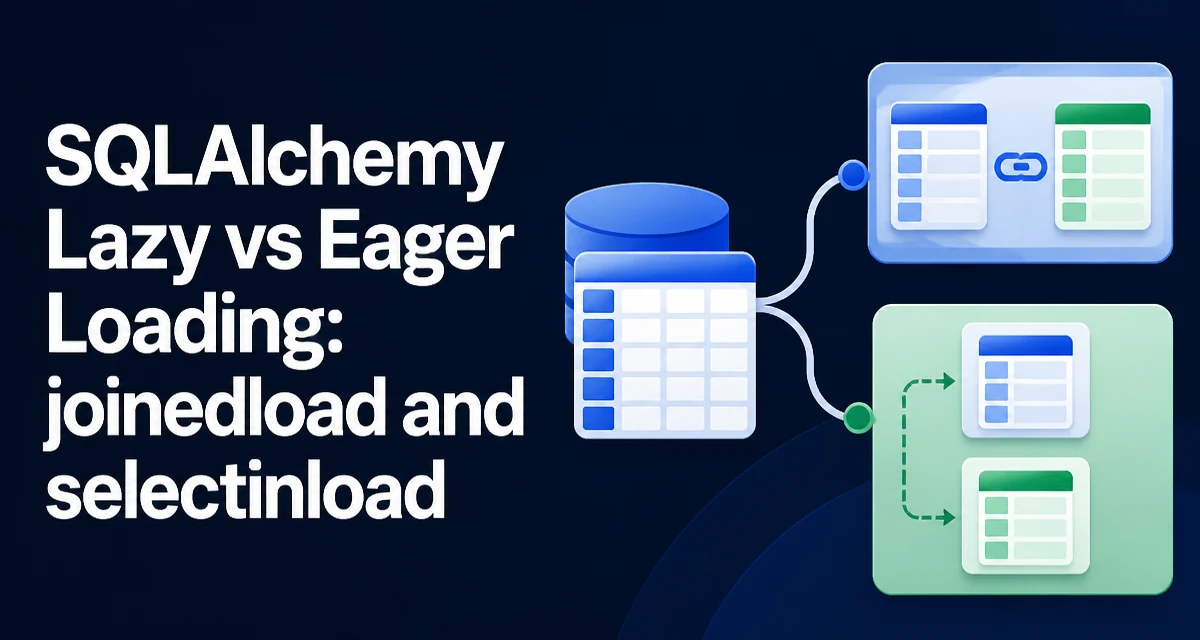
python sqlalchemy lazy loading eager loading joinedload and selectinload requires a clear understanding of the core syntax, runtime behavior, and practical implementation patterns demonstrated in the examples below.
When you query a parent object in SQLAlchemy and then access a related collection or many-to-one reference, SQLAlchemy by default issues a separate SELECT for each related row. This is lazy loading, and it is the root cause of the N+1 query problem that shows up in API endpoints and background jobs. The fix is to switch to eager loading using joinedload or selectinload. This article explains how both strategies work, where they differ, and how to pick the right one for your relationships.
The N+1 Problem and Why Lazy Loading Is the Default
Consider two models: User and Address, where a user has many addresses.
from sqlalchemy.orm import declarative_base, relationship
from sqlalchemy import Column, Integer, ForeignKey, String

Base = declarative_base()

class User(Base):
    __tablename__ = "users"
    id = Column(Integer, primary_key=True)
    name = Column(String)
    addresses = relationship("Address", back_populates="user")

class Address(Base):
    __tablename__ = "addresses"
    id = Column(Integer, primary_key=True)
    email = Column(String)
    user_id = Column(Integer, ForeignKey("users.id"))
    user = relationship("User", back_populates="addresses")
If you load all users and then iterate over their addresses, lazy loading triggers a new query for each user:
users = session.query(User).all()
for user in users:
    print(user.addresses)  # one SELECT per user
With 100 users, you get 1 query for the users and 100 queries for addresses. This is the classic N+1 pattern. Lazy loading is the default because it avoids loading related data until you actually need it, which can be efficient for single-object access. But in bulk operations, it becomes a performance disaster.
Eager Loading with joinedload: How It Works and When It Fits
joinedload tells SQLAlchemy to fetch the related objects in the same SQL query using a JOIN. For a many-to-one relationship, this is often a single LEFT OUTER JOIN. For a one-to-many collection, it produces a cartesian product of parent and child rows, which can become large if the collection is big.
from sqlalchemy.orm import joinedload

users = session.query(User).options(joinedload(User.addresses)).all()
This generates a single SQL query that joins users with addresses. SQLAlchemy then deduplicates the parent rows in Python, so you get a list of User objects with populated addresses collections without extra queries.
joinedload is most effective for many-to-one references where each parent has exactly one related object. For example, loading an Address with its User:
addresses = session.query(Address).options(joinedload(Address.user)).all()
This avoids the N+1 for the reverse direction. However, when the collection is large, the JOIN can produce a huge result set, increasing memory and network transfer. The deduplication step also adds CPU overhead.
Eager Loading with selectinload: A Second Query Strategy
selectinload takes a different approach. Instead of joining in the original query, it issues a second SELECT statement that loads all related objects for the parent set at once, using a WHERE ... IN clause on the foreign key.
from sqlalchemy.orm import selectinload

users = session.query(User).options(selectinload(User.addresses)).all()
This results in two queries total: one for the users, and one for all addresses whose user_id is in the list of loaded user IDs. The second query is efficient because it uses a single IN clause, and the result is processed into collections in Python.
selectinload avoids the large cartesian product that joinedload can create for collections. It also works well for nested eager loading, because each level adds one extra query, not a massive join.
Comparing joinedload and selectinload in Practice
The choice between the two often comes down to the cardinality of the relationship and the shape of your data.
| Criterion | joinedload | selectinload |
|---|---|---|
| SQL queries | One query with JOIN | Two queries (parent + IN subquery) |
| Result set size | Can blow up with large collections | Linear with number of related rows |
| Best for | Many-to-one references | One-to-many collections |
| Nested eager loading | Can become unwieldy with deep joins | Each level adds a separate query |
| Database compatibility | Works everywhere | Requires support for IN clauses (all) |
| Memory on client | Higher due to duplicate parent rows | Lower, since no duplication |
For a many-to-one relationship like Address.user, joinedload is usually the better choice because the JOIN adds only one extra column set and does not multiply rows. For a one-to-many relationship like User.addresses, selectinload is generally safer because it avoids the row multiplication.
There is also a subtle difference in how SQLAlchemy applies filtering. joinedload can affect the WHERE clause if you try to filter on the joined table, which changes the semantics of the query. selectinload does not interfere with the primary query's filtering because it runs separately.
Common Pitfalls: Filtering, Collection Size, and Query Complexity
A frequent mistake is using joinedload on a collection and then filtering the collection in the same query. For example:
# This filters the parent, not the collection
users = session.query(User).options(joinedload(User.addresses)).filter(User.addresses.any(email="a@b.com")).all()
This changes the JOIN into an INNER JOIN and only returns users that have at least one matching address, which may not be what you intended. To filter the collection itself, you need a separate relationship or use contains_eager with an explicit join, which is more complex.
selectinload avoids this pitfall because the collection loading is a separate query, so you can safely filter the parent query without affecting the related objects.
Another consideration is query complexity. If you have multiple collections on the same parent, joinedload can create a massive join with multiple tables, leading to a combinatorial explosion. selectinload keeps each collection loading separate, so the query count increases linearly with the number of collections, but each query stays simple.
Choosing the Right Strategy for Your Relationship
The decision should be based on the relationship type and the typical size of the related data.
- Use
joinedloadfor many-to-one references where you always need the related object. The extra JOIN is cheap and avoids a second round trip. - Use
selectinloadfor one-to-many collections where the collection can be large. The separate query is more predictable and avoids row multiplication. - If you need to eager load multiple collections, prefer
selectinloadto keep the query plan manageable. - If you are loading a single parent object and its small collection, either works;
joinedloadmight be marginally faster because it is one query, butselectinloadis often clearer.
A practical pattern is to define the loading strategy at the query level, not on the relationship itself, so you can vary it per use case. This keeps the default lazy but allows you to opt into eager loading where it matters.
For example, in a REST API endpoint that returns a user with their addresses, you would write:
user = session.query(User).options(selectinload(User.addresses)).filter(User.id == user_id).first()
This gives you a single user and all addresses in two queries, which is predictable and efficient.
When you have deeply nested relationships, such as User.addresses.city, you can chain the loading options:
from sqlalchemy.orm import selectinload

users = session.query(User).options(
    selectinload(User.addresses).selectinload(Address.city)
).all()
This will produce three queries: users, addresses, and cities. Each level is loaded independently, which is often more efficient than a deep join.
Remember that eager loading is not a substitute for proper indexing. The second query in selectinload uses a foreign key, so ensure that column is indexed. For joinedload, the join condition benefits from indexes on both sides. Without indexes, even eager loading will be slow.
Finally, be aware of the difference between eager loading and explicit joins. joinedload and selectinload are purely for loading related objects; they do not let you filter or modify the query based on the related table. If you need to filter on the related table, use join and contains_eager instead.
In summary, the default lazy loading is fine for single-object access but breaks down in bulk operations. joinedload and selectinload give you control over when related data is fetched. Choose joinedload for many-to-one and selectinload for collections, and always consider the size of the result set and the number of queries you are willing to execute.